Lando Norris
 McLaren
 Mercedes
 Red Bull
 Ferrari
 Williams
 Racing Bulls
 Aston Martin
 Haas
Haas Alpine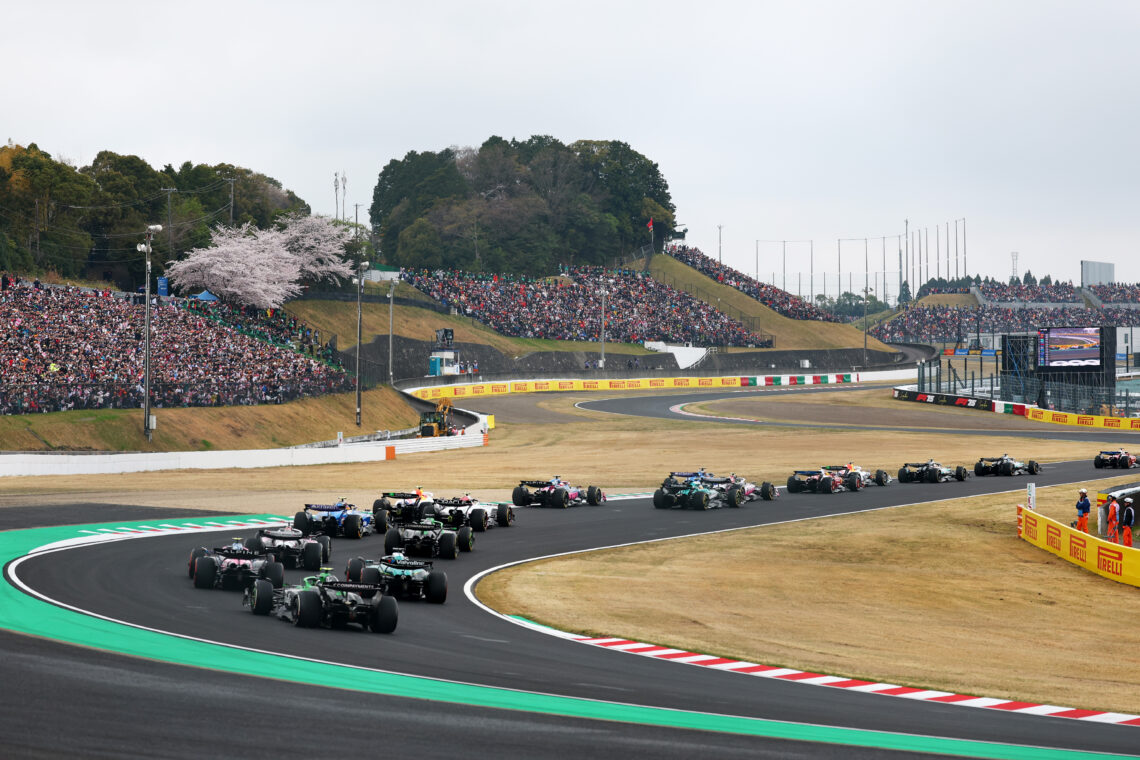


| First held: | 1976 |
| Times held: | 39 |
| Circuit: | Suzuka Circuit |
| Circuit length: | 5.8km (3.6m) |
| Laps: | 53 |
| Most wins: | 6x Michael Schumacher (1995, 1997, 2000, 2001, 2002, 2004) |
The Japanese Grand Prix is one of the truly legendary races on the Formula 1 calendar. It has been a part of F1’s fabric since the 1976 season and has delivered many iconic title-deciders.
Suzuka is the synonymous home of the Japanese GP now, but F1 has also sparingly raced at the Fuji Speedway. Fuji was even the first circuit in Japan that F1 visited for James Hunt and Niki Lauda’s 1976 title decider. Suzuka has held the race from 1987 to 2006 and since 2009.
F1 was not the first series to contest a Japanese GP, though. Instead, the first Japanese GP took place in 1963 as a sports car race. Formula 1 only took over the race in 1976, and there was not a Japanese GP in any form from 1978 to 1986 before F1 hit Suzuka for the first time.

History of the F1 Japanese GP
The Japanese GP joined the F1 calendar for the first time in 1976 at the rapid Fuji Speedway under the close gaze of Mount Fuji. It is one of the truly iconic backdrops in motorsport. The first Japanese GP also became one of the truly iconic F1 races as Hunt won the drivers’ title.
Monsoon rain threatened to prevent the 1976 race from going ahead. Lauda also famously chose to retire from the race, having returned from a near-fatal accident at the Nurburgring earlier that year. Hunt would finish the race in third place to get the title by one single point.
Tyre dramas threatened to blight Hunt’s title bid after the Briton suffered a puncture in the closing laps. But he recovered to third place with two laps to go after dropping down to fifth behind Clay Regazzoni and Patrick Depailler. Hunt would also return to Fuji in 1977 and win.
It would be the last Formula 1 race at Fuji until 2007, however, as plans for the Japanese GP were scrapped in 1978. Suzuka also did not take up staging the Japanese GP until 1987, as rebuilding works at the Honda-owned circuit were not finished in time for the 1985 season.
What is the Suzuka Circuit like?

Formula 1 has Soichiro Honda to thank for hiring John Hugenholtz to create Suzuka as a test track in 1962. It is one of the most iconic tracks on the F1 calendar and is adored by fans and drivers alike. The circuit provides the perfect blend of challenging corners and fast straights.
The first section of Suzuka requires a responsive car that is capable of handling fast corners as drivers climb a hill. Full commitment is then needed to flick through Degner One and Two to start sector two. The hairpin then sets up the run to Spoon and is a key overtaking spot.
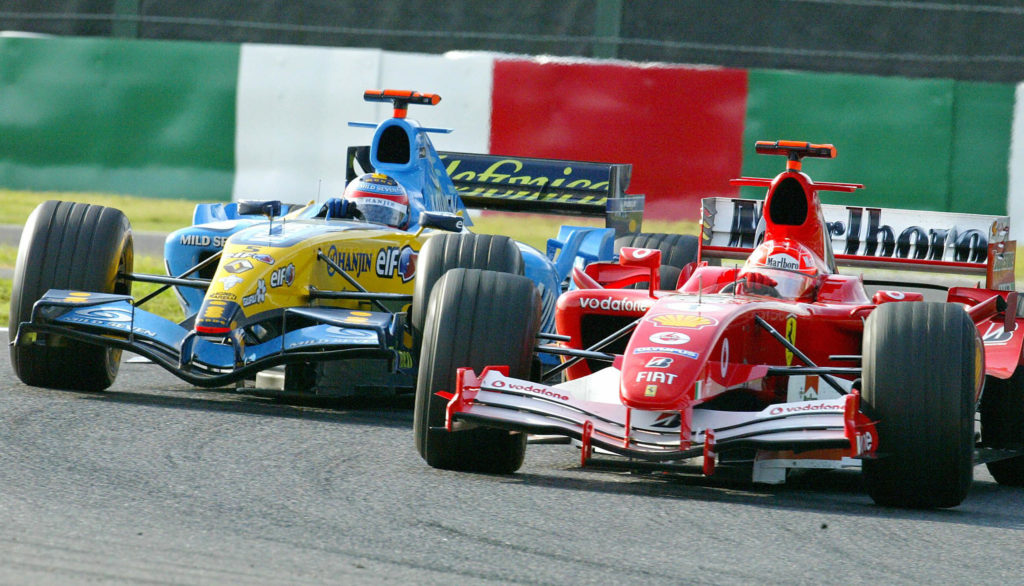
F1 cars gaining downforce over the years has seen 130R lose some of its challenge. Yet 130R is still one of the best turns on F1’s calendar, given its high-speed nature, and has seen some iconic overtakes, like Fernando Alonso’s around the outside of Michael Schumacher in 2005.
A slice of F1 history came at the 1987 Japanese GP at Suzuka
Suzuka is Honda’s test circuit, but it holds a slice of Formula 1 history as it is the only figure-of-eight track on the calendar. Nigel Mansell crashing in qualifying also gave Nelson Piquet a clear route to secure the 1987 drivers’ title, as the Briton would not race owing to his injury.
Mansell crashed heavily through the renowned Esses sequence that makes up Suzuka’s first section. The circuit is littered with iconic corners – including Dunlop Curve between Turns 7 and 8, the Degner bends of Turns 8 and 9, Spoon Curve at Turn 13 and also 130R at Turn 15.
Suzuka saw F1 history unfold between Ayrton Senna and Alain Prost
Suzuka continued to play host to F1 history as it unfolded at the 1988 Japanese GP, as well. The race was the penultimate round of the year but decided the title fight between Ayrton Senna and Alain Prost. It also returned one of McLaren’s 15 wins from 16 races that season.
McLaren used the spectacular MP4/4 and the supreme Honda RA168E 1.5 V6t engine to fire Senna and Prost to dominance. They locked out the front row of the grid with Senna on pole by 1.5 seconds to third place. Yet the Brazilian stalled off the line and dropped to 14th place.
Senna utilised Suzuka’s sloped straight to fire his Honda engine back alive and recovered six places on the first lap. He even ran P4 by Lap 4 while increasing rainfall worked in his favour. A chance to overtake Prost then appeared on Lap 27 whilst the McLaren rivals lapped traffic.
Prost could not match the blistering pace Senna kept setting as the Frenchman battled away despite a malfunctioning gearbox. They would end the race 13 seconds apart for P1 and P2, with the win handing Senna the title with a race to spare due to that year’s scoring system.
Ayrton Senna and Alain Prost’s rivalry went over the limit at Suzuka in 1989
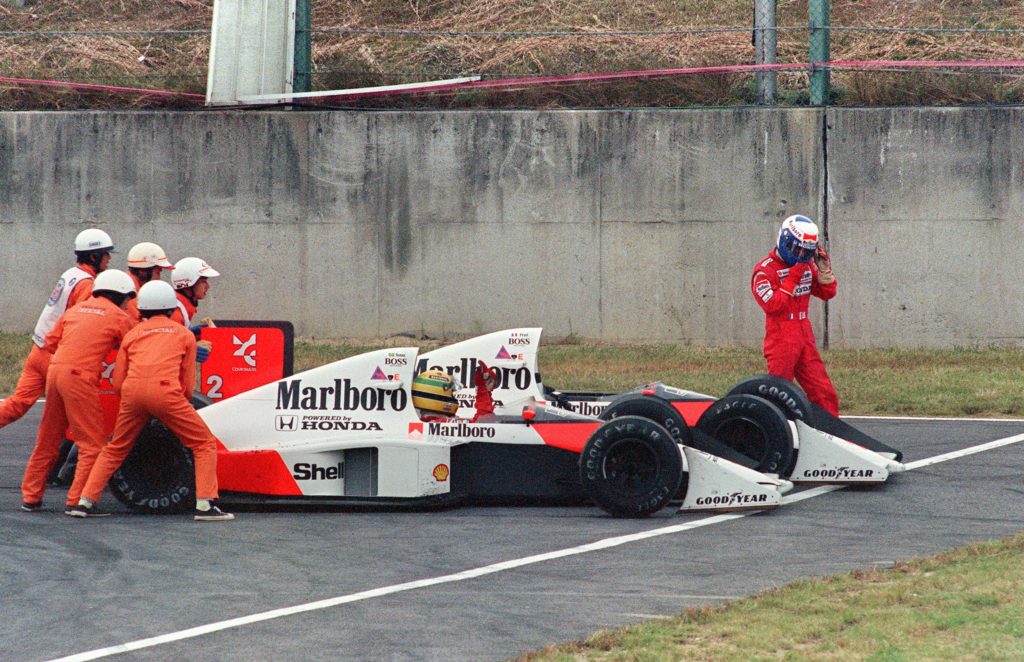
A chance at revenge awaited Prost when Formula 1 returned for the 1989 Japanese GP with McLaren still dominant. But controversy engulfed the race on Lap 47 when Prost and Senna collided at the last chicane. Prost retired after their crash, while Senna was later disqualified.
Senna made inroads into Prost’s lead tucked into his teammate’s slipstream on the run from Spoon and through 130R. But Prost saw Senna’s dive coming, so he moved to cover the line, which saw them lock wheels and stall. So, Prost retired, yet Senna got a push start and won.
The stewards, however, disqualified Senna from the 1989 Japanese GP after he had used an escape road to rejoin the race. McLaren later appealed the decision, having lost a race win. But it only led to Senna landing a further $100k (£80k) fine and a suspended six-month ban.
A chance at revenge then awaited Senna in 1990 when the Japanese GP decided the F1 title fight between the McLaren driver and Prost, now at Ferrari. The Brazilian also took pole but was angry as P1 was on the dirty side of the grid. Prost even got the lead with a better start.
Senna refused to yield to Prost, who took the 1989 title after the Brazilian’s disqualification from the Japanese GP. But his attempted move saw both drivers collide and retire instantly. It gave Senna the title to Prost’s fury, who branded their incident as “absolutely disgusting”.
Another F1 drivers’ title awaited Senna at the 1991 Japanese GP, but in far less controversial circumstances. The Brazilian secured his third and final crown with P2 after Mansell crashed out on Lap 10. Senna also conceded the win to Gerhard Berger for his teammate’s support.
Suzuka has delivered some truly legendary Formula 1 races
Formula 1’s visit to Suzuka for the 1992 Japanese GP was also a first of sorts, as it was the first race at the Honda-owned circuit that did not decide a drivers’ title. And while the 1995 event also did not determine the championship, Jean Alesi produced a truly legendary drive.
Alesi had qualified second to his Ferrari teammate Schumacher, but he dropped back early after receiving a 10-second stop-go penalty for a jump start. The Frenchman then yielded an array of further positions after pitting for dry tyres on Lap 7 after rain fell ahead of the start.
His penalty and subsequent pit stop left Alesi down in P17. Yet he used the slick rubber to go five seconds a lap faster than anyone else and was second only 18 laps later. The Frenchman even survived a spin after Minardi driver Pedro Lamy had forced the Tifosi hero off the road.
Alesi rallied and was soon hot on Schumacher’s tail with the lead in sight, but he suffered a driveshaft failure, and the win was gone. Yet what Alesi showed around Suzuka at the 1996 Japanese GP was one of and it also remains one of the greatest drives in Formula 1 history.
‘I’ve got to stop, because I’ve got a lump in my throat’
The 1996 Japanese GP then saw Suzuka host the title decider between Williams teammates Damon Hill and Jacques Villeneuve. It also yielded one of the most iconic commentary lines as Hill securing the title after Villeneuve lost a wheel nearly brought Murray Walker to tears.
Walker said: “This is something that many people didn’t think would possibly happen today. They thought Damon would drive a cautious race. But he fought! He fought from second on the grid, he passed Jacques Villeneuve, he took the lead, he stayed there!
“And Damon Hill exits the chicane and wins the Japanese GP! And I’ve got to stop, because I’ve got a lump in my throat… Damon Hill wins in Japan. I really am, for once, almost at a loss for words. I am so happy, as the majority of Britain will be.”
The 1998 Japanese GP also delivered a dramatic title fight as Schumacher fought to surpass Mika Hakkinen for the crown. But their year-long fight came to an abrupt end when debris left Schumacher with a puncture as he fought valiantly to recover, having stalled on the grid.
Schumacher was a dominant force around Suzuka during the seven-time F1 champion’s time with Ferrari, though. He had already won there in 1995 and 1997, and he went on to become the winningest F1 driver at the circuit with further victories in 2000, 2001, 2002 and in 2004.
Kimi Raikkonen drove his greatest F1 race at the 2005 Japanese GP

Kimi Raikkonen ended Ferrari’s stranglehold over the Japanese GP in 2005, though, after the Scuderia’s five-in-a-row helped by Rubens Barrichello in 2003. The Finn delivered one of the greatest F1 drives of all time to win at Suzuka, even though he started the race down in P17.
Increasing rain thwarted Raikkonen’s qualifying, and the McLaren driver’s race started poorly after running wide trying to overtake Villeneuve. Drama continued to unfold throughout the race as Raikkonen chased Schumacher and Alonso, who had both also qualified poorly.
The trio of Formula 1 icons fought lap after lap as they cut their way through the field. But it was Raikkonen who emerged in front after finally passing Schumacher on Lap 28 and set after Jenson Button and Mark Webber. Yet Giancarlo Fisichella would be his eventual target.
Raikkonen enforced his advantage over Button and Webber after BAR-Honda and Williams stopped their drivers. He only had two laps to create a gap, but drove phenomenally to jump them both with nine laps to go. He also brought the gap to Fisichella down to nine seconds.
Fisichella had led Raikkonen by 20 seconds before the final round of pit stops, but could not stop the Finn from reeling his Renault in. The McLaren driver’s relentless pace proved to be too much for the Italian to handle, and he started to defend from ghosts at the final chicane.
It eventually cost Fisichella as his needless defending gave Raikkonen the perfect chance for a slipstream down the pit straight. He tucked the McLaren in the Renault’s draft as the final lap started before jinking out at the last second and sweeping into the lead at Turn 1 to win.
The Japanese Grand Prix returned to Fuji in 2007 and 2008
Toyota buying the Fuji Speedway and Hermann Tilke redesigning the track saw the Japanese GP return in 2007 and 2008. But torrential rain saw F1’s return to Mount Fuji start behind the safety car, and Lewis Hamilton eventually won a race that began with 19 laps with no racing.
Hamilton’s return to Fuji in 2008 was blighted by a first-corner crash and another crash with title-rival Felipe Massa. Alonso went on to win the race for Renault. But F1 would not return to Fuji again in 2010, as planned, after Toyota pulled the plug amid the global economic crisis.
Fuji and Suzuka had agreed to alternate hosting the Japanese GP from the 2009 season. But Hiroaki Kato, president of the Fuji Speedway at the time, announced the “heart-wrenching” decision to abandon the plan after Toyota reported a net loss of 436.9 billion yen (£2.9bn).
Suzuka would resume hosting of the Japanese GP full-time thereafter. Button won the 2011 Japanese GP while wearing a special helmet as a tribute to those impacted by the Tohoku earthquake and tsunami. Home hero Kamui Kobayashi made the podium at Suzuka in 2012.
Japanese Grand Prix fatality marks significant F1 safety change
Typhoon conditions struck Japan again in 2014 but Formula 1 went ahead with the Japanese GP. Sauber driver Adrian Sutil spun out of the race at Dunlop on Lap 45. Marussia hero Jules Bianchi also went off at the same corner whilst marshals recovered Sutil’s car using a crane.
Bianchi suffered life-threatening injuries from his crash and was placed in a coma after being taken to a hospital. The talented Frenchman passed away nine months later in a hospital in Nice due to his injuries. His death led to Suzuka introducing changes to the Dunlop drainage.
The passing of Bianchi marked Formula 1’s most recent fatality and prompted significant changes to safety in the sport. Most notably, it led to the introduction of the Virtual Safety Car and played a key role in the eventual implementation of the halo four years later.
The FIA had already been working on the halo’s design at the time of Bianchi’s accident, and despite initial criticism from drivers, it has since proven to be a vital safety device in F1, saving numerous lives over the past eight years.
Winners of the F1 Japanese GP
| 1976 Japanese GP: | Mario Andretti (Lotus) |
| 1977 Japanese GP: | James Hunt (McLaren) |
| 1987 Japanese GP: | Gerhard Berger (Ferrari) |
| 1988 Japanese GP: | Ayrton Senna (McLaren) |
| 1989 Japanese GP: | Alessandro Nannini (Benetton) |
| 1990 Japanese GP: | Nelson Piquet (Benetton) |
| 1991 Japanese GP: | Gerhard Berger (McLaren) |
| 1992 Japanese GP: | Riccardo Patrese (Williams) |
| 1993 Japanese GP: | Ayrton Senna (McLaren) |
| 1994 Japanese GP: | Damon Hill (Williams) |
| 1995 Japanese GP: | Michael Schumacher (Benetton) |
| 1996 Japanese GP: | Damon Hill (Williams) |
| 1997 Japanese GP: | Michael Schumacher (Ferrari) |
| 1998 Japanese GP: | Mika Hakkinen (McLaren) |
| 1999 Japanese GP: | Mika Hakkinen (McLaren) |
| 2000 Japanese GP: | Michael Schumacher (Ferrari) |
| 2001 Japanese GP: | Michael Schumacher (Ferrari) |
| 2002 Japanese GP: | Michael Schumacher (Ferrari) |
| 2003 Japanese GP: | Rubens Barrichello (Ferrari) |
| 2004 Japanese GP: | Michael Schumacher (Ferrari) |
| 2005 Japanese GP: | Kimi Raikkonen (McLaren) |
| 2006 Japanese GP: | Fernando Alonso (Renault) |
| 2007 Japanese GP: | Lewis Hamilton (McLaren) |
| 2008 Japanese GP: | Fernando Alonso (Renault) |
| 2009 Japanese GP: | Sebastian Vettel (Red Bull) |
| 2010 Japanese GP: | Sebastian Vettel (Red Bull) |
| 2011 Japanese GP: | Jenson Button (McLaren) |
| 2012 Japanese GP: | Sebastian Vettel (Red Bull) |
| 2013 Japanese GP: | Sebastian Vettel (Red Bull) |
| 2014 Japanese GP: | Lewis Hamilton (Mercedes) |
| 2015 Japanese GP: | Lewis Hamilton (Mercedes) |
| 2016 Japanese GP: | Nico Rosberg (Mercedes) |
| 2017 Japanese GP: | Lewis Hamilton (Mercedes) |
| 2018 Japanese GP: | Lewis Hamilton (Mercedes) |
| 2019 Japanese GP: | Valtteri Bottas (Mercedes) |
| 2022 Japanese GP: | Max Verstappen (Red Bull) |
| 2023 Japanese GP: | Max Verstappen (Red Bull) |
| 2024 Japanese GP: | Max Verstappen (Red Bull) |
| 2025 Japanese GP: | Max Verstappen (Red Bull) |
Receive exclusive F1 news and updates twice a week to your mailbox