

 Lando Norris
 McLaren
 Mercedes
 Red Bull
 Ferrari
 Williams
 Racing Bulls
 Aston Martin
 Haas
Haas Alpine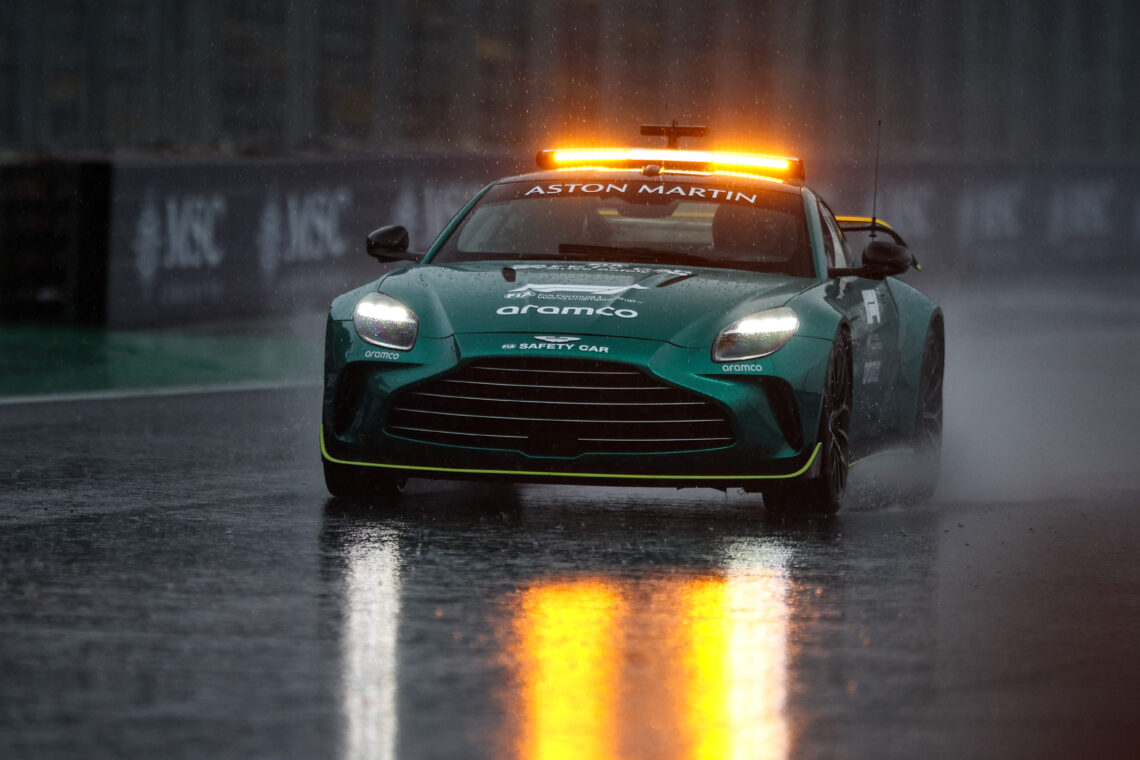


The Formula 1 safety car has been an integral part of a grand prix weekend for over 30 years and has evolved significantly over the decades.
The safety car is frequently used at a race if there has been an incident or crash on the track, and is used to control the speed of the cars on the circuit whilst the danger is cleared.
Alongside the physical car that can be used during a grand prix, the race director can also use a virtual safety car (VSC), which can be run in less dangerous situations or where vehicles and debris can be removed quickly.
The purpose of either of the safety cars is to reduce the speed of the race until a situation is resolved. Cars are required to lower their speed to a specific delta and will not be allowed to overtake the driver in front.
What is the F1 safety car and why is it used?
The Formula 1 safety car is a physical car that is brought out onto the track during a race to control the speed of the F1 cars. It drives at a specific slower speed to ensure marshals can safely make their way onto the circuit to retrieve a stopped car or clear debris off the tarmac.
By reducing the speed of an F1 race, cars must line up behind the safety car, and are regulated to remain within 10 car lengths of the vehicle in front of them.
No drivers are permitted to overtake the cars ahead of them, or the safety car unless they are told to do so. This is usually only allowed for the lapped cars if they are out of position in the line-up, ahead of the safety car returning to the pit lane.
If the weather conditions are deemed severe enough, the safety car can also be used on the formation lap to reduce speeds and prevent any accidents. On occasion, if the weather is extremely severe, the safety car may even lead the pack away at the start of a grand prix.
This was last seen at the 2025 Belgian Grand Prix, when a rolling start was called due to heavy rain and a severely wet track.
Drivers will be shown yellow flags and flashing ‘SC’ screens around the track to indicate that a safety car has been deployed and that they must slow to the mandated speeds.
When race stewards deem it is once again safe enough for the race to continue, then the safety car will return to the pit lane at the end of the lap, and drivers will be given the signal to continue racing.
As the safety car breaks away from the pack and heads to the pit lane, the first car will then dictate the pace of the pack and can decide when to begin to accelerate. The leader can make the decision to go at any point once the safety car boards are withdrawn, but cars behind are not allowed to attempt an overtake until they have crossed the start/finish line.
What cars serve as the F1 safety car and how fast do they go?
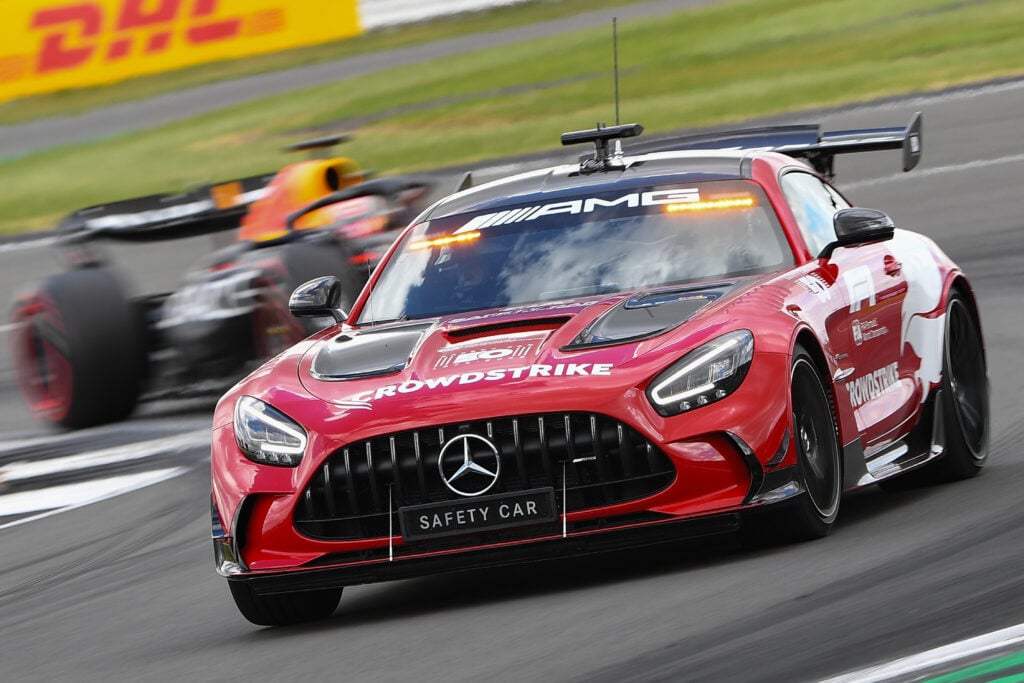
Two safety cars are in operation for the 2025 F1 season, with the Mercedes-AMG GT Black Series and Aston Martin Vantage S sharing the responsibility. The two manufacturers alternate race weekends, each providing the safety car for 12 Grands Prix in the season.
At the 2025 United States Grand Prix, the Mercedes-AMG car celebrates its 500th grand prix serving as the safety car. The 36 model was first used at the 1996 French Grand Prix and at the time marked the start of an exclusive partnership with Formula 1.
The Mercedes-AMG GT Black Series became the official safety car in 2022, replacing the AMG GT R. It has been equipped with apparatus for its role, including special lighting capabilities and an aerodynamic package to give it maximum downforce on the track. The AMG GT Black Series has 730 horsepower and can reach top speeds of 325 km/h (202 mph).
Aston Martin replaced the Vantage, which was previously introduced last year, with a new revised model in August 2025. The Vantage S made its debut at the Dutch Grand Prix and is 7mph faster than the older version.
The Aston Martin Vantage S has a four-litre twin-turbo V8 engine, which produces 680ps and 800Nm of torque and can reach 100kph (62mph) in 3.4 seconds. The car has seen improvements to its speed, now reaching top speeds of 325kph (202mph), meaning it now matches the performance of the Mercedes-AMG GT Black Series.
Who drives the Formula 1 safety car?
The Formula 1 safety car is driven by Bernd Maylander, who has been in the role since 2000. According to The Telegraph, the 54-year-old German has led over 1,400 as of July 2025, which places him 15th amongst drivers who have led the most laps, with Hamilton leading the tally with 5,488.
Before becoming the safety car driver, Maylander competed in Formula Ford, the Porsche Carrera Cup and DTM, with a victory at the 2000 Nurburgring 24 Hours and runner-up in the LMGT class of the 1999 Le Mans 24 Hours.
The safety car driver will be joined in the car by a co-driver, who assists with operations and communications so that Maylander can focus on leading the pack. The two drivers are required to stay seated in the safety car for the duration of the entire grand prix, so that the car can quickly come onto the track if required.
History of the Formula 1 safety car and when it was first introduced
The safety car was first seen at the 1973 Canadian Grand Prix, when a Porsche 914 was used at the Mosport Park circuit due to poor weather conditions, which had already caused several incidents.
The first outing for the safety car proved controversial, after its pilot Eppie Wietzes picked up the wrong leader, resulting in a number of cars being incorrectly marked as one lap down.
It took several hours after the grand prix to figure out the winner of the race, after the chequered flag was waved twice, with Peter Revson in the McLaren-Ford later declared victorious.
A safety car then made a handful of appearances over the next 20 years, including a Porsche 911 Turbo being used at the 1976 Monaco Grand Prix. After the race, organisers eventually changed to a Lamborghini Countach for the early 1980s, although it was never used under race conditions.
Formula 1 officially introduced the safety car in 1993, after trialling a more regulated approach to the race neutralisation tool at the 1992 French and British grands prix.
Various car models have been used as the safety car since a Fiat Tempra 16v came onto track at the 1993 Brazilian Grand Prix, including a Renault Clio at the 1996 Argentine Grand Prix and a Vauxhall Cavalier at the 1994 San Marino race.
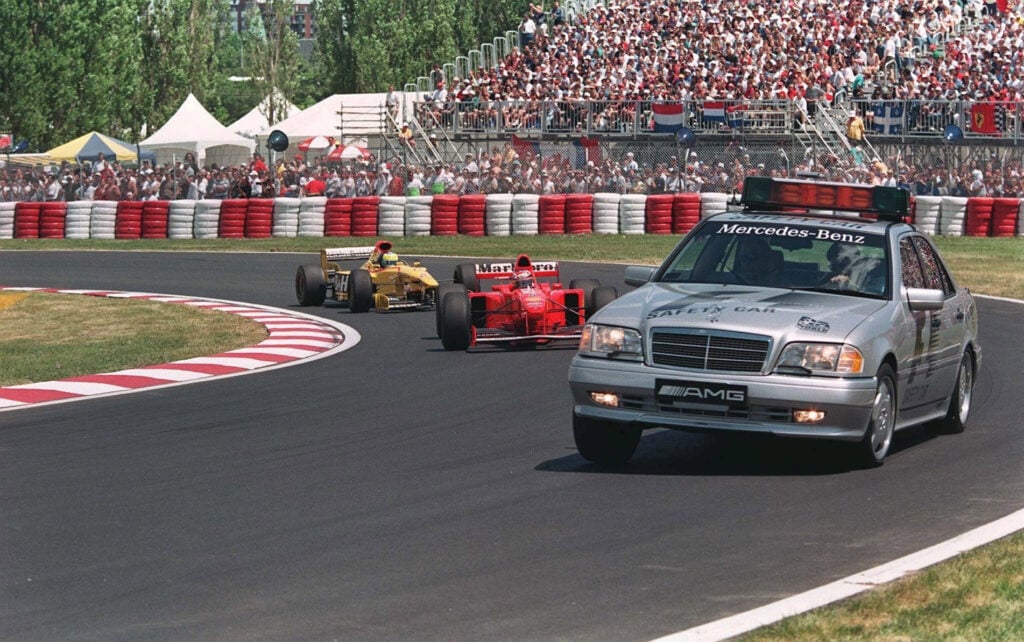
Just three years after the safety car was first introduced, it was standardised with a Mercedes-Benz, which ensured that the car was able to keep up with the pace of a Formula 1 car. Mercedes remained the sole supplier of the safety car until duties were split with Aston Martin from 2021.
What is a virtual safety car in F1 and how does it work?
The virtual safety car (VSC), is, as the name suggests, a virtual car instead of bringing a physical vehicle onto the track. The VSC means that drivers must stick to a set time, which means the pack will not bunch together like they would under a regular safety car.
As the drivers are required to stick to the same speed, the gap between each car stays the same, making it less disruptive than a full safety car. This also means that cars are not allowed to overtake each other when the virtual safety car is in action.
A VSC will be called if the race director believes it is safe enough for recovery work to be undertaken with the cars driving around the track at a slower pace. This will usually be called for debris on the track, or a smaller, localised hazard.
Each car will be shown a flashing VSC panel around the track, and a delta time will appear on the driver’s steering wheel, which will tell them if they are keeping within the regulated parameters. A VSC will usually reduce the pace of cars to around 30-40% of their normal race pace.
The VSC was introduced in Formula 1 after the death of Jules Bianchi following an accident at the 2014 Japanese Grand Prix. The race was under caution following a previous accident in the heavy rain, when the Marussia driver lost control of his car and collided with a recovery vehicle.
The FIA mandated a number of safety improvements to Formula 1, including the VSC, which was based on the Le Mans 24 Hours ‘Slow Zone’ system. Another change saw the introduction of the Halo to a Formula 1 car, which has saved the lives of many drivers since.
Receive exclusive F1 news and updates twice a week to your mailbox


