Lando Norris
 McLaren
 Mercedes
 Red Bull
 Ferrari
 Williams
 Racing Bulls
 Aston Martin
 Haas
Haas Alpine
| First held: | 1967 |
| Times held: | 54 |
| Circuit: | Circuit Gilles-Villeneuve |
| Circuit length: | 4.3km (2.7m) |
| Laps: | 70 |
| Most wins: | 7x Michael Schumacher (1994, 1997, 1998, 2000, 2002, 2003, 2004) |
| 7x Lewis Hamilton (2007, 2010, 2012, 2015, 2016, 2017, 2019) |
The Canadian Grand Prix has been a flagship race on the Formula 1 calendar since the 1967 season. It has also been held at the iconic Circuit Gilles-Villeneuve intermittently since 1978.
F1 first visited Canada in 1967 as the series took over the name of the Canadian GP. The race had originally been run as a sports car event which started in 1961 before taking on Can-AM rules in 1966. Formula 1 has since had routine trips to Canada with just an occasional break.
Canada has sporadically fallen off the Formula 1 calendar since its debut appearance in 1967 due to various issues. It first disappeared in 1975 over a dispute between the promoters and some F1 teams. It was also dropped in 1987, 2009 and the Covid-19 years of 2020 and 2021.
History of the F1 Canadian GP
The FIA sanctioned the first Formula 1 race on Canadian soil for the 1967 season as Canada welcomed the world. Canada sought to host thousands of celebratory events that year as it marked the country’s centenary. The Expo 67 World’s Fair also took place then in Montreal.
Mosport Park, a 3.9km (2.4m) track located in Ontario, had the honour of hosting the debut Formula 1 Canadian GP. Yet the race switched to Le Circuit Mont-Tremblant in Quebec when F1 returned in 1968. But Mosport Park prised the event back to its track in the 1971 season.
Formula 1 continued to visit the Ontario circuit through to 1977, except for during the 1975 season. A clash between the event’s promoters, Harvey Hudes and Bernie Kamin, and FOCA (the Formula One Constructors’ Association) over the prize money available saw it called off.
FOCA, through its representatives Bernie Ecclestone and Max Mosley, argued that Mosport Park should offer a $277k (£160k) purse for the Formula 1 teams. The track was already set to pay a $240k (£139k) purse for the 1975 race, as well as paying the team’s transport costs.
Mosport Park refused to pay an increased purse and the FIA, ultimately, cancelled the 1975 Canadian GP. But further discussions saw the race return in 1976 and 1977 before it moved to the Circuit Ile Notre-Dame. The track was renamed the Circuit Gilles-Villeneuve in 1982.
Why did the Canadian GP leave Mosport Park?
Labatt was one of the major reasons why the Canadian GP left Mosport Park as the sponsor questioned holding a Formula 1 race in a small town an hour away from Toronto. Questions were also growing over the suitability of racing at the hilly circuit shaped like an inverted ‘3’.
Plans had even been bubbling in the background to relocate the race to Toronto’s Exhibition Place since the late 1960s. But a city council ballot blocked that proposal. Instead, Montreal offered to build on Ile Notre-Dame and hired British engineer Roger Peart to create a circuit.
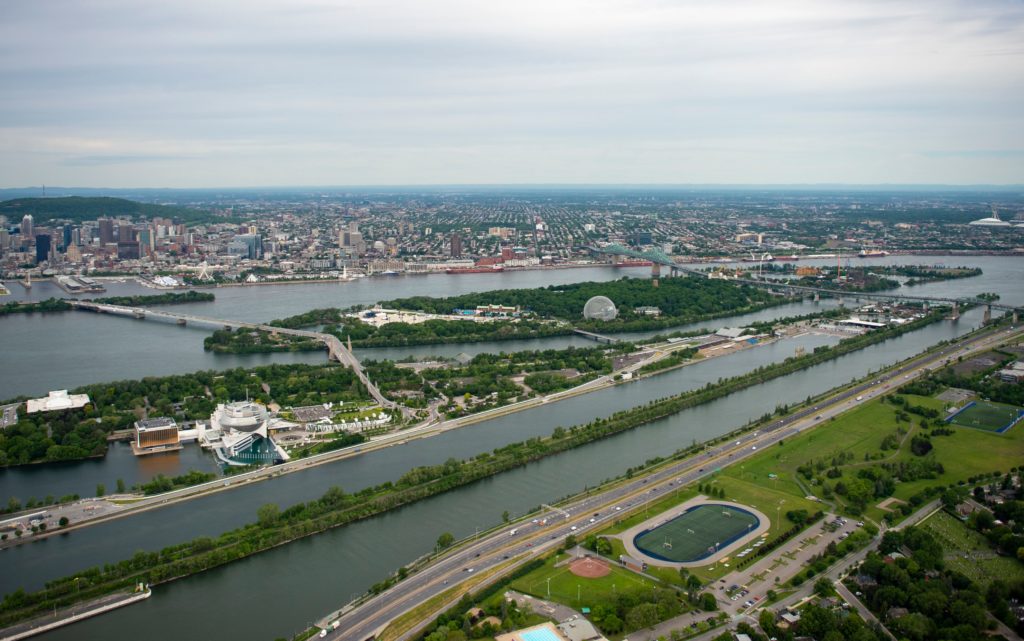
Peart exploited many of the features Canada built around the island in the St Lawrence River for Expo 67, too. The circuit also runs parallel to the Olympic Basin which hosted rowing and canoeing during the 1976 Olympics. And Montreal could not have wished for a better debut.
The Circuit Ile Notre-Dame was renamed after Gilles Villeneuve

Formula 1, finally, hit the Montreal circuit for the first time in 1978 and saw hometown hero Gilles Villeneuve win. The Quebec native beat Wolf’s Jody Scheckter by 13 seconds to win in a Ferrari. The 1978 season finale yielded the relaxed Canadian’s first of six wins in Formula 1.
Villeneuve became the first Canadian driver to win his home Formula 1 Grand Prix. But the gifted racer lost his life during qualifying for the 1982 Belgian GP. The Circuit Ile Notre-Dame honoured Villeneuve by renaming the track after him with ‘Sault Gilles’ put at the finish line.
The Circuit Gilles-Villeneuve has remained Formula 1’s home in Canada ever since the 1978 season. But proposed plans to return to Mosport Park for 1987 saw the race cancelled after clashes between the race’s title sponsor and promoter, who had looked into a new sponsor.
F1 also did not return in 2009 amid concerns over the Circuit Gilles-Villeneuve’s finances. It even meant Formula 1 did not have a race in North America that year. But the Canadian GP returned in 2010 after the government agreed to pay $15m (£8.7m) a year to host the race.
Canada’s tourism industry had pushed for the race to return with the Canadian GP a sell-out F1 race most seasons. But the Circuit Gilles-Villeneuve further had to upgrade its facilities to get the race. The track’s tarmac broke up through the 2008 event amidst red-hot conditions.
Michael Schumacher and Lewis Hamilton are synonymous with the Canadian GP
As well as hometown hero Villeneuve, the Canadian GP is synonymous with two F1 legends in Michael Schumacher and Lewis Hamilton. The pair have mastered the circuit like no other Formula 1 driver has yet. It was also the scene of Hamilton’s first F1 win as a rookie in 2007.
Schumacher shattered the previous record for race wins at the Canadian GP held by Nelson Piquet (1982, 1984, 1991). The seven-time F1 champion stood atop the podium seven times from 1994 until 2004. Schumacher won his first Canadian GP by 40 seconds to Damon Hill.
It was much closer in 2000 as Schumacher crossed the finish line just one-tenth of a second ahead of Ferrari teammate Rubens Barrichello. The Brazilian settled for second after reeling the German in as the rainfall increased with Ferrari urging Barrichello to ease his rapid pace.
Less than one second also split Schumacher from his brother, Ralf, at the 2003 Canadian GP. The Ferrari icon nursed his F2003 home with brake issues but the Williams driver did not get ahead. Juan Pablo Montoya and Fernando Alonso even finished within five seconds of them.
Hamilton later burst onto the Formula 1 scene as a sprightly 22-year-old in 2007 and sealed his first Grand Prix win from pole position in Canada with McLaren. But he would retire from the 2008 race in odd circumstances after crashing into Kimi Raikkonen at the exit of the pits.
Adrian Sutil’s burning Force India required a safety car at the scorching 2008 Canadian GP. But F1’s rules at the time closed the pit exit under safety car conditions. Yet Hamilton failed to see a red light and hit the rear of Raikkonen’s Ferrari before Nico Rosberg hit his McLaren.
Jenson Button won the longest race in Formula 1’s history
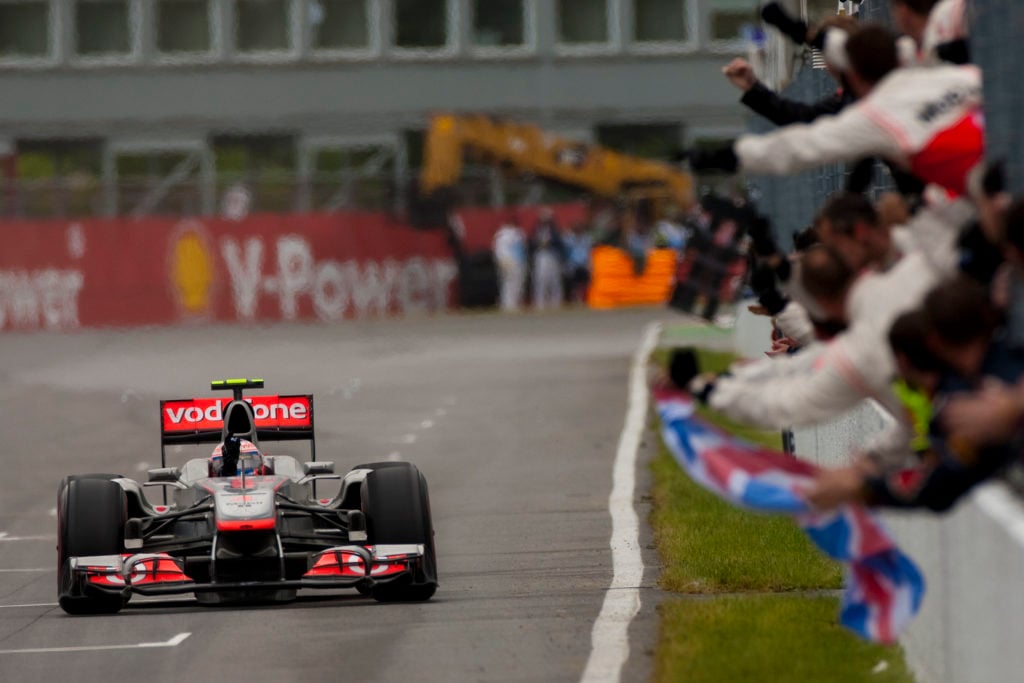
The 2011 Canadian GP secured its place in Formula 1’s history as the longest race ever. The race lasted four hours and four minutes thanks to a red flag delay of more than two hours. F1 and the FIA would tweak the series’ rules afterwards to give all races a firm three-hour limit.
McLaren driver Jenson Button also won the 2011 Canadian GP in legendary circumstances on the last lap. The 2009 F1 champion fought through the field throughout the race having driven through the pits six times. He even ran last with only 30 laps of the race remaining.
Just 12 of the first 40 laps of the 2011 Canadian GP were also held under racing conditions due to the torrential rainfall. Button started from P7 and he made up an early spot when Mark Webber spun. But he suffered a puncture on L7 after squeezing Hamilton into the pit wall.
The stewards then slapped Button with a drive-through penalty after he sped under yellow flags to recover Hamilton’s McLaren. He eventually fell to P15 once the safety car peeled in and Button served the penalty. But he soon had to stop again to go back onto full-wet tyres.
McLaren had swapped Button onto intermediate tyres when he initially pitted. But the rain becoming heavier forced another stop before the red flags were out. He was then back for another stop after the restart, having suffered another puncture from contact with Alonso.
Button was 100 seconds behind race leader Sebastian Vettel after the stop but a safety car, again, rescued his race. He then gained place after place before gambling on slick tyres and profiting from another safety car. Vettel then threw away his likely win at T6 on the last lap.
What is the Circuit Gilles-Villeneuve like?

The Circuit Gilles-Villeneuve and the Canadian GP are favourites for many Formula 1 drivers and fans for the same reasons. The stop-start nature of the low-downforce circuit allows for brilliant racing. Overtakes are also possible throughout every lap of the 4.3km (2.7m) track.
It even has one of the most iconic corners in Formula 1, the Wall of Champions, at Turn 14. The exit of the final chicane sealed its legendary status in 1999 when world champions Hill, Schumacher and Jacques Villeneuve – son of Gilles – all crashed there across the weekend.
Winners of the F1 Canadian GP
| 1967 Canadian GP: | Jack Brabham (Brabham) |
| 1968 Canadian GP: | Denny Hulme (McLaren) |
| 1969 Canadian GP: | Jacky Ickx (Brabham) |
| 1970 Canadian GP: | Jacky Ickx (Ferrari) |
| 1971 Canadian GP: | Jackie Stewart (Tyrrell) |
| 1972 Canadian GP: | Jackie Stewart (Tyrrell) |
| 1973 Canadian GP: | Peter Revson (McLaren) |
| 1974 Canadian GP: | Emerson Fittipaldi (McLaren) |
| 1976 Canadian GP: | James Hunt (McLaren) |
| 1977 Canadian GP: | Jody Scheckter (Wolf) |
| 1978 Canadian GP: | Gilles Villeneuve (Ferrari) |
| 1979 Canadian GP: | Alan Jones (Williams) |
| 1980 Canadian GP: | Alan Jones (Williams) |
| 1981 Canadian GP: | Jacques Laffite (Ligier) |
| 1982 Canadian GP: | Nelson Piquet (Brabham) |
| 1983 Canadian GP: | Rene Arnoux (Ferrari) |
| 1984 Canadian GP: | Nelson Piquet (Brabham) |
| 1985 Canadian GP: | Michele Alboreto (Ferrari) |
| 1986 Canadian GP: | Nigel Mansell (Williams) |
| 1988 Canadian GP: | Ayrton Senna (McLaren) |
| 1989 Canadian GP: | Thierry Boutsen (Williams) |
| 1990 Canadian GP: | Ayrton Senna (McLaren) |
| 1991 Canadian GP: | Nelson Piquet (Benetton) |
| 1992 Canadian GP: | Gerhard Berger (McLaren) |
| 1993 Canadian GP: | Alain Prost (Williams) |
| 1994 Canadian GP: | Michael Schumacher (Benetton) |
| 1995 Canadian GP: | Jean Alesi (Ferrari) |
| 1996 Canadian GP: | Damon Hill (Williams) |
| 1997 Canadian GP: | Michael Schumacher (Ferrari) |
| 1998 Canadian GP: | Michael Schumacher (Ferrari) |
| 1999 Canadian GP: | Mika Hakkinen (McLaren) |
| 2000 Canadian GP: | Michael Schumacher (Ferrari) |
| 2001 Canadian GP: | Ralf Schumacher (Williams) |
| 2002 Canadian GP: | Michael Schumacher (Ferrari) |
| 2003 Canadian GP: | Michael Schumacher (Ferrari) |
| 2004 Canadian GP: | Michael Schumacher (Ferrari) |
| 2005 Canadian GP: | Kimi Raikkonen (McLaren) |
| 2006 Canadian GP: | Fernando Alonso (Renault) |
| 2007 Canadian GP: | Lewis Hamilton (McLaren) |
| 2008 Canadian GP: | Robert Kubica (BMW Sauber) |
| 2010 Canadian GP: | Lewis Hamilton (McLaren) |
| 2011 Canadian GP: | Jenson Button (McLaren) |
| 2012 Canadian GP: | Lewis Hamilton (McLaren) |
| 2013 Canadian GP: | Sebastian Vettel (Red Bull) |
| 2014 Canadian GP: | Daniel Ricciardo (Red Bull) |
| 2015 Canadian GP: | Lewis Hamilton (Mercedes) |
| 2016 Canadian GP: | Lewis Hamilton (Mercedes) |
| 2017 Canadian GP: | Lewis Hamilton (Mercedes) |
| 2018 Canadian GP: | Sebastian Vettel (Ferrari) |
| 2019 Canadian GP: | Lewis Hamilton (Mercedes) |
| 2022 Canadian GP: | Max Verstappen (Red Bull) |
| 2023 Canadian GP: | Max Verstappen (Red Bull) |
| 2024 Canadian GP: | Max Verstappen (Red Bull) |
| 2025 Canadian GP: | George Russell (Mercedes) |