Lando Norris
 McLaren
 Mercedes
 Red Bull
 Ferrari
 Williams
 Racing Bulls
 Aston Martin
 Haas
Haas Alpine
| First held: | 1950 |
| Times held: | 70 |
| Circuit: | Spa-Francorchamps |
| Circuit length: | 7km (4.3m) |
| Laps: | 44 |
| Most wins: | 6x Michael Schumacher (1992, 1995, 1996, 1997, 2001, 2002) |
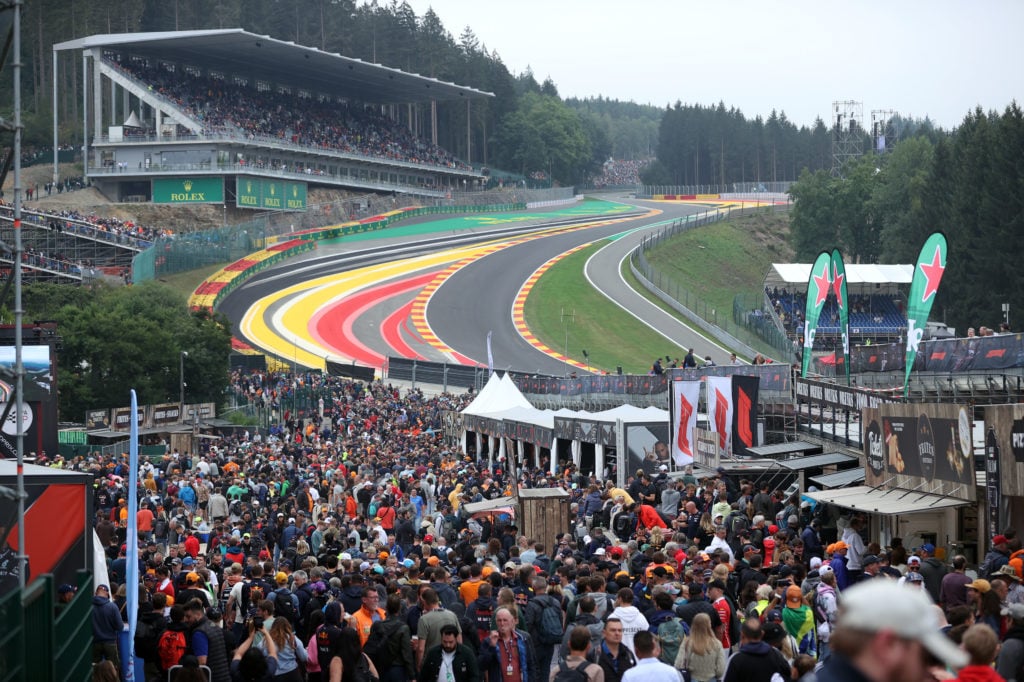
The Belgian Grand Prix has been a flagship race on the Formula 1 calendar since the maiden season in 1950. F1 has visited its spiritual home Spa-Francorchamps exclusively since 1985.
Spa-Francorchamps is the longest track on the schedule even though it has undergone vast modifications since F1 first visited. The original triangle-shaped track was built in 1921 using multiple public roads. It measured in at 14.9km (9.2m), more than double its current length.
Jules de Thier and Henri Langlois van Ophem created the original Spa-Francorchamps track. It passed through the towns of Francorchamps, Malmedy and Stavelot. Those towns earned names for corners on the shortened circuit, as well, when the track was redesigned in 1979.
History of the F1 Belgian GP
Formula 1 visited Spa-Francorchamps for the debut Belgian GP during its inaugural season in 1950. The series has since paid regular trips to the track in the Ardennes forest. But Nivelles and Zolder also hosted the Belgian Grand Prix before Spa became the race’s permanent site.
Nivelles debuted on the calendar in 1972 but F1 only returned to the track near Brussels in 1974. Emerson Fittipaldi also won both races at the circuit with Lotus. While Jackie Stewart won the first Belgian GP at Zolder in 1973. F1 later returned from 1975 to 1982 and in 1984.
Spa-Francorchamps has hosted every other Belgian GP to date with the circuit establishing itself as one of Formula 1’s most-loved tracks. Drivers and fans adore Spa for its mixture of long straights and challenging corners. It has also helped to deliver many iconic Grand Prix.
Formula 1 was not the first series to visit Spa-Francorchamps for a Belgian GP, however. The track actually first held Grand Prix racing in 1925. So, it was an obvious fit to feature on F1’s debut seven-round calendar in 1950 as Juan Manuel Fangio won in an Alfa Romeo one-two.
Formula 1 left Spa as the track was too dangerous
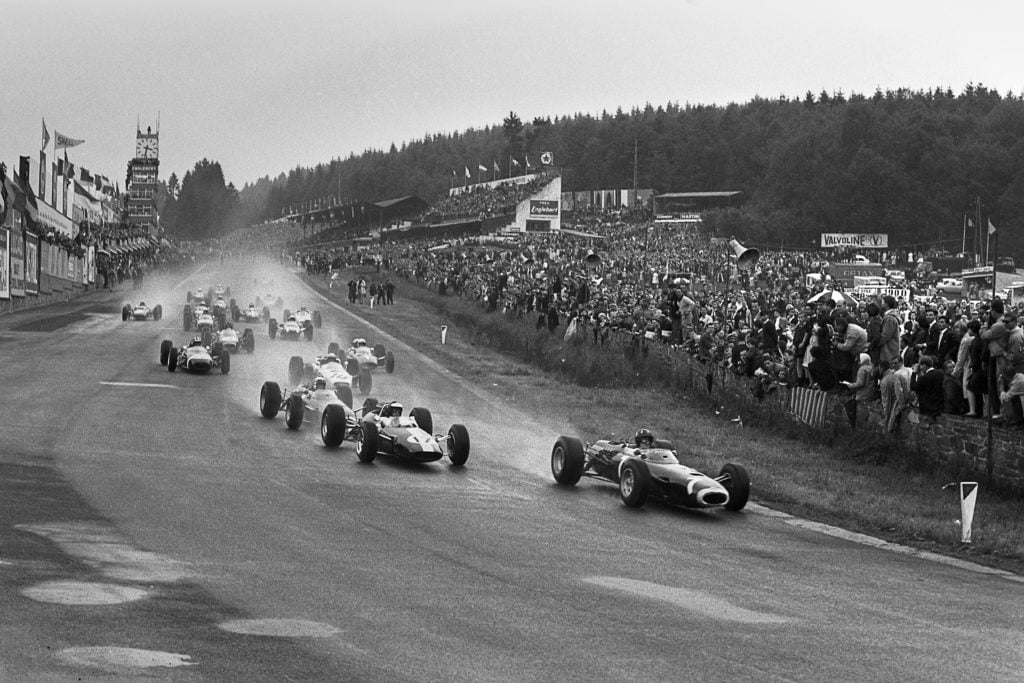
Stewart was one of the driving forces behind Formula 1 moving away from Spa in the 1970s, though. He campaigned the series’ governing body to drop the track as it was too dangerous for F1 races. Deaths and high-speed crashes were sadly all too common at the original track.
It was through the track’s need to increase driver safety that Spa-Francorchamps shortened the circuit in 1979. The changes removed the fearsome Masta Kink, where drivers could hit speeds of 310 km/h (190 mph). But Spa kept the iconic run from Eau Rouge to Les Combes.
The Belgian GP has delivered truly iconic F1 events
The Belgian Grand Prix has delivered some truly iconic moments in Formula 1’s history since F1 returned to Spa. Chaos even ensued from the very start in 1998 after McLaren star David Coulthard spun, sparking a 13-car pile-up. It took almost an hour for Spa to clear the debris.
Mika Hakkinen then span in the other McLaren car at the restart, before he was collected by Sauber star Johnny Herbert. Damon Hill would assume the lead for Jordan but soon lost it to Michael Schumacher of Ferrari. The German then charged clear to create a 40-second lead.
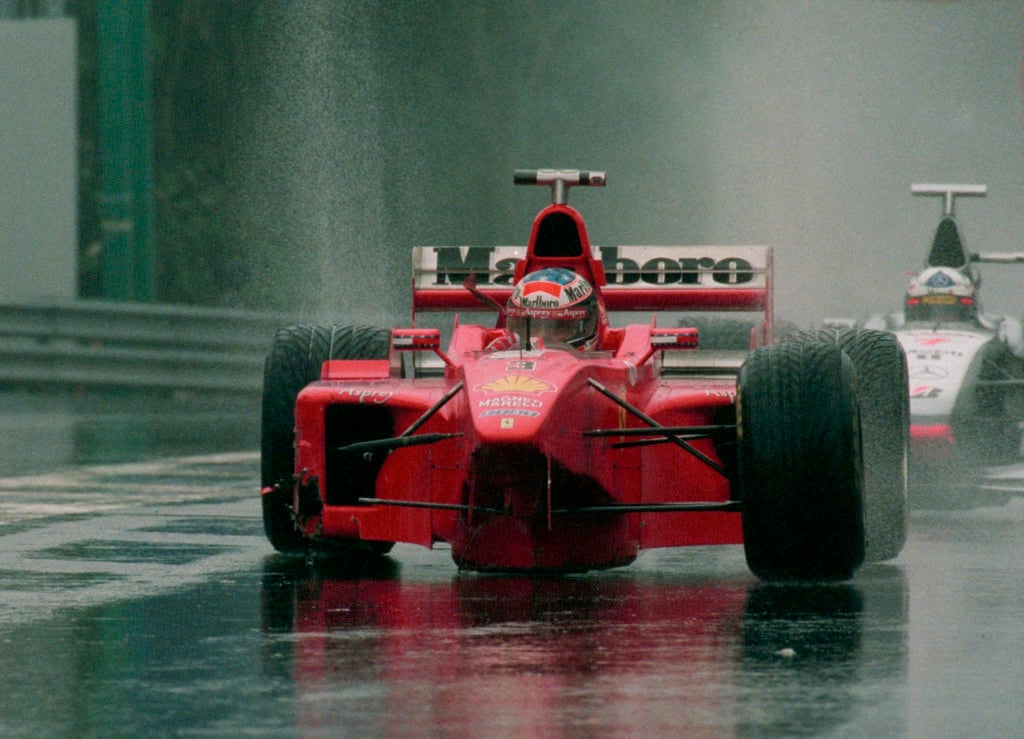
But Schumacher did not see Coulthard slowing on the racing line in the spray of his McLaren in the torrential rain. The seven-time F1 champion ploughed into the back of the Scot, losing a wheel. Schumacher crawled to the pit lane before accusing Coulthard of ‘trying to kill’ him.
Hill regained the lead of the 1998 Belgian GP after Coulthard and Schumacher’s incident. He would not have an easy run to the chequered flag, though. A safety car put Ralf Schumacher on the back of his teammate. Jordan eventually told the German to hold position in second.
Hakkinen, meanwhile, made fonder memories when Formula 1 returned to Spa for the 2000 Belgian GP. The Finn produced one of the most iconic overtakes in F1 history to pass Michael Schumacher for the lead as they split either side of Ricardo Zonta to lap the BAR-Honda star.
The Belgian GP also started in eye-opening fashion in 2012 when Romain Grosjean flew over the top of Fernando Alonso. He squeezed Lewis Hamilton as they charged off the grid. But it sent the McLaren into the rear of his Lotus before Grosjean narrowly missed Alonso’s head.
What is Spa-Francorchamps like?

Spa-Francorchamps is one of the most legendary race tracks in the world and a favourite of many Formula 1 fans and drivers. It gives a high-speed adrenaline run through the Ardennes with an elevation drop of 97 metres from its highest point (Les Combes) to its lowest (T15).
The Les Combes chicane marks the point where the current Spa-Francorchamps track splits from the original 14.9km (9.2m) circuit. Following changes introduced in 1979, drivers turn right off the Kemmel Straight and run down the hill. The track used to carry on to Malmedy.
Spa later named Turn 7 after Malmedy. But no corner is more legendary in name than Eau Rouge. It is the downhill dip of Turn 2 before running up a steep hill into Raidillon and onto the Kemmel Straight. Turn 9 at Spa is also called Speaker’s Corner but is dubbed No Name.
Iconic turns continue across Spa-Francorchamps with a high-speed double-left at Pouhon at T10-11, Stavelot at T14, the rapid left of Blanchimont at T17 and La Source at T1. A lap of Spa also ends at Turns 18-19, the Bus Stop Chicane, onto the brief Grand Prix pit straight.
What makes Spa-Francorchamps and the Belgian GP even more special is the unpredictable weather. The distance the track covers ensures parts of the circuit might face torrential rain while others still have sunshine. But rain can be a huge problem due to the lack of visibility.
Winners of the F1 Belgian GP
| 1950 Belgian GP: | Juan Manuel Fangio (Alfa Romeo) |
| 1951 Belgian GP: | Giuseppe Farina (Alfa Romeo) |
| 1952 Belgian GP: | Alberto Ascari (Ferrari) |
| 1953 Belgian GP: | Alberto Ascari (Ferrari) |
| 1954 Belgian GP: | Juan Manuel Fangio (Maserati) |
| 1955 Belgian GP: | Juan Manuel Fangio (Mercedes) |
| 1956 Belgian GP: | Peter Collins (Ferrari) |
| 1958 Belgian GP: | Tony Brooks (Vanwall) |
| 1960 Belgian GP: | Jack Brabham (Cooper) |
| 1961 Belgian GP: | Phil Hill (Ferrari) |
| 1962 Belgian GP: | Jim Clark (Lotus) |
| 1963 Belgian GP: | Jim Clark (Lotus) |
| 1964 Belgian GP: | Jim Clark (Lotus) |
| 1965 Belgian GP: | Jim Clark (Lotus) |
| 1966 Belgian GP: | John Surtees (Ferrari) |
| 1967 Belgian GP: | Dan Gurney (Eagle) |
| 1968 Belgian GP: | Bruce McLaren (McLaren) |
| 1970 Belgian GP: | Pedro Rodriguez (BRM) |
| 1972 Belgian GP: | Emerson Fittipaldi (Lotus) |
| 1973 Belgian GP: | Jackie Stewart (Tyrrell) |
| 1974 Belgian GP: | Emerson Fittipaldi (McLaren) |
| 1975 Belgian GP: | Niki Lauda (Ferrari) |
| 1976 Belgian GP: | Niki Lauda (Ferrari) |
| 1977 Belgian GP: | Gunnar Nilsson (Lotus) |
| 1978 Belgian GP: | Mario Andretti (Lotus) |
| 1979 Belgian GP: | Jody Scheckter (Ferrari) |
| 1980 Belgian GP: | Didier Pironi (Ligier) |
| 1981 Belgian GP: | Carlos Reutemann (Williams) |
| 1982 Belgian GP: | John Watson (McLaren) |
| 1983 Belgian GP: | Alain Prost (Renault) |
| 1984 Belgian GP: | Michele Alboreto (Ferrari) |
| 1985 Belgian GP: | Ayrton Senna (Lotus) |
| 1986 Belgian GP: | Nigel Mansell (Williams) |
| 1987 Belgian GP: | Alain Prost (McLaren) |
| 1988 Belgian GP: | Ayrton Senna (McLaren) |
| 1989 Belgian GP: | Ayrton Senna (McLaren) |
| 1990 Belgian GP: | Ayrton Senna (McLaren) |
| 1991 Belgian GP: | Ayrton Senna (McLaren) |
| 1992 Belgian GP: | Michael Schumacher (Benetton) |
| 1993 Belgian GP: | Damon Hill (Williams) |
| 1994 Belgian GP: | Damon Hill (Williams) |
| 1995 Belgian GP: | Michael Schumacher (Benetton) |
| 1996 Belgian GP: | Michael Schumacher (Ferrari) |
| 1997 Belgian GP: | Michael Schumacher (Ferrari) |
| 1998 Belgian GP: | Damon Hill (Williams) |
| 1999 Belgian GP: | David Coulthard (McLaren) |
| 2000 Belgian GP: | Mika Hakkinen (McLaren) |
| 2001 Belgian GP: | Michael Schumacher (Ferrari) |
| 2002 Belgian GP: | Michael Schumacher (Ferrari) |
| 2004 Belgian GP: | Kimi Raikkonen (McLaren) |
| 2005 Belgian GP: | Kimi Raikkonen (McLaren) |
| 2007 Belgian GP: | Kimi Raikkonen (Ferrari) |
| 2008 Belgian GP: | Felipe Massa (Ferrari) |
| 2009 Belgian GP: | Kimi Raikkonen (Ferrari) |
| 2010 Belgian GP: | Lewis Hamilton (McLaren) |
| 2011 Belgian GP: | Sebastian Vettel (Red Bull) |
| 2012 Belgian GP: | Jenson Button (McLaren) |
| 2013 Belgian GP: | Sebastian Vettel (Red Bull) |
| 2014 Belgian GP: | Daniel Ricciardo (Red Bull) |
| 2015 Belgian GP: | Lewis Hamilton (Mercedes) |
| 2016 Belgian GP: | Nico Rosberg (Mercedes) |
| 2017 Belgian GP: | Lewis Hamilton (Mercedes) |
| 2018 Belgian GP: | Sebastian Vettel (Ferrari) |
| 2019 Belgian GP: | Charles Leclerc (Ferrari) |
| 2020 Belgian GP: | Lewis Hamilton (Mercedes) |
| 2021 Belgian GP: | Max Verstappen (Red Bull) |
| 2022 Belgian GP: | Max Verstappen (Red Bull) |
| 2023 Belgian GP: | Max Verstappen (Red Bull) |
| 2024 Belgian GP: | Lewis Hamilton (Mercedes) |
| 2024 Belgian GP: | Oscar Piastri (McLaren) |
| 2025 Belgian GP: | Oscar Piastri (McLaren) |