Lando Norris
 McLaren
 Mercedes
 Red Bull
 Ferrari
 Williams
 Racing Bulls
 Aston Martin
 Haas
Haas Alpine


After Lewis Hamilton’s breakthrough win with the Scuderia at the Barcelona-Catalunya Grand Prix, discussion centered around one major talking point: Could this mark the beginning of a championship challenge for Ferrari?
The Austrian Grand Prix provided a resounding answer (no, not yet) and a reminder that fans had forgotten Formula 1’s golden rule: you’re never as good as you think, and you’re never as bad as you think.
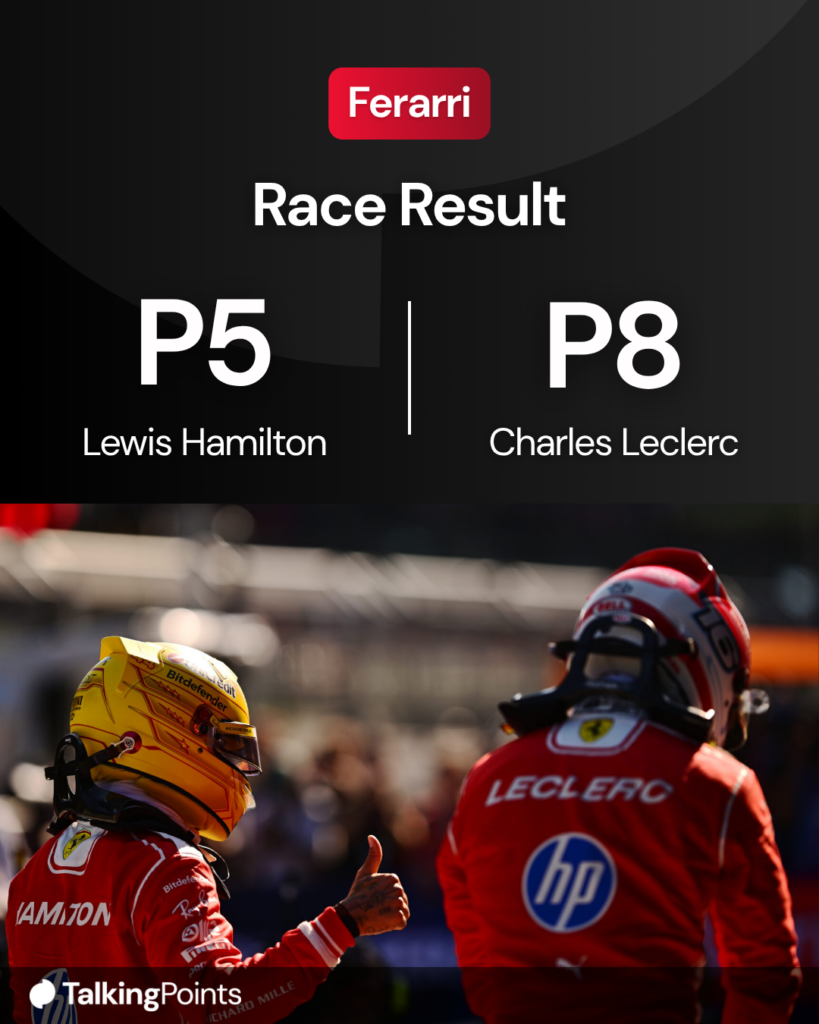
The Italian team had the qualifying speed to earn Charles Leclerc a place on the front row with Lewis Hamilton in third, but when the race kicked off on Sunday afternoon, Ferrari’s once-promising performance slipped away. Leclerc dropped to eighth at the chequered flag; Hamilton managed to salvage a fifth.
It’s clear that talk of a title challenge was premature, but what exactly made that the case? We’re going to dig into that today.
Barcelona: Not as representative as promised?
Ferrari’s performance at the Barcelona-Catalunya Grand Prix was held up by many as a clear sign that the team had made some kind of turnaround because the track itself is believed to be representative of much of what will come. But was that not the case here?
Well, yes and no.
Barcelona is the kind of track that requires a car to perform in a variety of different ways. It has high-, low-, and medium-speed corners. Its straight is long, but not too long. Each sector represents a different defining feature of many of the events that will come later in the season. It isn’t super fast or super slow. It’s one of the first “normal” tracks on the F1 calendar in a year, in the sense that it’s the start of the European road course season. It’s also traditionally been the home of at least one pre-season testing session, which means that every team should theoretically arrive with performance data even in an era of major regulatory evolution. Because of that, many teams arrive with their first major upgrades package of the year, too.
The fact that Ferrari performed well in Barcelona but struggled in Austria, though, does not mean Barcelona is no longer representative. Instead, it means we’re in a very unique era of Formula 1.
What went wrong for Ferrari at the Austrian Grand Prix?
The 2026 regulations brought with them major changes in everything from engine development to aerodynamics. That alone would be a major hurdle for many teams to overcome; add in the loss of two races early in the season as a result of global conflict, and you end up with perhaps a more off-sequence upgrade schedule than planned.
Ferrari brought a major upgrade package to Barcelona that included a revised front wing, a new floor, and updated sidepods. It also brought upgrades to Austria, this time in the engine department.
However, Ferrari title rivals like Mercedes and Red Bull only brought minor tweaks to Barcelona. Mercedes, which have been the class of the field, didn’t need a major upgrade for either race; Red Bull, though, utilized its home race in Austria to transform their car.
Ferrari’s success at Barcelona and struggles in Austria do not necessarily mean that Barcelona is no longer representative. Rather, the unusual upgrade schedule by many major players this season and the varying track conditions between Spain and Austria can go a long way in explaining the pace differential.
Ferrari’s internal struggles made clear in Austria
According to Ferrari team principal Fred Vasseur, the Scuderia struggled with overall performance in Austria, yet its biggest issue may actually have resulted from intra-team struggles.
“Looking back, we were probably too focused on Mercedes today,” Vasseur told media after the Austrian Grand Prix, as reported by The Race. “We pushed too hard in the opening laps with both cars and then perhaps reacted too aggressively with the strategy, trying to stay with them when, realistically, that wasn’t our race.”
From Lewis Hamilton’s three-stop strategy to Charles Leclerc’s decision to battle his teammate on the track despite their differing strategies to both drivers questioning the calls of their race engineers, the team’s lowly result in the race can’t solely be attributed to its overall pace.
Indeed, Hamilton pointed out that he felt the team had opted for a strategy that put them on the back foot right from the start.
“This morning, in the strategy meeting, they said it’s a two-stop. Three-stop is four seconds slower. Last night, and this morning, they gave us that information,” Hamilton told media, as reported by Motorsport Week.
“But I was dead set, it was a three for me, because I thought the deg was going to be super high, particularly as the track temperature today was the highest we’ve had it in a long, long time, mid 50s to 60 degree track temperature, so I thought the deg was going to be massive for us.
“I wanted to start on a soft, but the team were nervous, and so they pushed for us to start on the medium, which ultimately, I think was suboptimal.
“I think maybe we probably would have been around the same place. Maybe, just maybe, if I started on the soft, I would have got fourth.”
Can Ferrari still challenge for the F1 2026 championship?
While the F1 2026 season is still far from over, it is admittedly difficult to see a future where Scuderia Ferrari is able to topple the dominant might of Mercedes. Yet there’s one major factor that could still transform things: ADUO.
ADUO, or “Additional Development and Upgrade Opportunities,” refers to a system by which certain teams are allowed the ability to upgrade the internal combustion component of their hybrid power units. The FIA has determined that Red Bull has the ‘best’ combustion unit, which means every other team on the grid has the opportunity to introduce at least one to two upgrades throughout the remainder of 2026.
Now, both Ferrari and Mercedes have one opportunity to introduce a major engine upgrade. We could see Ferrari absolutely crush that upgrade; Mercedes could also somehow manage to make its engine worse (though that is admittedly difficult to imagine).
The biggest thing to keep in mind is that any upgrade also needs to come alongside a team-wide effort to translate an upgrade into success. So, we can’t completely count Ferrari out of the title fight after Austria, but the race certainly allowed us to pinpoint some of the team’s major weaknesses that, if addressed, could change the course of the season.
Receive exclusive F1 news and updates twice a week to your mailbox