Lando Norris
 McLaren
 Mercedes
 Red Bull
 Ferrari
 Williams
 Racing Bulls
 Aston Martin
 Haas
Haas Alpine


When Formula 1 and the FIA introduced the regulatory overhaul set to be introduced for the 2026 season, both parties stressed that the overall goal would be to level the playing field. One mechanism for doing so is called ADUO.
At its most basic, ADUO refers to an engine manufacturer’s ability to make mid-season alterations to their power unit without being penalised. The goal is to help maintain a level playing field with plenty of competition.
But with the news that Mercedes and Ferrari, two of the most successful teams of 2026, will be able to upgrade their engines under the ADUO system rules, many are wondering how this system evaluates performance.
Let’s take a deeper look at ADUO and its potential impact on Formula 1.
Why does Formula 1 need ADUO?
ADUO is an acronym that stands for “Additional Development and Upgrade Opportunities,” and at its most basic, it is a way for the five constructors entered in the 2026 Formula 1 season to make mid-season changes to their power units without the severe enforcement of the cost cap.
Heading into 2026, F1’s 1.6-litre V6 hybrid turbo power units were subject to a major overhaul. Previously, roughly 80% of an F1 unit’s power came from its internal combustion engine; the remaining 20% was electric power generated by the hybrid element.
Heading into 2026, though, that 80/20 ratio was leveled out to 50/50. That means that F1 cars are utilizing more electric power than ever before due to the 2026 regulations, and the FIA anticipated that there would be some developmental challenges along the way. It was entirely possible that, with such significant changes, a manufacturer or two could build a power unit so disastrous that its teams simply would not be able to compete.
In the rapidly evolving world of Formula 1, one minor mistake at the beginning of a regulatory set can be extremely costly. As the more successful PU suppliers continue to develop a more powerful and efficient engine, a struggling PU supplier could spend just as much money trying to engineer a functional but underpowered product, which can create massive performance disparities throughout the entire duration of this regulatory period.
The FIA did not want that massive performance gap to widen, so it implemented a mechanism by which struggling teams can initiate upgrades without penalties.
What is ADUO and how is it determined?
The ADUO system enables the FIA to provide ‘homologation tokens’ to struggling power unit suppliers in order to make much-needed upgrades without penalty. That means the money spent on these upgrades will not be included under the usual cost cap regulations; instead, the FIA will determine how much money a PU supplier can spend in order to ‘catch up’ with the competition.
Most interestingly, the ADUO system only evaluates the performance of the ICE component of the power unit. The electric components are not considered. So, in theory, an engine supplier could create a highly efficient energy management system but still be afforded the ability to upgrade their ICE component should it be deemed to be struggling.
What are your thoughts on Mercedes being granted an engine upgrade through ADUO despite their 2026 dominance?
But how does the FIA determine which PU makers are eligible for upgrades?
In effect, the FIA has split up a season into three monitoring periods; the first monitoring period concluded after the Canadian Grand Prix. During that monitoring period, the FIA will evaluate the performance of the ICE component of every power unit manufacturer to determine both the ‘lead’ manufacturer and the amount by which every other power unit manufacturer lags behind that lead manufacturer.
If a manufacturer’s PU is at least 2% but less than 4% down on ICE power when compared to the leading ICE, then that PU manufacturer will be eligible for one additional homologation in 2026, as well as an additional homologation in 2027. These manufacturers will be provided an extra allowance of USD $3 million beyond the cost cap.
If a manufacturer’s ICE is down on power by a factor of 4% or more when compared to the leading ICE, then that PU manufacturer will be eligible for two additional homologation upgrades in 2026, plus two additional homologation upgrades in 2027.
Additional funds for manufacturers down by 4% or more will be awarded on a sliding scale. Those who are 4-6% behind the leading manufacturer will be given an allowance of USD $4.65 million; those 6-8% behind will receive up to USD $6.35 million; those 8-10% behind will receive up to USD $8 million; and any manufacturer with a deficit of 10% or more can receive up to USD $11 million, though there is an option for additional financial support in that final category depending on the level of the problem at hand.
Manufacturers who are provided the opportunity for an ADUO upgrade must take that opportunity to upgrade their cars. They cannot wait to initiate upgrades during a later monitoring period. If they do not, they forfeit their ability to initiate any upgrades in 2026 but will have the opportunity to initiate upgrades in 2027.
Again, this process only evaluates the ICE component of a power unit. The efficiency and power of the hybrid element is not taken into consideration.
What upgrades can be made under ADUO regulations?
When F1 power unit manufacturers are informed that they will be able to make upgrades under the ADUO homologation system, they will have the ability to make a variety of upgrades.
Permitted upgrades can be made to certain elements of the ICE, the engine exhaust system, the turbocharger and waste gate, any electrical components and sensors mounted to the ICE or exhaust, ERS and its cooling systems, the MGU-K, control electronic, hydraulic functions, fluids, and ballast.
The FIA has not released the exact metrics they’re tracking in order to make these determinations, nor has the FIA announced the exact metrics of the sliding scale, so it is not possible to know exactly how far the trailing manufacturers are from the lead manufacturer. The goal here is to prevent PU suppliers and teams from manipulating metrics in order to be provided with additional upgrades.
What is 2026’s lead manufacturer, and what teams are eligible for ADUO?
During the Monaco Grand Prix weekend, Ferrari driver Lewis Hamilton let it slip that Red Bull Powertrains, which partnered with Ford, has been determined to be the leading PU maker of the first segment of the 2026 season. Because of that, the Red Bull engine is not eligible for a homologation token.
The four remaining manufacturers are eligible.
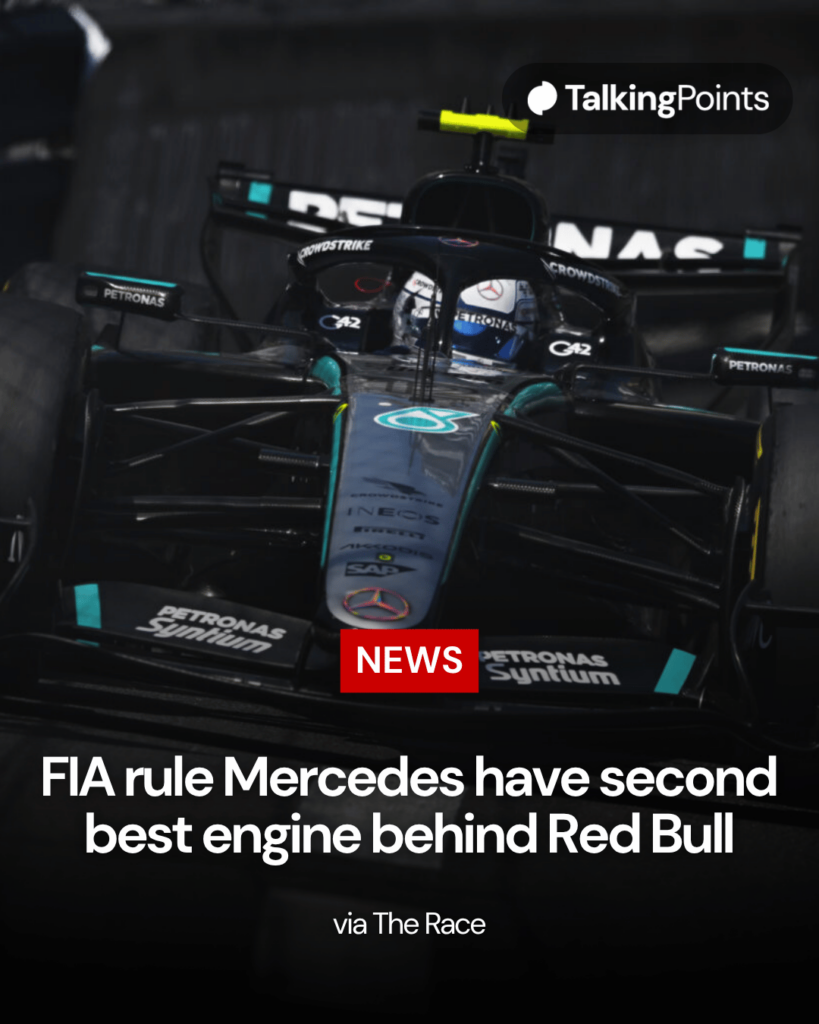
Sky Sports News has reported that Mercedes is between 2 and 4% adrift of Red Bull; as a result, Mercedes will be able to initiate one engine upgrade in 2026 and 2027 for a cost of USD $3 million.
Ferrari, Audi, and Honda have all been determined as lacking 4% or more in power when compared to Red Bull; as a result, those three PU suppliers will be able to initiate two upgrades in 2026 and two in 2027. The exact deficit, though, is not clear, which means there is currently no indication how much money each of those teams will receive to initiate those upgrades.
For many fans, the news that Red Bull/Ford is the lead manufacturer is something of a shock, considering the fact that Mercedes has appeared to have the dominant power unit this season. But the ADUO system does not evaluate overall performance; its specific focus is the ICE element of the hybrid power unit.
That means that Red Bull may be generating an impressive amount of power through their ICE but has struggled to develop an efficient energy management system. By contrast, Mercedes’ energy management system may be the class of the field, but because the energy management system is not being evaluated by the FIA, their PU can be seen to be less powerful than that of Red Bull.
ADUO-related upgrades will not result in an instant change in the pecking order, as PU development is a complex process. It is more likely that there will be a gradual shift in performance as manufacturers make changes, though PU suppliers are allowed to implement changes as early as the race after which they receive their place in the pecking order.
The second ADUO evaluation period began in Monaco and will come to a conclusion after the Hungarian Grand Prix; the final ADUO evaluation period will cover rounds 12 through 18, from the Dutch to Mexico City Grands Prix.
Receive exclusive F1 news and updates twice a week to your mailbox