Lando Norris
 McLaren
 Mercedes
 Red Bull
 Ferrari
 Williams
 Racing Bulls
 Aston Martin
 Haas
Haas Alpine
| First held: | 1964 |
| Times held: | 39 |
| Circuit: | Red Bull Ring |
| Circuit length: | 4.3km (2.6m) |
| Laps: | 71 |
| Most wins: | 4x Max Verstappen (2018, 2019, 2021, 2023) |
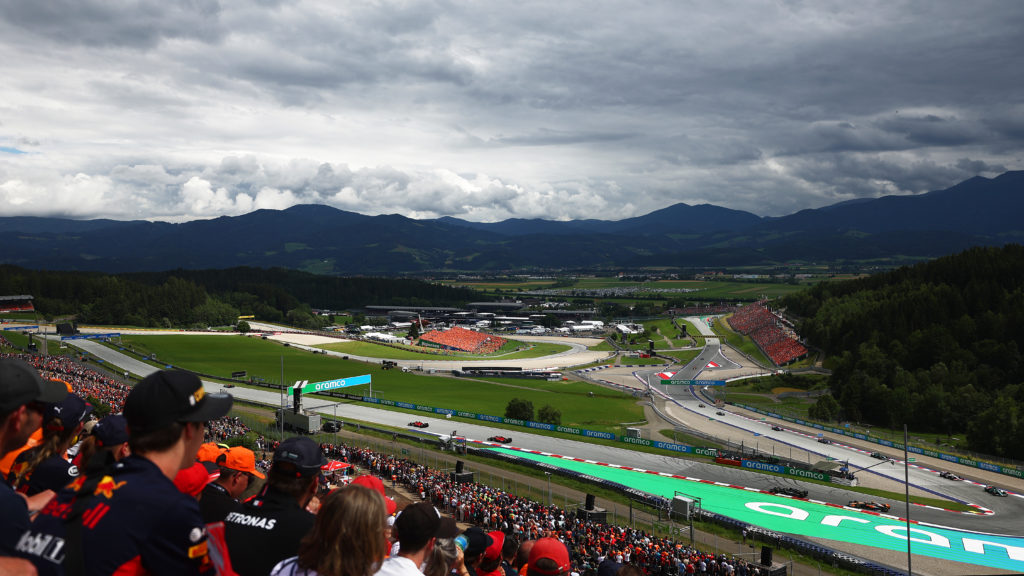
The Austrian Grand Prix has been a part of the Formula 1 calendar discontinuously since the 1964 season. F1 has regularly dropped the race from its schedule but has kept it since 2014.
Formula 1, actually, first travelled to the Central European country in the Eastern Alps during the 1963 season. But the meet was a non-championship event at the Zeltweg Airfield, which also hosted the 1964 race. The Osterreichring later took up hosting the Austrian GP in 1970.
Austria did not hold a Formula 1 event at all during the in-between years and, again, lost its race between 1988 and 1996 plus 2004 and 2013. F1’s return to Austria in 2014 came after Red Bull bought the Osterreichring, by then called the A1-Ring, and it upgraded its facilities.
History of the F1 Austrian GP
Lorenzo Bandini got his first, and only, win as a Formula 1 driver at the inaugural Austrian GP in 1964. The Italian came through from P9 on the grid to win the 105-lap event for Ferrari at the Zeltweg Airfield. Only Richie Ginther also finished the event within three laps of Bandini.
A field of 20 drivers started the first Austrian GP but just nine finished the race. Jochen Rindt was the last driver classified as retiring on Lap 58 of what was his Formula 1 debut. The race also marked a home debut for Rindt, who went on to win the drivers’ title in 1970 for Lotus.
Formula 1 would never return to the Zeltweg Airfield after the first Austrian GP marked as a championship race, though. Instead, the country in the Eastern Alps waited until 1970 before it featured on the calendar again. This time, the Osterreichring would see F1 race in Austria.
Formula 1 moved the Austrian GP to the Osterreichring in 1970
Formula 1’s return to Austria delivered a happy homecoming for Rindt, as well, as he sealed pole position by half a second. But his first home race since 1964 ended on Lap 21 due to an engine problem. Instead, Jacky Ickx saw that Ferrari won in a one-two with Clay Regazzoni.
The Osterreichring had only opened in 1969 near to the Zeltweg Airfield in Spielberg, Styria. It has since been Formula 1’s home whenever the series has raced in Austria. But the circuit has undergone several modifications from its original layout to be the Red Bull Ring of today.
Drivers and fans quickly appreciated the original Osterreichring for its fast corners and long straights that cut through the Styrian mountains. But its lack of run-off areas meant it was a dangerous track. F1 cars hitting nearly 250 kmh (155 mph) ultimately saw it canned in 1987.
Several drivers had huge accidents at the original Osterreichring. The track also had to instal a chicane at the Voest-Hugel corner in 1977 following Mark Donohue’s fatal crash during the morning warm-up in 1975. The chicane made the fastest bend on the track into the slowest.
Hermann Tilke redesigned the Osterreichring for Formula 1’s return
Formula 1 would not race in Austria between 1988 and 1996. But the series returned to the site of the Osterreichring in 1997 following extensive refurbishment works. The track hired Hermann Tilke to redesign its circuit, cutting its length from 5.9 to 4.3 km (3.6 to 2.6 miles).
By then, the track had also adopted the name A1-Ring for sponsorship purposes. But its new layout removed the long straights that headed off into the Styrian mountains. Instead, Tilke created a tighter circuit and shortened some of the older corners to create overtaking spots.
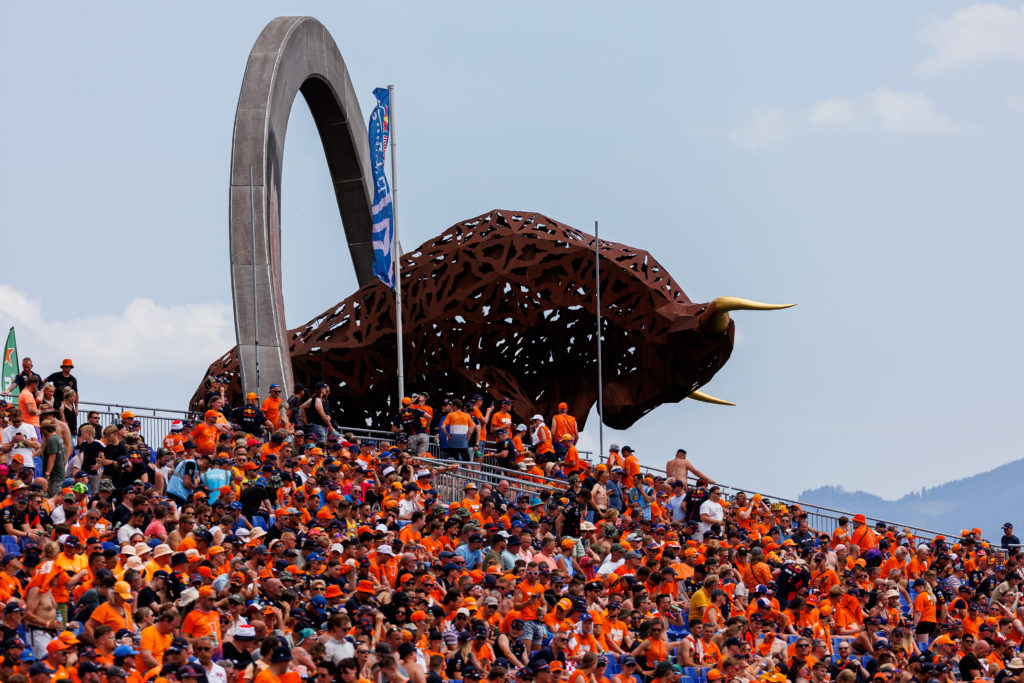
But the changes only kept the Austrian GP on the F1 calendar until 2003, at which point Red Bull’s owner Dietrich Mateschitz bought the circuit. He injected further funds into the track, as well, including destroying and upgrading the pit complex, the grandstands and the track.
Red Bull spent €70m (£60m) to reconstruct the track and bring it back up to a standard for motorsport events. It officially opened the Red Bull Ring in May 2011 with a variety of Red Bull-branded displays. Red Bull then confirmed F1’s return for the 2014 season in July 2013.
Ferrari made Rubens Barrichello let Michael Schumacher win in 2002
Red Bull’s Formula 1 team have since brought vast success back to Austria with the Austrian-owned outfit winning multiple Austrian Grand Prix. But only one Austrian driver has yet won their home race. Niki Lauda stood on the top step of the podium after winning back in 1984.
Lauda went on to win his third and final F1 drivers’ championship in 1984, pipping McLaren teammate Alain Prost by only half a point. He also returned to the Austrian GP in 1985 and announced his retirement. The Red Bull Ring later renamed its Turn 1 after Lauda in 2019.
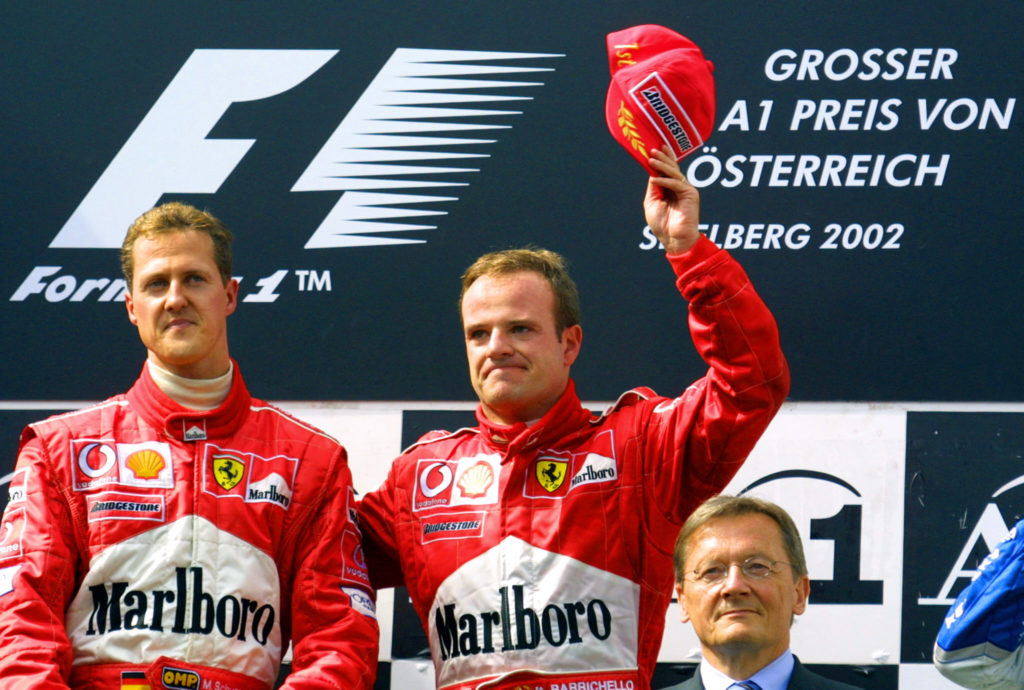
Michael Schumacher won the Austrian GP twice during his dominant era for Ferrari. But the seven-time F1 champion only won the race on merit once as Ferrari told Rubens Barrichello to concede his race win in 2002. The FIA fined Ferrari and their drivers $1m (£800k) for it.
Ferrari ordered Barrichello to move aside for Schumacher to steal the victory over the finish line. The Brazilian had weathered his teammate’s attack and deserved the win he was set to take. Schumacher knew it, too, and forced Barrichello atop the podium and took up second.
The FIA and F1 even banned team orders from the 2003 season in the aftermath of the 2002 Austrian GP. Ferrari and Schumacher would also not need the extra four points for the win in the title fight. Barrichello ended the season a distant second, 67 points behind the German.
What is the Red Bull Ring like?

The Red Bull Ring is far from as fearsome as the Osterreichring but the home of the Austrian GP often delivers exciting F1 races. Drivers push flat-out through the first half of the lap with many overtaking opportunities. The second half of the lap then necessitates a balanced car.
Overtakes are possible into Turns 1, 3 and 4 but moves can continue through Turn 5 and into the challenging Turn 6 left-hander. Drivers can even stay side-by-side all the way from Turn 1 to Turn 9 in the right circumstances. The final two bends can then catch any F1 driver out.
Track limits are one of the defining characteristics of the Red Bull Ring, though. Drivers must stay within the bounds of the circuit at Turn 1 or jeopardise a legal charge up the hill into T3, with Turn 2 only a small kink in an F1 car. Track limits are also again crucial coming out of T3.
Running wide at Turn 4 is often costly, too, with a large gravel trap waiting for any driver left on the outside. Gravel also awaits on the outside of T6 as the drivers chase a fine racing line into T7. The downhill nature of Turns 9 and 10 can then bite as drivers push for faster times.
Winners of the F1 Austrian GP
| 1964 Austrian GP: | Lorenzo Bandini (Ferrari) |
| 1970 Austrian GP: | Jacky Ickx (Ferrari) |
| 1971 Austrian GP: | Jo Siffert (BRM) |
| 1972 Austrian GP: | Emerson Fittipaldi (Lotus) |
| 1973 Austrian GP: | Ronnie Peterson (Lotus) |
| 1974 Austrian GP: | Carlos Reutemann (Brabham) |
| 1975 Austrian GP: | Vittorio Brambilla (March) |
| 1976 Austrian GP: | John Watson (Penske) |
| 1977 Austrian GP: | Alan Jones (Shadow) |
| 1978 Austrian GP: | Ronnie Peterson (Lotus) |
| 1979 Austrian GP: | Alan Jones (Williams) |
| 1980 Austrian GP: | Jean-Pierre Jabouille (Renault) |
| 1981 Austrian GP: | Jacques Laffite (Ligier) |
| 1982 Austrian GP: | Elio de Angelis (Lotus) |
| 1983 Austrian GP: | Alain Prost (Renault) |
| 1984 Austrian GP: | Niki Lauda (McLaren) |
| 1985 Austrian GP: | Alain Prost (McLaren) |
| 1986 Austrian GP: | Alain Prost (McLaren) |
| 1987 Austrian GP: | Nigel Mansell (Williams) |
| 1997 Austrian GP: | Jacques Villeneuve (Williams) |
| 1998 Austrian GP: | Mika Hakkinen (McLaren) |
| 1999 Austrian GP: | Eddie Irvine (Ferrari) |
| 2000 Austrian GP: | Mika Hakkinen (McLaren) |
| 2001 Austrian GP: | David Coulthard (McLaren) |
| 2002 Austrian GP: | Michael Schumacher (Ferrari) |
| 2003 Austrian GP: | Michael Schumacher (Ferrari) |
| 2014 Austrian GP: | Nico Rosberg (Mercedes) |
| 2015 Austrian GP: | Nico Rosberg (Mercedes) |
| 2016 Austrian GP: | Lewis Hamilton (Mercedes) |
| 2017 Austrian GP: | Valtteri Bottas (Mercedes) |
| 2018 Austrian GP: | Max Verstappen (Red Bull) |
| 2019 Austrian GP: | Max Verstappen (Red Bull) |
| 2020 Austrian GP: | Valtteri Bottas (Mercedes) |
| 2021 Austrian GP: | Max Verstappen (Red Bull) |
| 2022 Austrian GP: | Charles Leclerc (Ferrari) |
| 2023 Austrian GP: | Max Verstappen (Red Bull) |
| 2024 Austrian GP: | George Russell (Mercedes) |
| 2025 Austrian GP: | Lando Norris (McLaren) |