Lando Norris
 McLaren
 Mercedes
 Red Bull
 Ferrari
 Williams
 Racing Bulls
 Aston Martin
 Haas
Haas Alpine


Alain Prost is a four-time Formula 1 drivers’ champion yet the Frenchman is one of the most underrated pilots to grace F1, so here is everything you need to know about him.
The child of a wealthy furniture store owner, Prost raced in the pinnacle of motorsport from 1980 to 1993. His Formula 1 career even saw the Frenchman drive exclusively with some of the best teams to hit the grid in McLaren, Renault, Ferrari and Williams before Prost retired.
Drivers’ championship also fell at Prost’s feet with McLaren in 1985, 1986 and 1989 and one with Williams in 1993. The Professor, as he was nicknamed due to Prost’s cerebral approach to racing, hung up his racing gloves after sealing the 1993 F1 title to bow out at the very top.

Alain Prost wanted to win Formula 1 races ‘at the slowest speed possible’
Prost always adopted a well-thought-out strategy and seldom drove on his emotions. One of the defining quotes of Prost’s Formula 1 career was also, “I always say that my ideal is to get pole [position] with the minimum effort, and to win the race at the slowest speed possible.”
It was not that Prost refused to take risks or push his limits, rather that the Frenchman knew where and how much he had to push to get the rewards. He always placed finishing the race above driving excessively, believing also that driving smoothly was when Prost was quickest.
Yet many at the time Prost competed in Formula 1 and long after continue to undervalue his talents. Unlike drivers like his great rival, Ayrton Senna, there was no mythology to Prost and no out-of-body qualifying displays – just a meticulous yet still devastatingly fast race driver.
Alain Prost’s father and brother helped convert his passion from football to motorsport
Motorsport was not Prost’s first passion, though, as the Frenchman grew up an avid football fan and played it until he was 17. But whilst lacing up his boots to hit the pitch, a passion for racing grew stronger – even aided by attending the 1970 Monaco Grand Prix with his father.
Prost’s brother Daniel also helped to further fuel his passion for motorsport in 1970 after his sibling took him to an amusement park in the Cote d’Azur, where they had a small kart track. After that, Alain worked in his dad’s furniture store to make enough money to buy a go-kart.
His first kart was a tired, well-used machine that Prost regularly had to repair. But it laid the foundation for him to shine when offered a better kart to borrow and win a regional race. It even preceded Prost winning the French Kart Championship in the 1974 and 1975 seasons.
A move to single-seaters then arrived in 1976 and Prost attended the Winfield racing school and took Pilote Elf honours, resulting in a seat in the French Formula Renault Championship. That move yielded instant success as Prost won the title as a rookie with 12 wins in 13 races.
Alain Prost made his Formula 1 debut with McLaren at the 1980 Argentine Grand Prix
Further titles also followed in the 1977 Challenge de Formule Renault Europe, the 1978 and 1979 French Formula 3 and the 1979 FIA European Formula 3 championships before Prost’s Formula 1 debut arrived with McLaren in 1980. His debut race was the Argentine Grand Prix.
Prost secured four points-scoring finishes through his 13 Grand Prix entries with McLaren in 1980. It was enough to convince Renault to poach the Frenchman for 1981 as Prost replaced Jean-Pierre Jabouille, a move that yielded his first race win at the French Grand Prix in Dijon.
Despite leaving McLaren in acrimonious circumstances, Prost returned to the British team in 1984 to partner Niki Lauda after Ron Dennis took over. It even proved to be the making of a new McLaren team as Prost won seven of the 12 races and Lauda won five but also the title.
His first world championship and the first Formula 1 title for a French driver would arrive in 1985, though, as Prost beat Ferrari rival Michele Alboreto by 20 points. A second world title also followed in 1986 as Prost thwarted Williams driver Nigel Mansell by a mere two points.
Unlike his new teammate for 1986, Keke Rosberg, Prost relished the set-ups McLaren had to adopt to combat the chronic understeer of the MP4/2C. His talent was not enough to retain the title as the TAG/Porsche V6 lost its edge and McLaren moved to Honda engines in 1988.
Alain Prost and Ayrton Senna built a fierce and controversial title rivalry at McLaren
The arrival of Honda engines also paired Prost with Senna as teammates in 1988 as McLaren dominated Formula 1. Gerhard Berger denied McLaren a clean sweep by winning the Italian Grand Prix, with Senna scoring eight Grand Prix victories plus the title and Prost seven wins.
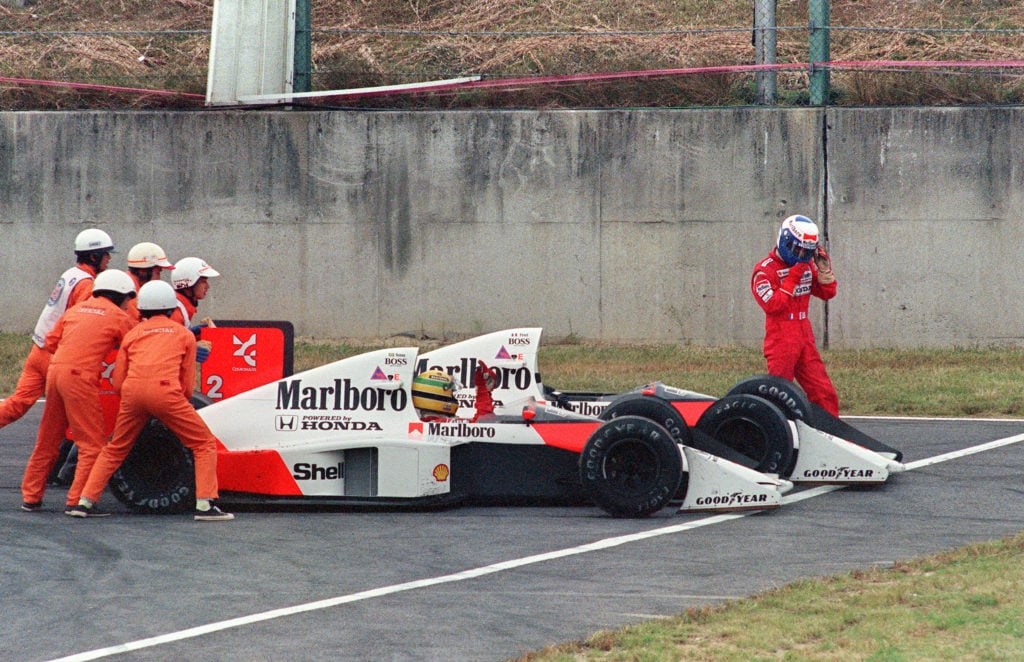
Senna sealed the 1988 drivers’ championship at Prost’s expense after winning the Japanese Grand Prix by 13 seconds to the Frenchman after recovering from stalling on the grid. But it was Prost who prospered for the title at the 1989 Japanese GP after Senna was disqualified.
Prost was wise whilst watching Senna in his mirrors to close the inside line into Suzuka’s last chicane when the Brazilian made a late dive. But Prost turning in saw the teammates collide and stall, so he retired. Yet Senna got a push start to jump his engine and he went on to win.
But FISA president Jean-Marie Balestre disqualified Senna from the 1989 Japanese GP as he used an escape road to return to the pits to get a new front wing, rather than re-joining the circuit where he ran off. The Frenchman’s ruling saw Senna accuse Balestre of manipulation.
The fallout from the 1989 Japanese GP and his worsening relationship with Senna helped to convince Prost to leave McLaren after that season, so he joined Ferrari with the Scuderia on the rise. Yet it failed to prevent Senna and Prost from also fighting for the 1990 drivers’ title.
Again, the title race was decided at Suzuka in controversial settings after Senna took himself and Prost off into Turn 1 knowing the crown was the Brazilian’s if both retired. He refused to yield from pole as the Frenchman begun to inch ahead after Prost started on the racing line.
It would be the only time that Prost would challenge for a drivers’ title with Ferrari after the Scuderia persisted with developing a car first seen in 1988 through the 1991 season. Ferrari even sacked Prost before the 1991 Australian Grand Prix in Adelaide after criticising the car.
Prost would ultimately take a sabbatical during the 1992 season with no front-running seats available after leaving Ferrari before final round of the 1991 campaign. Yet he returned with Williams in 1993 and secured the drivers’ title after winning seven of the first 10 of 16 races.
Mansell leaving Williams to experience IndyCar after falling out with Frank Williams handed Prost his chance to join the team in 1993. But despite winning the drivers’ championship, it would be Prost’s final season on F1’s grid as he retired and Senna replaced him at Williams.
Alain Prost views being a Formula 1 team owner after buying Ligier as his biggest ‘mistake’

Prost would not stay away from Formula 1 for long after retiring from driving, as he became a test driver for McLaren. A chance to buy the Ligier team then arose for Prost in 1997, and he renamed them, Prost Grand Prix. But his team would only remain on the grid through 2001.
The Prost GP team earned three podium finishes through 83 entries with a best finish of P2 in the 1997 Spanish Grand Prix with Olivier Panis plus the 1999 European Grand Prix at the Nurburgring with Jarno Trulli. Bankruptcy ended the Prost GP team before the 2002 season.
Having to design their own car and securing an exclusive engine deal with Peugeot in 1998 had marked the start of Prost GP’s decline. Prost also later admitted that he viewed being a Formula 1 team owner as the biggest ‘mistake’ of his career and wished he pulled the plug.
“Three months after I started the team, we had some very good results and we almost won a race [in Canada],” Prost admitted in 2015. “But to my family and close friends, I was saying ‘I’m dead’. I knew from the beginning.
“I know Formula 1 too well. I know the country too well. If I made one mistake, it was this. It would have been better not to have done it. I should not have made the decision to do it at the last minute. Two days before I signed the contract, I did not want to do it anymore.
“We had a plan with Peugeot and a contract for five years of free engines with lots of development. Then they came back two days before I signed it and it was only three years and I had to pay for the engine. In the end, I was happy to stop.”
Prost later returned to Formula 1 in 2017 as an advisor to Renault, but left the Enstone crew in 2022 after Groupe Renault renamed the team as Alpine. He also hit out at Group Renault CEO Laurent Rossi as Prost felt forced out, even also calling Rossi ‘incompetent’ in 2023.
Alain considers the 1987 Brazilian GP to be his best and most rewarding race

The 1987 Formula 1 season proved to be Prost’s worst campaign through his second stint at McLaren. But the Frenchman rates his victory with McLaren in the 1987 Brazilian Grand Prix at the Jacarepagua Circuit in Rio de Janeiro as Prost’s best and most rewarding display in F1.
With the TAG/Porsche V6 no longer as powerful as the Honda units powering Williams plus Lotus that season, Prost could only qualify in fifth place for the 1987 Brazilian GP. His Q2 lap was even 3.047 seconds off the pace that Mansell set to pip Nelson Piquet for pole position.
Teo Fabi even out-qualified Prost in the Italian’s Ford-engined Benetton by 0.758s for fourth place on the grid in Rio. Yet the Frenchman favoured a low-downforce race set-up while the field went high-downforce, giving Prost more straight-line speed plus less tyre degradation.
Prost later said about his victory in the 1987 Brazilian GP by 40.547s to Piquet: “When you win a race like this, the feeling is very, very good. There have been times when I have been flat-out to finish sixth, but you can’t see that from the outside.
“In 1980, I finished three or four times in seventh place. I pushed like mad, yet everyone was gathered around the winner and they were thinking that I was just trundling around.
“But that’s motor racing. So, in fact, the only thing you can judge in this sport is the long-term. You can judge a career or a season, but not one race.”
When and where was Alain Prost born?
Prost was born on February 24, 1955 in the commune of Lorette in the Loire department in France. His parents Andre Prost, who ran a furniture store, and Marie-Rose Karatchian gave him the name Alain Marie Pascal Prost. He also had an elder brother Daniel Prost, who died of cancer in September 1986. Daniel was the motor-racing fan in his plus Alain’s childhood.
Alain Prost’s net worth
Despite the failure of Prost Grand Prix due to increasing debt levels after a failure to sign up sponsors, Prost’s net worth is believed to stand at around £78m as one of F1’s richest icons.
Alain Prost’s Formula 1 career stats
Prost enjoyed 13 seasons on the Formula 1 grid between 1980 and 1993, which also yielded the drivers’ championship in 1985, 1986, 1989 and 1993. The Frenchman even won 25.63% of his Grand Prix, Prost took pole position at 16.58% and he stoon on the podium at 53.27%.
| F1 TITLES | GRAND PRIX ENTRIES | GRAND PRIX WINS | GRAND PRIX POLES | GRAND PRIX PODIUMS |
| 4 | 202 | 51 | 33 | 106 |
Each of Alain Prost’s Formula 1 drivers’ championships:
- 1985 F1 season: 16 races, 5 wins, 2 poles, 5 fastest laps, 11 podiums
- 1986 F1 season: 16 races, 4 wins, 1 pole, 2 fastest laps, 11 podiums
- 1989 F1 season: 16 races, 4 wins, 2 poles, 5 fastest laps, 11 podiums
- 1993 F1 season: 16 races, 7 wins, 13 poles, 6 fastest laps, 12 podiums
Receive exclusive F1 news and updates twice a week to your mailbox