McLaren
 Mercedes
 Red Bull
 Ferrari
 Williams
 Racing Bulls
 Aston Martin
 Haas
Haas Alpine
| First held: | 1950 |
| Times held: | 71 |
| Circuit: | Circuit de Monaco |
| Circuit length: | 3.3km (2m) |
| Laps: | 78 |
| Most wins: | 6x Ayrton Senna (1987, 1989, 1990, 1991, 1992, 1993) |
The Monaco Grand Prix has been the crown jewel of the Formula 1 calendar since the 1950 season. It is also part of motorsport’s triple crown with the Indy 500 and Le Mans 24 Hours.
F1 first hit the streets of the Principality for the series’ inaugural season in 1950 as part of a seven-round calendar. But Formula 1 was not the first series to contest a Monaco GP. Races on the iconic roads of Monte Carlo had already taken place since 1929 in an array of series.
Hosting racing in Monaco was the brainchild of Antony Noghes, who was the commissioner general of the Automobile Club of Monaco. The Monegasque took it upon himself to set up a race in Monaco with the support of Prince Louis II to seal the Principality’s FIA recognition.

History of the F1 Monaco GP
Formula 1 contested the 11th running of the Monaco GP, which Juan Manuel Fangio won in an Alfa Romeo, in 1950. The race was not held in any format between 1938 and 1947 due to WWII, plus economic reasons. It was also cancelled in 1949 after the death of Prince Louis II.
Various cancellations also kept the Monaco GP off the calendar between 1951 and 1954 bar a non-Formula 1 world championship race in 1952. F1 then returned to Monte Carlo for the 1955 event and has every year since but for 2020, when it was cancelled owing to Covid-19.
Fangio ensured Formula 1 got off to a triumphant start at the 1950 Monaco GP as he sealed his first victory. It was to be the first of many as the Argentine swept 24 victories through 51 Grand Prix from 1950 to 1958. He also won five championship titles from seven full seasons.
The 1950 Monaco GP further featured the first of the extremely rare set of Monegasque F1 drivers in Louis Chiron. He had won the race in 1931, as well, and came third on Formula 1’s debut visit to Monte Carlo. Fangio won the race by one full lap with Chiron two laps behind.
Monte Carlo would see Fangio triumph again in 1957 but Stirling Moss soon went one better than the dominant Argentine. The Briton won the Monaco GP in 1956 and later became the first back-to-back winner in 1960 and 1961. But the rise of Mr Monaco was soon on the way.
Graham Hill was Mr Monaco with five wins during the 1960s
Graham Hill earned the nickname Mr Monaco after mastering the famous streets during the 1960s. The 1962 and 1968 F1 champion took Monaco GP glory in 1963, 1964, 1965, 1968 and 1969. His initial dominance was for BRM before teammate, Jackie Stewart, won in 1966.
No race summed up Hill’s status as the King of Monaco more than the 1965 Grand Prix. The Briton magnificently drifted his way to pole position, sliding his BRM out of the corners. But he then had to overcome an early spin to fight his way back through the field to take victory.
Hill set a strong pace from the off but conceded the lead of the Monaco GP on Lap 25 so as to avoid the slow-moving Bob Anderson. He shot up the escape road exiting the tunnel with Anderson crawling through the chicane with a drive shaft failure without room for two cars.
F1’s rules at the time forced Hill to get out and push his car back on the track in order to re-join the 1965 Monaco GP. He dropped to fifth place as a result of the incident and Stewart stole the lead. But Stewart wasted a comfortable advantage when he then spun on Lap 30.
Stewart re-joined in P4 just ahead of Hill but waved his BRM teammate through with Hill in blistering form. No one could match his pace as Hill set about catching and passing Lorenzo Bandini and John Surtees. They made it challenging but Hill’s lap record pace was too much.
Jackie Stewart led the charge for improvements to track safety
The 1969 Monaco GP saw the organisers of the event install Armco barriers at certain points of the circuit for the first time. Stewart pushed F1 and the circuits the series visited to install better safety measures throughout the end of the decade with the previous standards basic.
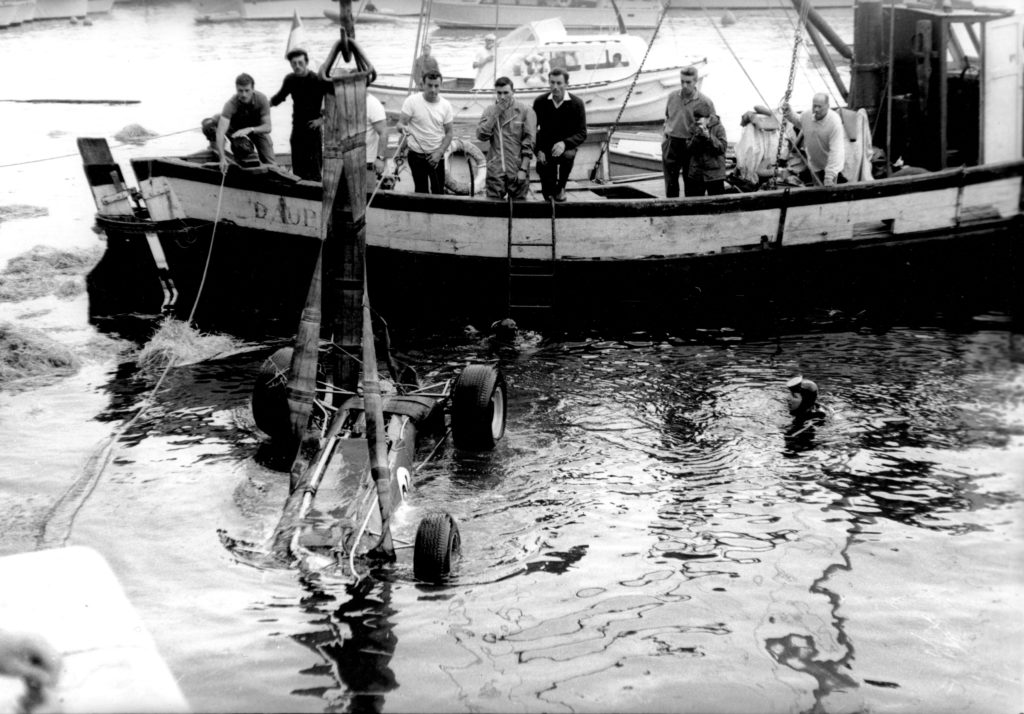
Alberto Ascari, who won the F1 championship in 1952 and 1953, and Paul Hawkins had even wound up crashing into the harbour at past Monaco Grand Prix. Ascari went for a dip during the 1955 event, while Hawkins went for a dip in 1965 after spinning through the straw bales.
Monaco GP organisers continued to improve the safety of the race and by 1972, most of the circuit had Armco barriers. The 1972 race also featured the first changes to the layout of the track. The pit building moved to sit beside the waterfront. Further changes followed in 1973.
The 1973 changes introduced one of the most iconic sections of the Circuit de Monaco, too. A double-chicane was added that wrapped around the Rainier III Nautical Stadium following the construction of the swimming pool. It also allowed Monaco to create a new pit building.
The 1982 Monaco GP was one of F1’s craziest races
After Hill dominated the Monaco GP in the 1960s, a new Mr Monaco appeared at the end of the 1980s. But before Ayrton Senna won six times in seven years, the craziest race from F1’s history unfolded around Monte Carlo’s streets in 1982 as Riccardo Patrese won for Brabham.
It was the race that no driver seemingly wanted to win as the lead changed four times in just three laps at the end. Just five cars would take the chequered flag, too, with Rene Arnoux an early retiree at the Swimming Pool Chicane. The French Renault driver stalled whilst leading.
Alain Prost assumed the lead but his Monaco GP unravelled after others fell by the wayside as rain fell. The 1985, 1986, 1989 and 1993 F1 champion lost control of his Renault through the harbourside chicane. His car flung into the barriers, destroying both wings and a wheel.
Patrese then led for less than a lap before he lost control of his car on an oil spill on the run to the hairpin. It was then Didier Pironi’s turn to retire from the lead after his Ferrari ran out of fuel. The same fate also befell Alfa Romeo’s driver, Andrea de Cesaris, during the final lap.
Pironi and De Cesaris running out of fuel allowed Patrese to regain the lead having used the downhill run out of the hairpin to restart his stalled Brabham. Yet Pironi and De Cesaris still joined Patrese on the podium in second and third place having lapped the rest of the field.
McLaren dominated the Monaco GP with Ayrton Senna and Alain Prost

Prost eventually won his first Monaco GP in 1984 after switching to McLaren and would win three in a row. But Senna would shatter the records from 1987 until 1993 with six wins from seven trips to Monte Carlo. Prost interrupted the Brazilian’s supremacy to win again in 1988.
It, arguably, should have been Senna who won the 1984 Monaco GP, as well. The 1988, 1990 and 1991 F1 champion burst onto the F1 scene in 1984 with Toleman and stunned everyone with his blistering speed. He also displayed immense skill around a rain-soaked Monte Carlo.
Senna mastered the challenging conditions and shot into the spotlight with a brave overtake around the outside of Niki Lauda into Sainte Devote. His pace was electric and soon caught up with Prost in the lead. But before Senna could make a pass, the race was called to a stop.
Prost called for the 1984 Monaco GP to be red flagged for a few laps as the conditions did not improve. It was, eventually, called after 31 laps with Prost crawling to a halt on the finish line whilst Senna flew past. The Brazilian could not hide his disappointment at only being P2.
Senna would get his first Monaco GP victory in 1987 with Lotus before dominating the race with McLaren. His win in 1992 would also be an iconic result as Senna fended off Williams’ Nigel Mansell, despite the Briton being on new tyres and driving the all-conquering FW14B.
Mansell had taken the Williams car designed by Adrian Newey to pole position and the win at each of the opening five rounds. He then took pole and looked set to win in Monte Carlo. But a loose wheel nut forced the 1992 champion to pit late on and dropped him behind Senna.
Michael Schumacher repeated Graham Hill’s five Monaco GP wins
No driver has dominated the Monaco GP like Senna since the Brazilian mastered the Monte Carlo streets. But Michael Schumacher matched Hill’s five Monaco GP wins with the seven-time Formula 1 drivers’ champion winning twice with Benetton and three times with Ferrari.
Schumacher also made himself the villain in 2006 after parking his Ferrari in the wall exiting Rascasse. The German was on provisional pole position but had Fernando Alonso hot on his tail for Renault. And with Schumacher not improving, he parked up so Alonso also could not.
In a very tactical way, Schumacher locked up into Rascasse before snaking his car through to the barriers. He enraged Renault, who gave the Ferrari driver the thumbs down as he later walked past their motorhome. The stewards also agreed and stripped pole off Schumacher.
Alonso would go on to win the race from pole and ultimately beat Schumacher – who came through to finish the Monaco GP in fifth – to that year’s championship. The Spaniard already had an advantage before racing in Monaco after Schumacher retired from the Australian GP.
Schumacher would ultimately not win another Monaco GP after the 2001 race, and neither would Ferrari until 2017 with Sebastian Vettel. But Schumacher put on a show in 2012 with the fastest lap time in qualifying for Mercedes. He would not get pole due to a grid penalty.
Qualifying antics also engulfed the 2014 Monaco GP as Nico Rosberg locked up at Mirabeau and denied Mercedes teammate Lewis Hamilton a chance to steal pole position. But he kept pole position after surviving a post-session investigation into his controversial lock-up in Q3.
What is the Circuit de Monaco like?

The Circuit de Monaco is one of the most challenging tracks on the Formula 1 calendar even though it is the shortest. The Armco-lined roads of Monte Carlo leave no room for error. Yet it is the task of threading a needle at speed around the Principality that makes it so special.
Ex-Ferrari and Williams driver Felipe Massa claimed in 2017 that racing around Monaco in a car was ‘a bit like trying to ride your bike in the kitchen’. Three-time F1 champion and fellow Brazilian Nelson Piquet also famously likened it to ‘riding a bicycle around your living room’.
The tight roads also put an emphasis on qualifying as the cream truly always rises to the top. Drivers must be at their outright limits to skim past and brush the Armco barriers. Any touch with a barrier can be the difference between starting from pole position and from last place.
No spot on the circuit shows the drivers pushing the limits between glory and disaster more than the Swimming Pool Chicane. Cars fly into the sequence of corners at around 200 km/h (124 mph) before kissing the barrier to widen the angle of the corner and carry more speed.
Winners of the F1 Monaco GP
| 1950 Monaco GP: | Juan Manuel Fangio (Alfa Romeo) |
| 1955 Monaco GP: | Maurice Trintignant (Ferrari) |
| 1956 Monaco GP: | Stirling Moss (Maserati) |
| 1957 Monaco GP: | Juan Manuel Fangio (Maserati) |
| 1958 Monaco GP: | Maurice Trintignant (Cooper) |
| 1959 Monaco GP: | Jack Brabham (Cooper) |
| 1960 Monaco GP: | Stirling Moss (Lotus) |
| 1961 Monaco GP: | Stirling Moss (Lotus) |
| 1962 Monaco GP: | Bruce McLaren (Cooper) |
| 1963 Monaco GP: | Graham Hill (BRM) |
| 1964 Monaco GP: | Graham Hill (BRM) |
| 1965 Monaco GP: | Graham Hill (BRM) |
| 1966 Monaco GP: | Jackie Stewart (BRM) |
| 1967 Monaco GP: | Denny Hulme (Brabham) |
| 1968 Monaco GP: | Graham Hill (Lotus) |
| 1969 Monaco GP: | Graham Hill (Lotus) |
| 1970 Monaco GP: | Jochen Rindt (Lotus) |
| 1971 Monaco GP: | Jackie Stewart (Tyrrell) |
| 1972 Monaco GP: | Jean-Pierre Beltoise (BRM) |
| 1973 Monaco GP: | Jackie Stewart (Tyrrell) |
| 1974 Monaco GP: | Ronnie Peterson (Lotus) |
| 1975 Monaco GP: | Niki Lauda (Ferrari) |
| 1976 Monaco GP: | Niki Lauda (Ferrari) |
| 1977 Monaco GP: | Jody Scheckter (Wolf) |
| 1978 Monaco GP: | Patrick Depailler (Tyrrell) |
| 1979 Monaco GP: | Jody Scheckter (Ferrari) |
| 1980 Monaco GP: | Carlos Reutemann (Williams) |
| 1981 Monaco GP: | Gilles Villeneuve (Ferrari) |
| 1982 Monaco GP: | Riccardo Patrese (Brabham) |
| 1983 Monaco GP: | Keke Rosberg (Williams) |
| 1984 Monaco GP: | Alain Prost (McLaren) |
| 1985 Monaco GP: | Alain Prost (McLaren) |
| 1986 Monaco GP: | Alain Prost (McLaren) |
| 1987 Monaco GP: | Ayrton Senna (Lotus) |
| 1988 Monaco GP: | Alain Prost (McLaren) |
| 1989 Monaco GP: | Ayrton Senna (McLaren) |
| 1990 Monaco GP: | Ayrton Senna (McLaren) |
| 1991 Monaco GP: | Ayrton Senna (McLaren) |
| 1992 Monaco GP: | Ayrton Senna (McLaren) |
| 1993 Monaco GP: | Ayrton Senna (McLaren) |
| 1994 Monaco GP: | Michael Schumacher (Benetton) |
| 1995 Monaco GP: | Michael Schumacher (Benetton) |
| 1996 Monaco GP: | Olivier Panis (Ligier) |
| 1997 Monaco GP: | Michael Schumacher (Ferrari) |
| 1998 Monaco GP: | Mika Hakkinen (McLaren) |
| 1999 Monaco GP: | Michael Schumacher (Ferrari) |
| 2000 Monaco GP: | David Coulthard (McLaren) |
| 2001 Monaco GP: | Michael Schumacher (Ferrari) |
| 2002 Monaco GP: | David Coulthard (McLaren) |
| 2003 Monaco GP: | Juan Pablo Montoya (Williams) |
| 2004 Monaco GP: | Jarno Trulli (Renault) |
| 2005 Monaco GP: | Kimi Raikkonen (McLaren) |
| 2006 Monaco GP: | Fernando Alonso (Renault) |
| 2007 Monaco GP: | Fernando Alonso (McLaren) |
| 2008 Monaco GP: | Lewis Hamilton (McLaren) |
| 2009 Monaco GP: | Jenson Button (Brawn GP) |
| 2010 Monaco GP: | Mark Webber (Red Bull) |
| 2011 Monaco GP: | Sebastian Vettel (Red Bull) |
| 2012 Monaco GP: | Mark Webber (Red Bull) |
| 2013 Monaco GP: | Nico Rosberg (Mercedes) |
| 2014 Monaco GP: | Nico Rosberg (Mercedes) |
| 2015 Monaco GP: | Nico Rosberg (Mercedes) |
| 2016 Monaco GP: | Lewis Hamilton (Mercedes) |
| 2017 Monaco GP: | Sebastian Vettel (Ferrari) |
| 2018 Monaco GP: | Daniel Ricciardo (Red Bull) |
| 2019 Monaco GP: | Lewis Hamilton (Mercedes) |
| 2021 Monaco GP: | Max Verstappen (Red Bull) |
| 2022 Monaco GP: | Sergio Perez (Red Bull) |
| 2023 Monaco GP: | Sergio Perez (Red Bull) |
| 2024 Monaco GP: | Charles Leclerc (Ferrari) |
| 2025 Monaco GP: | Lando Norris (McLaren) |