Lando Norris
 McLaren
 Mercedes
 Red Bull
 Ferrari
 Williams
 Racing Bulls
 Aston Martin
 Haas
Haas Alpine
| First held: | 1973 |
| Times held: | 52 |
| Circuit: | Autodromo Jose Carlos Pace (Interlagos) |
| Circuit length: | 4.3km (2.6m) |
| Laps: | 71 |
| Most wins: | 6x Alain Prost (1982, 1984, 1985, 1987, 1988, 1990) |
The Sao Paulo Grand Prix has been one of the most iconic rounds on the Formula 1 calendar since 1973. Brazil’s race on the F1 billing has also seen a raft of drivers’ champions crowned.
Brazil has hosted a Grand Prix in every Formula 1 season since its debut race in 1973, except the Covid-disrupted 2020 season. F1’s return to the South American nation in 2021 also saw the race adopt a new name. It was traditionally run as the Brazilian GP from 1973 until 2019.
Promoters of the Brazilian GP sought to change its name to the Sao Paulo GP for Formula 1’s return in 2021 after fending off the threat of Rio de Janeiro stealing the race from Sao Paulo. The tweak in the race’s name also indicated the greater involvement of the local authorities.
History of the F1 Sao Paulo GP
The Brazilian GP, or the Sao Paulo GP as it has been called since 2021, has a cherished place in many Formula 1 fans’ hearts. It has delivered numerous iconic races, and seen an array of drivers and teams seal championships whilst the race acted as the final round of the season.
Every drivers’ title between 2005 and 2009 was also confirmed at the Brazilian GP. Fernando Alonso (twice), Kimi Raikkonen, Lewis Hamilton and Jenson Button all secured the F1 title at Interlagos. Sebastian Vettel also edged Alonso for his title in 2012 there in dramatic fashion.
No Formula 1 titles were decided when the series first raced in Brazil back in 1972, however. Instead, Interlagos held a non-championship race to prove Brazil could host a Grand Prix. F1 returned for the first championship race in 1973 as Sao Paulo native Emerson Fittipaldi won.
Home heros enjoyed great success at the early championship editions of the Brazilian GP as Fittipaldi also won in 1974. Jose Carlos Pace even won the 1975 race for his only victory as a Formula 1 driver. The Interlagos circuit was renamed after Pace in 1977 after his death at 32.
Fellow Brazilians Ayrton Senna and Nelson Piquet also matched 1972 and 1974 F1 champion Fittipaldi on two Brazilian GP wins. As did Felipe Massa, but even the victory in 2008 did not see the Sao Paulo native pip Hamilton to the title as the Briton took the crown by one point.
Ayrton Senna helped Sao Paulo wrestle the Brazilian GP back from Rio
Interlagos is the traditional home of Brazil’s round on the Formula 1 calendar – as both the Brazilian and Sao Paulo GP. But the pre-World War II circuit set deep in an urban area of Sao Paulo lost its race to the Jacarepagua track in Rio de Janeiro in 1978 and from 1981 to 1989.
F1 initially moved away from Interlagos after a few of the drivers started to complain about the track surface. But even upgrades to the circuit failed to resolve Interlagos’ problems. So, Jacarepagua seized the Brazilian GP during most of the 1980s before Sao Paulo won it back.
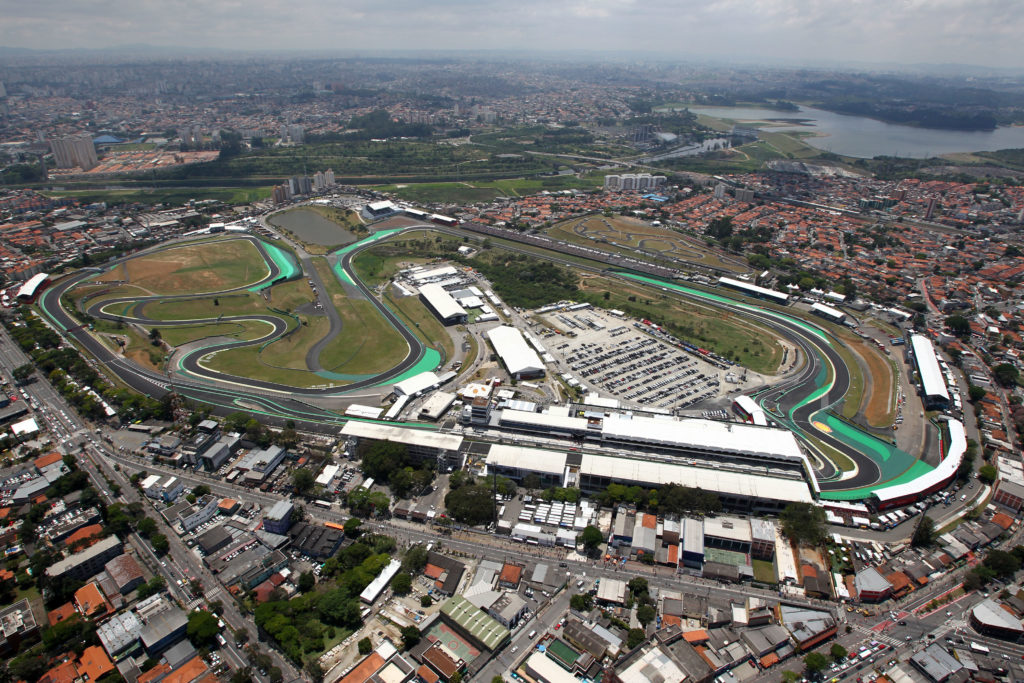
Sao Paulo sought to take the Brazilian GP back to Interlagos amid the rise of Senna, a native of the city. The track also introduced a huge change to its layout for F1’s return in 1990 as it shrank from 7.8km (4.9m) to 4.3km (2.6m). The circuit has also only changed slightly since.
Senna’s great rival, Alain Prost, was a dominant force at the Jacarepagua circuit with five of his six Brazilian GP wins. The Frenchman even earnt the nickname, the King of Rio, given his successes at Jacarepagua. Rio native Piquet was the only Brazilian driver to win at the track.
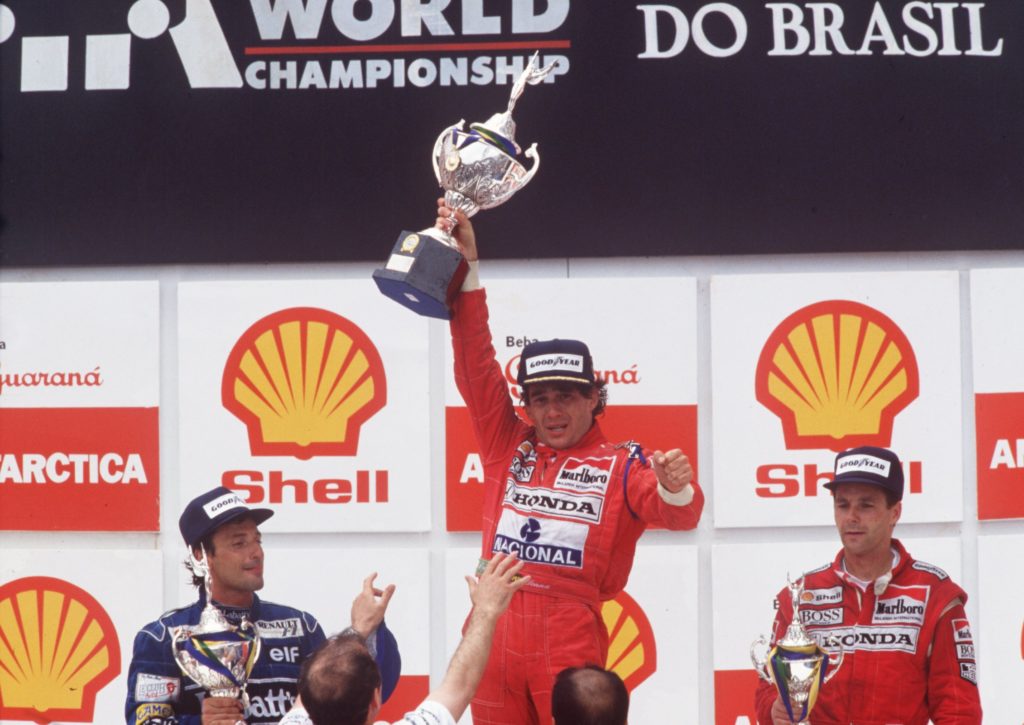
Prost also won the first Brazilian GP back at Interlagos in 1990 after Senna hit a backmarker, Satoru Nakajima, whilst leading the race. But Senna would finally claim his first home win in 1991. Yet he also had to wrestle the last laps at speed stuck in his McLaren’s long sixth gear.
Senna lost each gear except sixth when the 1991 Brazilian GP win was his to lose after Nigel Mansell spun out. Riccardo Patrese would also eat chunks of time into the home hero’s lead. But a late rain shower aided an exhausted Senna, who needed help to get out of his MP4/6.
Interlagos has produced iconic Brazilian Grand Prix and title deciders
Interlagos also played host to Giancarlo Fisichella’s remarkable Brazilian GP win for Jordan in 2003. Torrential rain flooded the track ahead of the race and 10 of the 20-strong field would retire by Lap 53. Carnage then ensued as Mark Webber lost control of his Jaguar at speed.
Webber span at 241kph (150mph) and destroyed all four corners of his car, scattering debris everywhere. Alonso would also crash out after hitting one of the Australian’s wheels, forcing the red flags. The stewards would even call the result as 75% of the race had been fulfilled.
But Raikkonen would stand atop the podium after crossing the finish line in first at the end of Lap 53. FIA rules stated that the result should be declared from two laps before the red flags flew. But Jordan appealed the result as Fisichella was 10 seconds into the Italian’s 56th lap.
Jordan won their appeal, giving Fisichella the win by 0.9 seconds to Raikkonen. Alonso also failed to make the podium in third after heading to the local hospital for checks. But he did make the rostrum in 2005 in P3 to seal that year’s championship as the youngest ever then.
The shoe was on the other foot for Alonso in 2012 when Vettel won the third of his four F1 championships, though. Alonso needed at least a top-three finish and got that with P2. But Vettel came through to finish in sixth after colliding with Bruno Senna and dropping to P22.
Vettel sustained vast damage to the side of his Red Bull after Senna, the nephew of Ayrton, pitched the German into a spin. But he worked his way back up the order to clinch the title. Raikkonen also nearly took Vettel out on L1 before he tried to go up a closed escape road.
Lewis Hamilton beat Felipe Massa to the 2008 F1 title as ‘Is that Glock?’ was born

Yet the 2012 Brazilian GP was just the latest dramatic Formula 1 title-deciding Brazilian GP. Button had pipped Vettel to the 2009 crown at Interlagos in similarly dramatic fashion. The Briton could only qualify in P14 for Brawn GP but charged through to P5 to secure the title.
Hamilton had also eclipsed Alonso as the then-youngest Formula 1 drivers’ champion at the 2008 Brazilian GP. Massa did everything the Sao Paulo native could to take the title and won from pole position for Ferrari. But a P5 finish would see Hamilton take the title by one point.
It was no easy drive to P5 for Hamilton, however, as the Briton trailed Massa, Raikkonen and Alonso for much of the race. Vettel also pressured the Stevenage native for P4 as rain fell on Lap 63 of 71. Both drivers would peel into the pit lane on Lap 66 to take intermediate tyres.
But Timo Glock electing to stay out on slick tyres moved the German up to fourth. Hamilton would also give P5 to Vettel after the McLaren driver ran wide as the rain intensified on L69. Yet the rain would come back in Hamilton’s favour when Glock lost all pace on the final tour.
Glock slowed to a crawl and Hamilton passed the Toyota driver into the final actual corner at Turn 12, Juncao. It was enough to win the 2008 F1 drivers’ title at Massa’s expense, who had already won the Brazilian GP 39 seconds ahead. One single point determined the 2008 title.
Hamilton passing Glock into Juncao also wrote Martin Brundle’s famous commentary line on ITV of, ‘Is that Glock? Is that Glock going slowly? It is! That’s Glock!’, into Formula 1’s history. While Massa showed his class on the podium as he pounded his chest with tears in his eyes.
What is the Autodromo Jose Carlos Pace (Interlagos) like?

The Autodromo Jose Carlos Pace (still commonly referred to as Interlagos) is a perfect track for the Brazilian GP, or the Sao Paulo GP as it is called today. It offers the ideal blend of tight corners, fast bends and long straights in the heart of Sao Paulo with a 43m elevation shift.
Turn 1 is the highest point of the track before a sharp downhill plunge through the Senna S – named after the 1988, 1990 and 1991 F1 champion – and onto Turn 4 down the Reta Oposta straight. The circuit then runs back up and then downhill throughout a twisty middle sector.
The middle sector ends between the tightening downhill left of Mergulho (T11) and Juncao (T12). Juncao is the final true corner of the lap as the circuit curves back onto the pit straight during the charge back up the hill through the gentle left-hand bends of Turns 13, 14 and 15.
Having such a blend of corners, long straights and elevation changes helps to see the track yield exhilarating races. Overtakes are possible at Turns 1, 4, 5, 6, 8, 9, 10, 11 and 12, as well as on the straights. Battles for places can even last from Juncao all the way to the finish line.
Last 10 winners of the F1 Sao Paulo GP
| 2015 Brazilian GP: | Nico Rosberg (Mercedes) |
| 2016 Brazilian GP: | Lewis Hamilton (Mercedes) |
| 2017 Brazilian GP: | Sebastian Vettel (Ferrari) |
| 2018 Brazilian GP: | Lewis Hamilton (Mercedes) |
| 2019 Brazilian GP: | Max Verstappen (Red Bull) |
| 2021 Sao Paulo GP: | Lewis Hamilton (Mercedes) |
| 2022 Sao Paulo GP: | George Russell (Mercedes) |
| 2023 Sao Paulo GP: | Max Verstappen (Red Bull) |
| 2024 Sao Paulo GP: | Max Verstappen (Red Bull) |
| 2025 Sao Paulo GP: | Lando Norris (McLaren) |