Lando Norris
 McLaren
 Mercedes
 Red Bull
 Ferrari
 Williams
 Racing Bulls
 Aston Martin
 Haas
Haas Alpine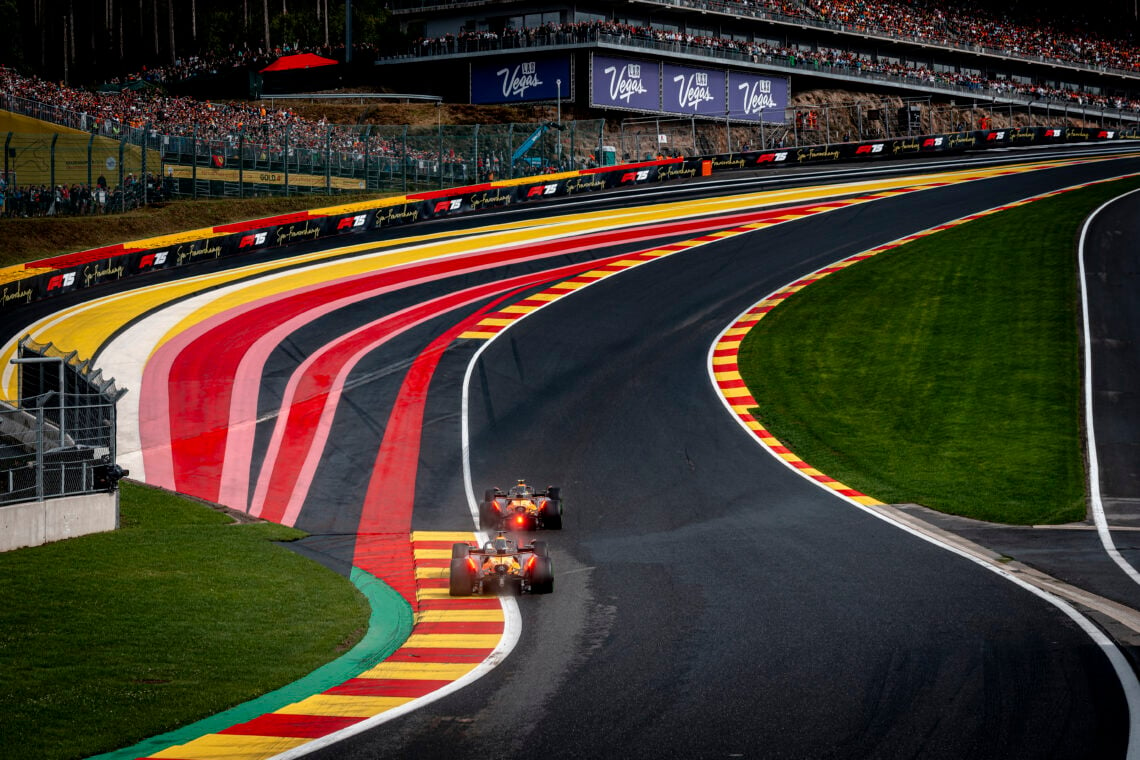


Spa-Francorchamps, the home of the Belgian Grand Prix, is one of F1’s most legendary circuits and, as such, each corner at the track has earned its own name over the years.
Few tracks in the world are steeped in as much F1 history as Spa, so the corners are not only named through numbers. Spa is also one of a select few circuits where the names of each of the turns can get hearts racing, along with Silverstone, the streets of Monaco and Interlagos.
Spa is adored among F1 drivers and fans alike for its high-speed flowing layout nestled in the Ardennes forest, even though the circuit has changed multiple times since it held the first F1 Belgian GP in 1950. Spa is also still the longest circuit on F1’s calendar at 7.004km (4.352mi).
Eau Rouge is arguably the most famous corner at Spa, although a debate often erupts when Formula 1 arrives for the Belgian GP as many mistakenly confuse Raidillon for Eau Rouge. So, with that in mind, F1 Oversteer has taken a look at how every corner at Spa earned its name.
Turn 1: La Source
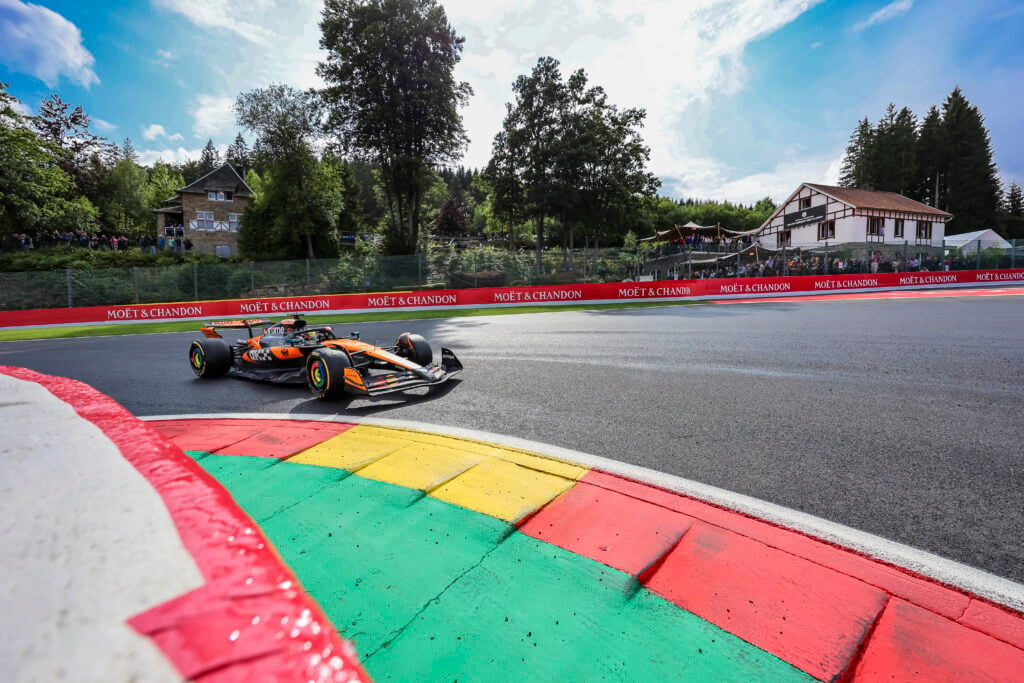
Turn 1 at Spa-Francorchamps is called La Source, and the tight right-hand hairpin is also one of the most important corners throughout the Belgian Grand Prix. La Source is often a crash point at the start of the race, as well, as drivers want to place their cars as close to the apex.
READ MORE: How every Monaco GP corner got its name, from Sainte Devote to Rascasse
The name La Source comes from its literal meaning, the source, to reference the numerous water sources around the region of the Ardennes forest in which the Spa circuit is situated.
Turns 2/3/4: Eau Rouge and Raidillon
Where do Eau Rouge and Raidillon rank among Formula 1’s best corners?
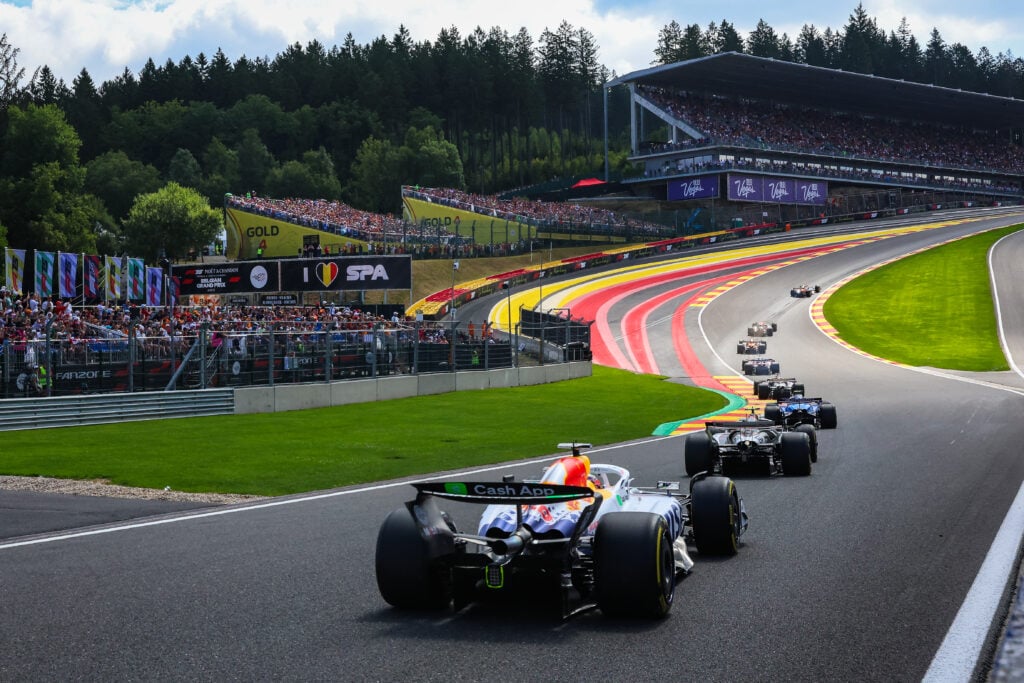
In the past, Turn 2 at Spa was denoted as the right-hand kink after the exit of La Source. But over the years, the track designated Turn 2 as the left-hand entry point to Eau Rouge, which continues through the right-hand aspect of Turn 3 and into the left-hand Raidillon at Turn 4.
Some often mistake Raidillon for Eau Rouge, but the former is only the left-hand turn at the top of the hill. As for the corners’ names, Spa gave Eau Rouge its moniker to denote the red water (due to its high iron levels) from the river that flows underneath the base of the turn.
As for Raidillon, Spa chose that corner’s name as it means steep path in French, and the top point of the iconic sequence of turns features a 15° gradient from the base to the peak. It is a real rarity among corners on the F1 calendar, and has often seen an array of huge crashes.
Kemmel Straight
After exiting Eau Rouge and Raidillon, a blast down the Kemmel Straight follows to round off the first sector at Spa. But the reason behind the name Kemmel Straight is often debated, as it is not actually believed to be a nod toward the Kemmelberg hill in West Flanders anymore.
Turns 5/6: Les Combes chicane
Spa reconfiguring its corner designations over the years has seen Turns 5 and 6 become the Les Combes chicane nowadays. The right-left chicane, where most of the overtaking during a Belgian Grand Prix takes place, earned its name as Les Combes translates as the valleys or ravines – and Turns 5 and 6 are also at the highest point of the Spa-Francorchamps circuit.
Turn 7: Malmedy
In its earliest formats, Spa-Francorchamps would stretch into the nearby towns of Malmedy and Stavelot, as it utilised the local road networks to create a 14.982km (9.309mi) track. So, when Spa first adopted a shorter track in 1979, it named what is now Turn 7 after Malmedy.
Turn 8: Bruxelles
Spa nowadays calls the long, downhill right-hand corner at Turn 8 as Bruxelles in honour of Belgium’s capital circuit Brussels. But in the past, Turn 8 at Spa was known as Rivage after a local hamlet – and many still refer to the corner as Rivage, rather than its updated moniker.
Turn 9: No Name / Speaker’s Corner / Jacky Ickx Curve
Turn 9 at Spa is regularly referred to as the corner without a name, as for many years it did not have a specific name. Over the years, Turn 9 has however been referred to as Speakers’ Corner as it was the only spot at Spa to offer the broadcast announcers a view of the track.
READ MORE: How Silverstone’s corners got their names, including Maggotts and Becketts
Today, however, Turn 9 at Spa is named Jacky Ickx Curve after the legendary Belgian driver. Ickx competed in Formula 1 between 1966 and 1979 with teams including Tyrrell, Ferrari, Brabham, McLaren, Frank Williams Racing and Lotus. Brussels native Ickx also won the 24 Hours of Le Mans outright six times between 1969 and 1982 racing in Fords and Porsches.
Turn 10/11: Pouhon
Pouhon is one of the most legendary corners at Spa-Francorchamps. It may only look like a simple double-apex left-hand corner, but it is one of the fastest corners at the circuit and is very challenging to get right in an F1 car as the kerbs can easily send a driver to the barrier.
The name Pouhon comes from its meaning, with the word loosely translating to English as the place where the water is drawn from due to the springs similar to Eau Rouge. However, Pouhon is also often referred to as Double Gauche in French as it is a double-left corner.
Turns 12/13: Fagnes / Pif-Paf
Turns 12 and 13 at Spa are yet more corners to adopt different names over the years, as the chicane is officially named Fagnes yet is also frequently called Pif-Paf. The chicane also got its official name of Fagnes for various reasons, such as the nearby Fen nature reserve in the Ardennes Forest, as well as a cross-border, domed plateau between Germany and Belgium.
As for the Pif-Paf moniker that the Turns 12/13 chicane at Spa also embraces, it is merely a colloquial slang term in French for the fast S-bend due to it being a fast change of direction.
Turn 14: Stavelot / Campus
Officially, Turn 14 at Spa is nowadays called Campus after the circuit paid tribute to the local Campus Automobile education centre. But Turn 14 at Spa is more often known by its former name of Stavelot, which reflected the nearby city that the original Spa track passed through.
Turn 15: Curve Paul Frere
Spa renamed what is now Turn 15 as Curve Paul Frere following his death in 2008. Paul Frere was a Belgian racing driver turned journalist, who raced in Formula 1 from 1952 to 1956 for HWM, Gordini and Ferrari. Frere also won the 24 Hours of Le Mans outright once for Ferrari in 1960, adding to his earlier lower-class victories during the 1953, 1955 and 1958 editions.
Turns 16/17: Blanchimont
While Blanchimont is often only regarded as the rapid left-hand Turn 17, it is actually a two-part corner starting at Turn 16. Spa gave Blanchimont its name for two reasons, firstly after the nearby town of Blanchimont, and also after a farm that used to reside near the circuit.
Turns 18/19: Bus Stop chicane
A lap of Spa concludes with the Bus Stop chicane as in the circuit’s earlier years whilst using the local roads, what now forms Turns 18 and 19 was an actual bus stop when not required for part of the track. The actual bus stop was also only officially removed in 2007 when the Spa track had yet another redesign to create space for the pit lane and start/finish straight.
Receive exclusive F1 news and updates twice a week to your mailbox