Lando Norris
 McLaren
 Mercedes
 Red Bull
 Ferrari
 Williams
 Racing Bulls
 Aston Martin
 Haas
Haas Alpine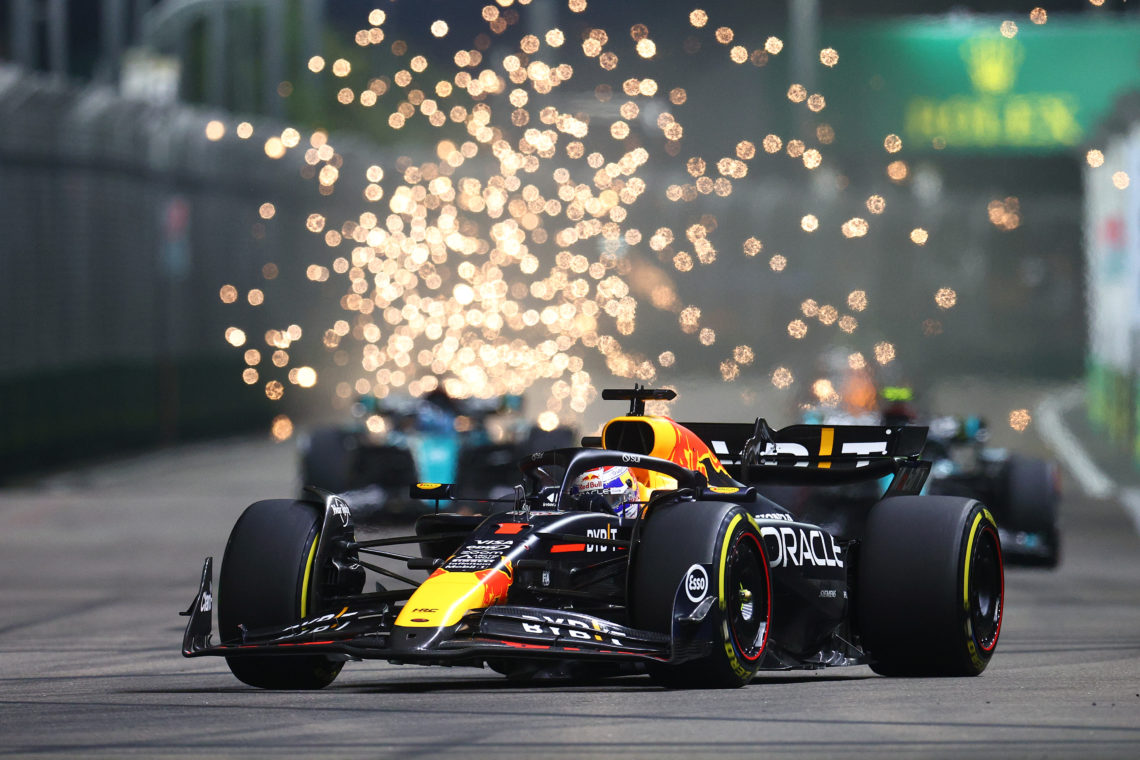


The FIA superlicence has come under scrutiny due to how it can be obtained under the current rules and how it undervalues certain series.
Put simply, any driver aspiring to get into Formula 1 needs to have a superlicence, and there are certain criteria that they have to fulfil in order to get one.
Under the current rules, a driver must accumulate 40 points over a three-year period in junior racing categories. For example, winning FRECA gets drivers 25 points, with Formula 3 giving 30 points and the full 40 points can be obtained by winning the Formula 2 title.
Points are given out depending on what position a driver finishes in a championship, but there are also other stipulations, such as needing to be 18 years old, hold an International Grade A competition license, complete 80% of two full seasons of a single-seater championship and pass an FIA theory test on the F1 sporting code and regulations.
However, as of 2024, special dispensation can be given to a driver aged 17 if they display outstanding ability and maturity. This rule came into effect after Mercedes upped their efforts to sign Andrea Kimi Antonelli as Lewis Hamilton’s replacement for 2025, which they confirmed at the Italian Grand Prix.
Max Verstappen, Kimi Raikkonen, Fernando Alonso and Jenson Button would not have qualified for a superlicence today

But according to Edd Straw on the Race F1 Podcast, the current superlicence system has been ‘corrupted’ and ‘makes no sense’ due to the fact that it undervalues certain championships in favour of others and denies drivers who clearly have the ability to race in F1 the chance to do so.
This is particularly the case with IndyCar, as Colton Herta – who finished second in the 2024 championship and has been linked with a move to F1 for some time – does not qualify for a superlicence as he has not obtained 40 points in the series, nor has he tested an F1 car in a free practice session.
The talent that is missing out on a superlicence is the reason why Straw thinks the system needs a ‘revamp’, especially when he pointed out that Max Verstappen, Kimi Raikkonen, Fernando Alonso and Jenson Button, who are all F1 champions, would not have got one under the current rules when they started their careers.
“It’s a lot like, well so many things happen in Formula 1, you take a reasonable idea and then it gets hammered into an absurd-shaped hole that makes just no sense,” he said.
“You’ve got to have a bar but when you look back, Max Verstappen wouldn’t have been eligible for a superlicence, I think under the current rules. Kimi Raikkonen wouldn’t have been.
“I don’t think Fernando Alonso would have quite made it. He was an F3000 race winner, he’d won the Euro Open by Nissan series. Jenson Button I don’t think would have made it because he finished third in British F3 and he’d done Formula Ford but nothing else.
“When you look at those case studies, you’re thinking: ‘This isn’t quite right is it?’ So, I’d like to see something more… if they’re going to have the qualification points, it needs to be revamped.”
Does the criteria to get a superlicense need to be looked at?
When you look at those examples of drivers who would not have made it to F1 under the current rules, given the quality that they have gone on to show in the sport, it can be argued that the superlicence qualifications do need to be reassessed.
Verstappen would not have qualified by just being 17 alone, but even if he was old enough, winning the Zandvoort Masters and finishing third in the Formula 3 European Championship would probably have not been enough either.
READ MORE: Red Bull driver Max Verstappen’s life outside F1 from net worth to girlfriend
Raikkonen may have just missed out with his two Formula Renault UK titles, while Alonso only won the Euro Open by Nissan title in his junior career, as well as winning a race in F3000, also denying him a superlicence under the current rules.
Button won Formula Ford, finished third in British F3 and second at the Macau Grand Prix in 1999, which also would have prohibited him from entering F1.
Given that these four went on to win seven F1 world championships between them, with Verstappen on course to add a fourth this year, a reassessment of the criteria for a superlicence may be worth considering.
Receive exclusive F1 news and updates twice a week to your mailbox