Lando Norris
 McLaren
 Mercedes
 Red Bull
 Ferrari
 Williams
 Racing Bulls
 Aston Martin
 Haas
Haas Alpine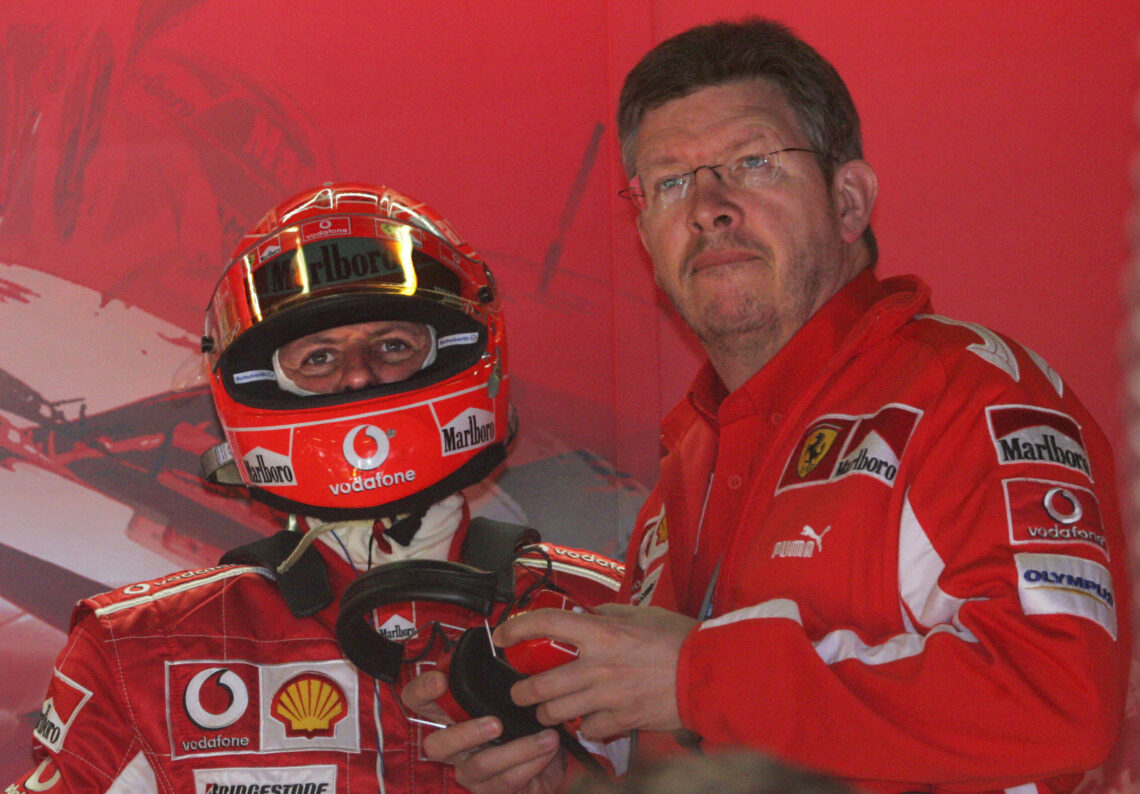


Ross Brawn was instrumental in all seven of Michael Schumacher’s F1 drivers’ titles, but he now accepts the FIA was right to ensure the Ferrari “juggernaut” was beaten.
The iconic British engineer reunited with Schumacher at Ferrari towards the end of the 1996 F1 season, following the German’s move from Benetton at the start of the year. Schumacher won his first two drivers’ titles with Benetton, where Brawn acted as their technical director.
Brawn also embraced the role of technical director at Ferrari, and his strategic nous, coupled with the work that Schumacher plus Jean Todt as the team principal carried out, helped turn the Scuderia around. Todt joined Ferrari in 1993, and he set about creating F1’s dream team.
Ferrari had not won the F1 drivers’ championship since 1979 before Schumacher secured his first title with the pride of Italy in 2000. It was a watershed moment, as Schumacher claimed five drivers’ titles in a row through 2004 – an F1 record that he alone still continues to boast.
When you think of Michael Schumacher, what is the first moment that comes to mind?
Ross Brawn admits the FIA had to change F1’s tyre rules otherwise Michael Schumacher would have kept winning
Fernando Alonso ultimately brought Ferrari and Schumacher’s dominance to an end in 2005 with the first of the Spaniard’s two successive titles. Ferrari could not compete with Renault that term after the FIA banned changing tyres mid-race, which Bridgestone struggled with.
READ MORE: Every F1 record that Michael Schumacher still holds ahead of the 2026 season
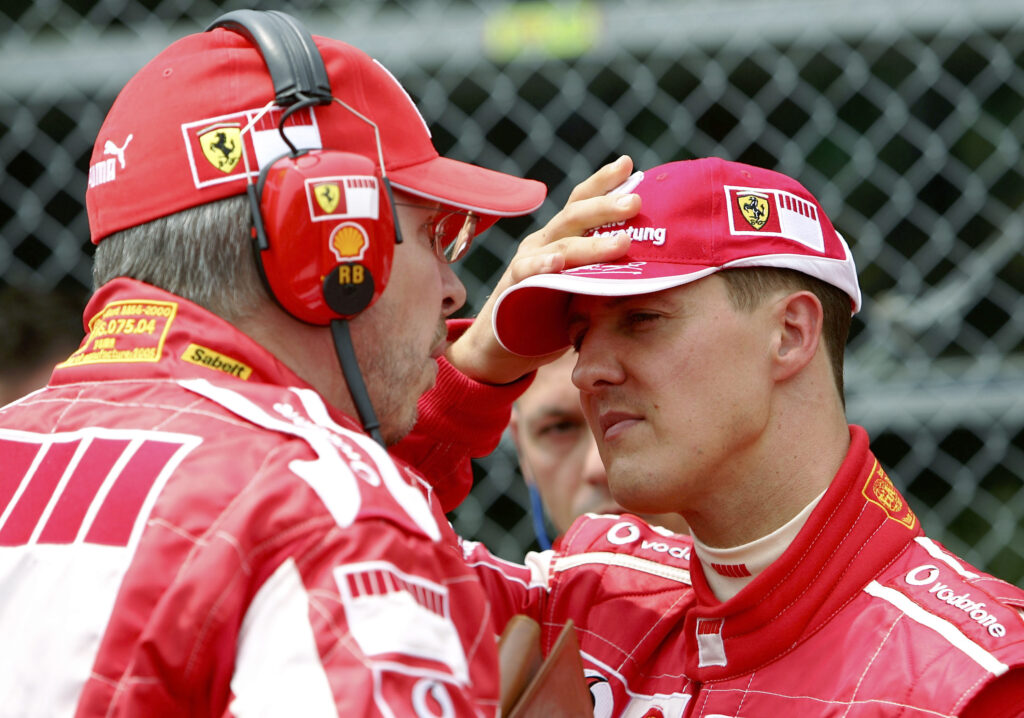
Yet Brawn admits that the FIA was right to change the tyre regulations for the 2005 season, otherwise Schumacher and Ferrari would have simply kept winning. Having worked as F1’s managing director from 2017-2022, he sees the issues that Schumacher’s success brought.
Brawn told the official F1 website: “I think the pinnacle of my time at Ferrari was the 2004 car. It all came together. The thing I loved at Ferrari was every year being better than the one before – in terms of the team, the cars we built [and] the way it was functioning.
“Every year we were chipping away at it, and every year we were making things a bit better. It culminated in the 2004 car, I think, being the best ever.
“We got screwed thereafter by the tyre regulations changing. But I think we’d become too successful, and we had to be stopped somehow. That juggernaut would not have stopped any other way, because we just had everything working so well.
“Having sat on the other side of the fence since then, I can understand the frustration of Bernie [Ecclestone], Max [Mosley] and the promoters. It was becoming a shock when we didn’t win, rather than a shock when we did win. That was a very special car.”
F1 banned changing tyres during pit stops in 2005 to end Ferrari and Michael Schumacher’s dominance
Schumacher was especially dominant in the 2002 and 2004 F1 seasons, as he won 11 of the 17 Grands Prix and 13 of the 18 Grands Prix respectively. He even finished every race on the podium in 2002 and won 12 of the first 13 races in 2004, interrupted by crashing in Monaco.
READ MORE: Everything to know about Michael Schumacher, from F1 career to net worth
What was the worst F1 race you have ever watched?

But Bridgestone could not compete with Michelin in 2005 after the FIA ruled that one set of tyres must last the full Grand Prix distance, barring any punctures or changes in the weather. Schumacher secured Ferrari’s only win of 2005 in the controversial United States Grand Prix.
Only the six Bridgestone-shod runners contested the 2005 US Grand Prix at Indianapolis, as all of the Michelin-shod drivers withdrew on the formation lap due to concerns about their tyres failing in Turn 13 after huge crashes for Ralf Schumacher and Ricardo Zonta in practice.
Kimi Raikkonen crashing from the lead of the 2005 European Grand Prix at the Nurburgring, when his right-front suspension failed after flat spotting the Michelin tyre on his McLaren, saw the FIA relent and allow teams to change tyres during a race from the 2006 campaign.
Schumacher returned to title contention in 2006, after he finished 71 points adrift as Alonso won the 2005 title, but he finished the year 13 points shy of the Spaniard. Schumacher also retired at the end of the 2006 F1 season, and Brawn decided to leave Ferrari that year, too.
Receive exclusive F1 news and updates twice a week to your mailbox