Lando Norris
 McLaren
 Mercedes
 Red Bull
 Ferrari
 Williams
 Racing Bulls
 Aston Martin
 Haas
Haas Alpine


Red Bull caught their rival F1 teams’ attention on Day 1 of the Barcelona shakedown test, as Isack Hadjar set the pace with the real version of Max Verstappen’s 2026 car.
The Milton Keynes crew were one of the seven teams that decided to run on the first day of F1’s opening pre-season test. Teams have the choice of running on any three of the five days that F1 is spending at the Circuit de Barcelona-Catalunya for a private shakedown this week.
Formula 1 is holding a behind-closed-doors shakedown at the Montmelo venue to let teams debug their new cars, as the championship enters its new era. The 2026 F1 regulations mark the biggest overhaul of the rulebook in history with new engine, aero, chassis and tyre rules.
Red Bull’s potential use of a loophole in F1’s 2026 engine rules has sparked a stir among the paddock ahead of the season, as rival teams fear they found a way to increase their rate of combustion during operation. Yet rival teams have also now noted another part on their car.
Barcelona, Day 1 done 🏁 Who’s catching your eye so far? 👇

Red Bull’s small sidepods in Barcelona have ‘baffled’ their rival F1 teams
That is according to SPEEDWEEK, which reports that rival teams are ‘baffled’ by the sidepod concept that Red Bull revealed on Day 1 of the Barcelona shakedown test this Monday. The RB22 that Hadjar set the pace in looked considerably different to the team’s initial renders.
READ MORE: Everything you need to know about the 2026 F1 engine and aero regulations
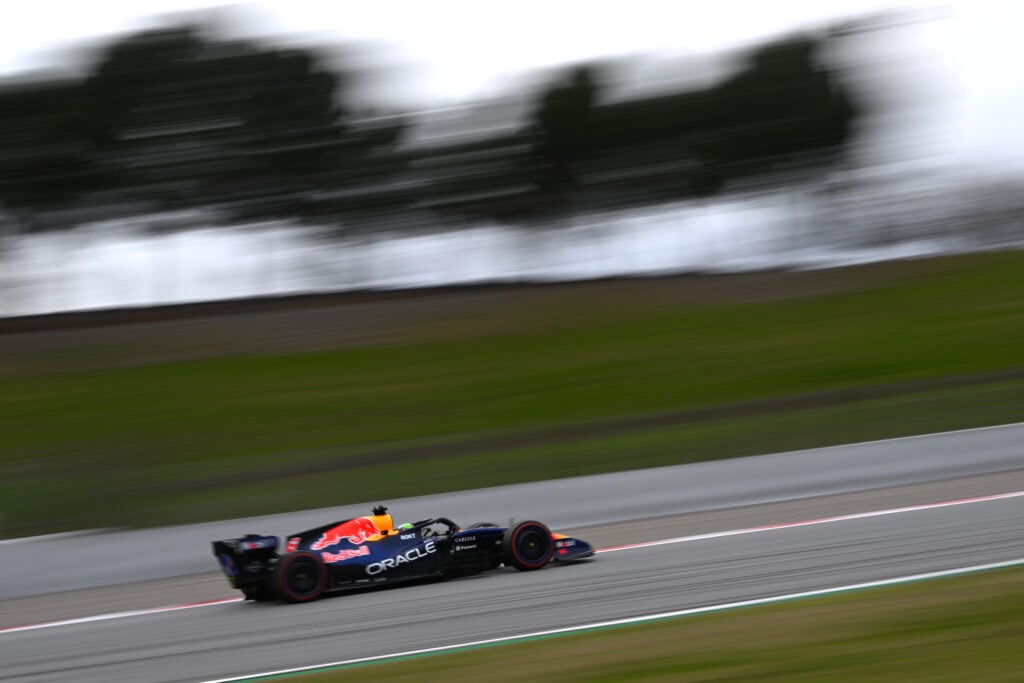
While lap times are essentially meaningless during testing, the sidepods on the RB22 caught the attention of Red Bull’s rivals as they are ‘significantly’ smaller than the renders the team used to launch the car in Detroit. The narrow design is most striking at the rear of the RB22.
Red Bull appear to have found a way to arrange their radiators and heat exchanges to allow their designs the most aerodynamic freedom to generate additional downforce in the ‘coke bottle’ area. This area refers to the lower bodywork between the floor and the engine cover.
Gary Anderson refutes suggestions that Red Bull have designed a ‘zero sidepod’ concept
What is your favourite era of F1 regulations?
Red Bull’s sidepods on the RB22 that Hadjar drove this Monday have drawn comparisons to the zero-pod concept that Mercedes created for the start of the ground-effect era in 2022. The Silver Arrows ultimately abandoned the concept in 2023, as they failed to get it to work.
Former Jordan technical director Gary Anderson does not think Red Bull’s sidepod concept for the start of the 2026 F1 rules is as extreme as a zero-pod concept. But it is clear that Red Bull did not reveal the real version of Verstappen and Hadjar’s car with their launch renders.
Anderson told The Race: “Comparing Red Bull’s initial ‘concept’ renders to the studio shots, we can see a marked difference in the sidepod size and upper surface detail.
“Could we call this a ‘zero sidepod’ solution? Well, it’s certainly smaller than most. But ‘zero’? Not really. The radiator intake is similar in size and concept to the other cars we have seen.”
Verstappen took his first laps in the RB22 on Tuesday morning, as Red Bull continued to test their new car on Day 2 of the Barcelona shakedown. The Dutchman caused the first red flag stoppage of the day after a small trip into the gravel, but he was ultimately able to continue.
Receive exclusive F1 news and updates twice a week to your mailbox