Lando Norris
 McLaren
 Mercedes
 Red Bull
 Ferrari
 Williams
 Racing Bulls
 Aston Martin
 Haas
Haas Alpine


Red Bull find themselves embroiled in a row ahead of the 2026 F1 season, after fears spread among rival teams about the use of a loophole in the new engine regulations.
Formula 1 will enter a new era in 2026, as the latest power unit rules necessitated a broader overhaul featuring new aerodynamic regulations. F1 has removed the MGU-H to reduce the costs of engines, increased the electrical power output and moved to fully sustainable fuels.
The 2026 F1 season also marks the start of a new era for Red Bull, as they will also race with an engine that they have built themselves for the first time ever. Red Bull Powertrains struck a technical partnership with Ford, as well, to gain the brand’s help with battery technologies.
What are your thoughts on Red Bull’s first new livery since 2016?
Let us know in the comments below!

Rival F1 teams suspect Red Bull’s engine loophole relates to the position of the piston
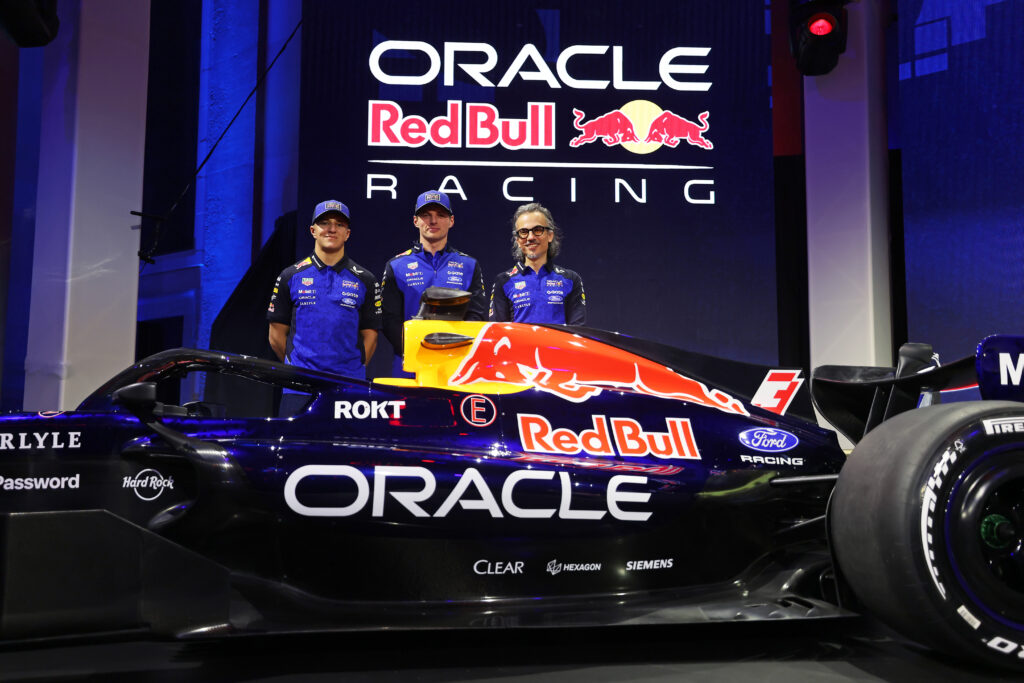
Red Bull unveiled their 2026 F1 car in Detroit on Thursday, in what was a livery launch as the real car is not set to break cover before testing. A lot of the focus in Ford’s backyard was also on the claims that rival teams fear Red Bull have found a loophole in F1’s 2026 engine rules.
READ MORE: Everything you need to know about the 2026 F1 engine and aero regulations
According to FunoAnalisiTecnica, one theory about how Red Bull have potentially gained an advantage through the 2026 engine rules has also now become the ‘most widely accepted’ among the F1 paddock. The ‘suspicion’ relates to Red Bull’s rate of compression in their ICE.
F1 has regulated a maximum compression rate of 16:1 for the 2026 engines, which the FIA will only test in static conditions. Yet there is a belief that some teams, namely Red Bull and Mercedes, have found ways to increase their rate of compression to 18:1 during operation.
Rival crews believe Red Bull’s method for increasing their compression rate during operation comes down to controlled thermal expansion of the internal components. In particular, rival teams suspect Red Bull have found a way for the piston to move closer to the cylinder head.
Red Bull engine chief Ben Hodgkinson is ‘confident’ their 2026 F1 power unit is ‘legal’
Fact or Fiction? What are your thoughts on the RBPT director’s accusation against Mercedes?
Let us know in the comments below!

The proposed loophole, relating to rule C5.4.3 of the 2026 F1 regulations, could be worth as much as three to four tenths of a second per lap. So, Audi, Ferrari and Honda have all asked the FIA for clarification, with a meeting with technical experts due to be held on January 22.
Red Bull Powertrains chief Ben Hodgkinson is adamant that his team have not done anything wrong, as their engine design satisfies the “super clear” wording of the 2026 F1 regulations. Hodgkinson also feels any rival engineers who did not spot the loophole do not belong in F1.
“It’s frustrating, really, some of this stuff,” Hodgkinson said, via The Telegraph. “For me as an engineer, it’s frustrating that the press has got hold of this.
“I think any engineer worth their salt who doesn’t understand about thermal expansion doesn’t belong in this sport. Doesn’t deserve to be an engineer, really.
“Almost every material changes with temperature. So, it’s understanding how materials behave in different temperatures, pressures, stresses [and] loads. That’s literally our job.
“The regulations are super, super clear about compression ratio. You’ve got a 16-to-1 limit. The regulations say that 16-to-1 is measured in a very specific way.
“There’s a document that describes exactly how you measure it. And it has to be measured at ambient temperature. So, it’s super clear.”
Hodgkinson has also been quoted by F1i noting that Red Bull’s power unit department have taken their interpretation of the 2026 F1 regulations “to the very limit”. But he is “confident that what we’re doing is legal”, as the specific rule is about conditions outside of operation.
Receive exclusive F1 news and updates twice a week to your mailbox