Lando Norris
 McLaren
 Mercedes
 Red Bull
 Ferrari
 Williams
 Racing Bulls
 Aston Martin
 Haas
Haas Alpine


Mercedes threw down the gauntlet at the opening round of the 2026 F1 season with a one-two finish in Australia, but their superiority over the rest of the field may actually prove to be their “biggest problem” as the season continues.
Mercedes enjoyed their best start to a new F1 season since 2019 at the weekend, with George Russell securing first-place at the Australian Grand Prix to take charge of the drivers’ championship for the first time in his career.
The Silver Arrows have clearly got the strongest power unit on the grid at this moment in time, with Ferrari indicating that they are currently second-best, with Red Bull-Ford in third.
Ahead of the new year of racing, Mercedes’ dominance was expected. Given the introduction of a new engine formula, the Brackley-based team was expected to leverage the same technical expertise they demonstrated during the previous amendments to F1 power units in 2014.
Who is going to win the 2026 F1 Chinese Grand Prix?
Let us know why in the comments!
To combat lightning striking twice for Mercedes, the FIA introduced a scheme to combat known as Additional Development and Upgrade Opportunities (ADUO).
The initiative seeks to monitor engine performance throughout the 2026 season, with formal reviews scheduled after each quarter of the season.
Engine manufacturers found to be significantly behind the competition may be granted extra resources, including cost-cap relief or additional opportunities to modify their homologated power units.
- READ MORE: Telemetry reveals Mercedes’ decisive energy advantage over Red Bull at Australian Grand Prix
Mercedes may struggle to hide their superiority before ADUO takes effect
In a recent episode of the F1 Insider podcast, renowned journalist Ralf Bach highlighted how Mercedes’ superiority could actually prove to be an issue for them going forward.
The ADUO requirements stipulate that if a team’s engine is between 2% and 4% off the fastest power unit, they can bring in one update after each quarter of the F1 calendar, while any engine that’s more than 4% slower than the best-performing power unit can bring in two upgrades.
This means that if Mercedes prove to be too far ahead in the benchmark tests, their rivals will be able to bring a swathe of upgrades at future races to try and counter them.
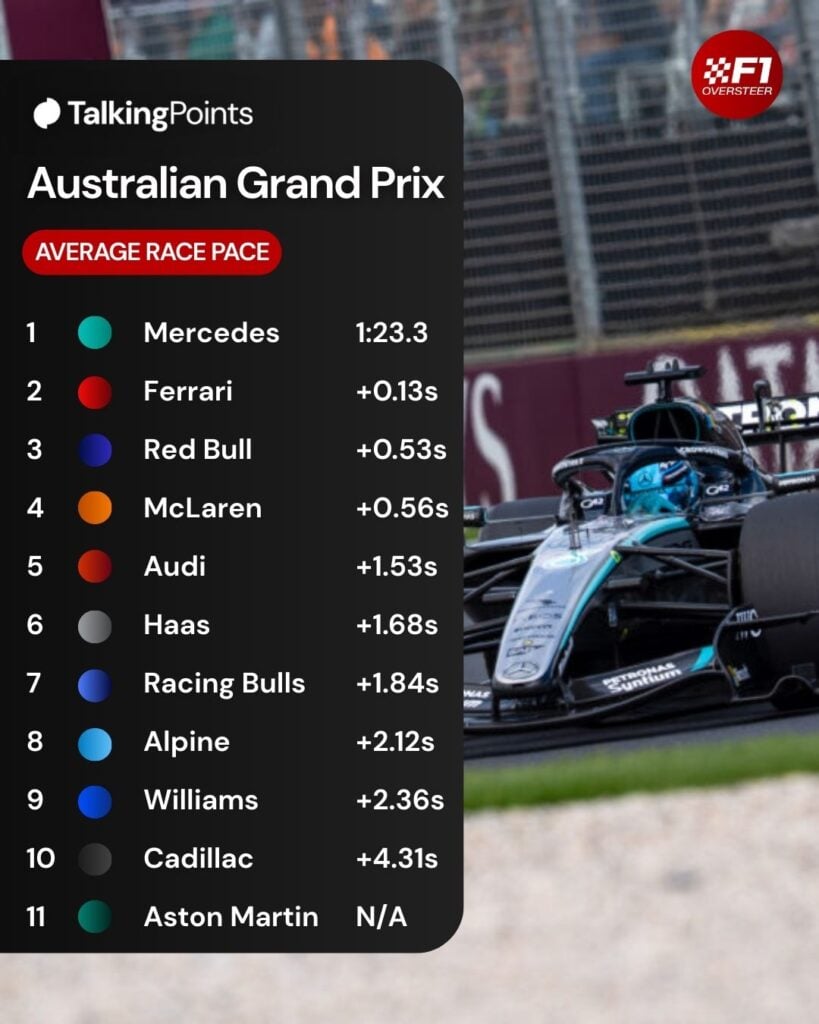
Which F1 team had the most surprising race pace data at the Australian Grand Prix?
Let us know in the comments below! Data from @FDataAnalysis
“If there are rule changes, Mercedes will still be ahead because they simply have the best people behind the scenes. I’m just saying. These are regulations for automotive companies, high-tech companies, whoever has a technological advantage,” Bach said.
“That won’t change even if you adjust the rules. The others are simply too far behind with these regulations. I don’t have to be right about that. I’m pretty sure that no matter what happens, you can’t change the rules enough to reduce Mercedes’ technological superiority.
“You might be able to reduce it a little, but from what I’ve heard, it’s so great that it will be Mercedes’ biggest problem. How much can I hide my superiority? How slowly can I drive to finish only five or ten seconds behind?
“And that’s the problem. That won’t change for me. My experience tells me that. It was the same in 2014.”
- READ MORE: Charles Leclerc hints George Russell’s defence of new F1 regulations backed by Mercedes ‘advantage’
Receive exclusive F1 news and updates twice a week to your mailbox