Lando Norris
 McLaren
 Mercedes
 Red Bull
 Ferrari
 Williams
 Racing Bulls
 Aston Martin
 Haas
Haas Alpine


Mercedes secured a dominant one-two finish at the Australian Grand Prix, but their dominance has also shown signs of vulnerability through ‘reliability issues’ that saw George Russell and Kimi Antonelli receive new engine components ahead of the race.
As per the rumours that were rampant last year, Mercedes have developed the benchmark engine at this moment in the new 2026 F1 regulatory lifecycle.
What do you expect from George Russell in the 2026 F1 season?

According to their main rivals, Ferrari, Mercedes’ new power unit is giving them somewhere around half a second of pace over the rest of the engine manufacturers.
This was evident during qualifying at the Australian Grand Prix, where George Russell ended up over eight tenths of a second faster than the next team.
Mercedes have already used fresh power unit components for George Russell and Kimi Antonelli
However, there have also been some signs of the new Mercedes power unit showing vulnerability.
According to a report by F1 Technical, the Silver Arrows’ engineers were forced to swap out some components of Russell’s power unit ahead of his win at Albert Park last weekend.
Due to the current regulations being driven by a brand-new engine formula, each driver has access to an extra component for 2026, which will then be reduced from next year onwards.
The report states that Russell’s W17 received a fresh energy store, control electronics and power unit ancillary component as a precautionary measure to ‘ensure reliability’ under such unfamiliar conditions.
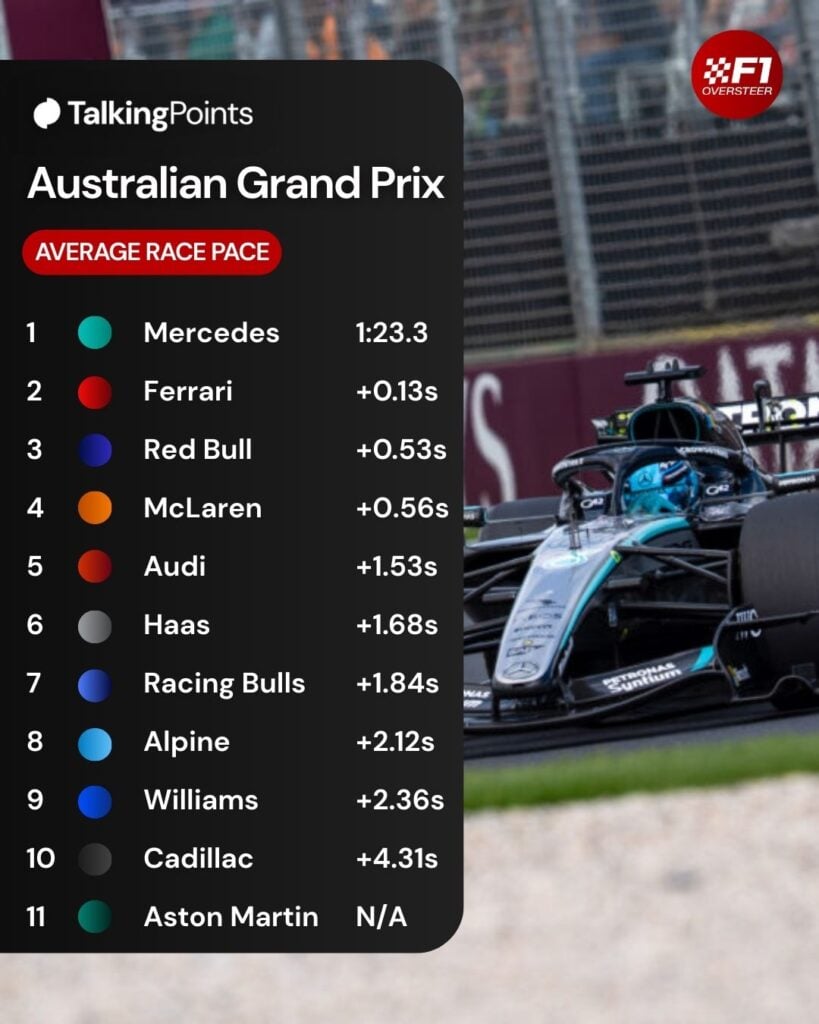
Which F1 team had the most surprising race pace data at the Australian Grand Prix?
Let us know in the comments below! Data from @FDataAnalysis
Russell was one of five F1 drivers who required new parts ahead of the season-opener, with Williams’ Carlos Sainz, a customer of the Brixworth-based engine manufacturer, needing the same new parts as the Brit.
Mercedes teammate Kimi Antonelli also received some new components ahead of the race, for the same reasons. He was fitted with two new power unit ancillary components.
Audi’s Gabriel Bortoleto and Aston Martin’s Lance Stroll required a single new ancillary component.
The Silverstone-based team are clearly at the back of the pack on the engine side of things, with it being reported that they used two out of their four allocated batteries for the whole season in Melbourne.
Aston Martin’s batteries were failing ‘en masse’ ahead of the season-opener, which is one of the many issues they currently face with Honda’s new power unit.
- READ MORE: Mercedes told why their 2026 F1 superiority is now their ‘biggest problem’ ahead of the Chinese GP
Mercedes’ early changes could haunt them at the end of the season
Changes being made this early will certainly make the rest of the season a touch more difficult for the Silver Arrows, especially if Russell and/or Antonelli are locked into a title fight in the latter stages of the year.
If it wasn’t before, management of their power units is even more of a necessity now, with there still being another 23 races left on the yearly schedule before the chequered flag falls on 2026.
Toto Wolff was over the moon with Mercedes’ reliability during pre-season testing, but things may be a little bit touch-and-go for the German constructor from here.
Receive exclusive F1 news and updates twice a week to your mailbox