Lando Norris
 McLaren
 Mercedes
 Red Bull
 Ferrari
 Williams
 Racing Bulls
 Aston Martin
 Haas
Haas Alpine


The initial data from George Russell’s race simulation during the final day of F1’s Bahrain test shows a clear deficit to his rivals on the grid, indicating that Mercedes are continuing to suffer from an issue that curtailed their campaign last year.
With Mercedes splitting the duties of their drivers equally over the entirety of the three-day test in Bahrain, George Russell was given the first run out in the W17 on the third and final day.
After Mercedes impressed the rest of the grid with their reliability in the Barcelona shakedown, it seems as if the first official test of the season has exposed some vulnerabilities of the W17, which has been built in line with the new set of F1 regulations.
With Mercedes’ compression ratio trick currently dominating the headlines, Russell’s early race simulations have indicated that Toto Wolff may have something else to worry about this season.
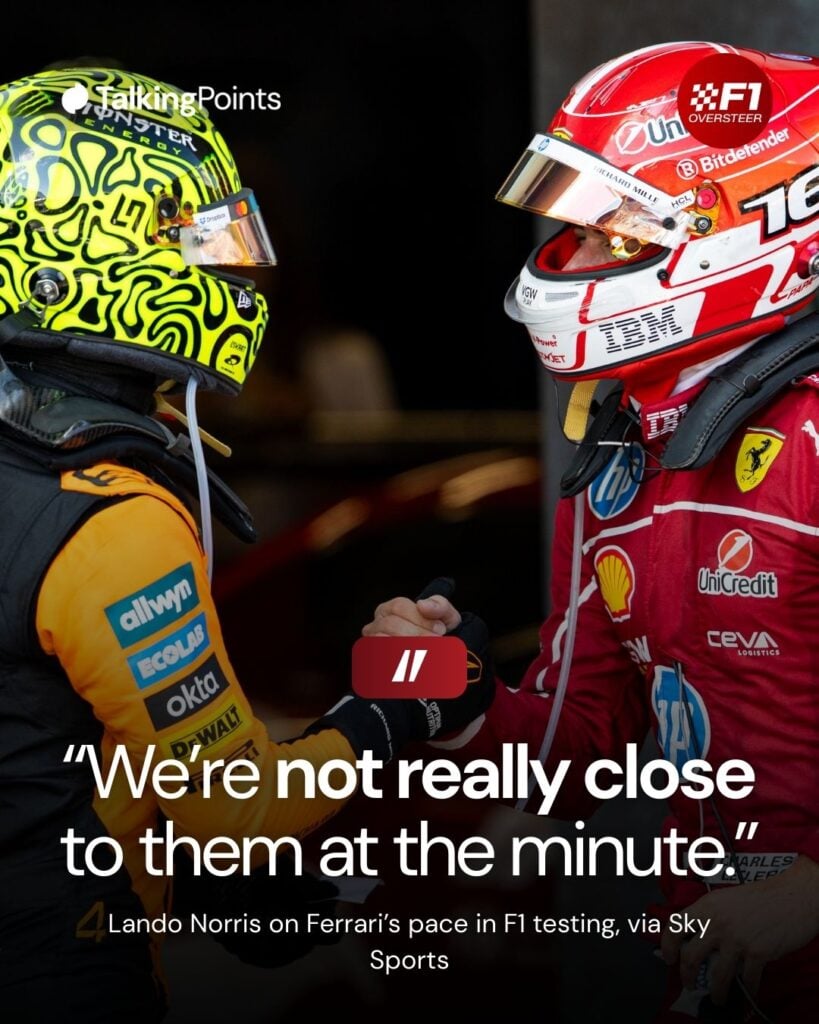
How much have Ferrari impressed you in testing?
Mercedes’ race simulations at Bahrain F1 test show a clear deficit to Red Bull and Ferrari
According to a mid-session report from Sky Sports F1, Russell’s race pace simulation on the third and final day of the first Bahrain test showed a stark deficit to the lap times that Max Verstappen and Charles Leclerc have been clocking in during their respective programmes.
The Mercedes driver completed a full Grand Prix distance with a full tank of fuel and began on the soft tyres.
Russell’s initial lap times saw him set lap times of around 1:39s, but he dropped down to the 1:41s during the latter stages of the 15-lap stint.
After bolting on a set of medium tyres for the second stint, the Briton dropped down to the 1:40s after starting in the 1:38s, which is of stark contrast to the kind of lap times that the Red Bull and Ferrari drivers were clocking in.
The report states that Leclerc was able to remain in the 1:37s consistently across several different stints, with Verstappen doing the same while also dipping into the low 1:38s.
Undesirable amounts of tyre degradation were a problem for the Silver Arrows for the entirety of the previous ground-effect ruleset, and Martin Brundle recently highlighted the potential for Mercedes to suffer from the same issue heading into the new regulations.
Helmut Marko identified the tyre degradation issue from Mercedes at last year’s pre-season test, and the Brackley-based outfit struggled all season long to find a solution to it.
- READ MORE: Ferrari SF-26 debuts ‘aggressive’ diffuser extensions to outpace Mercedes and Williams on downforce
Is Toto Wolff playing mind games with Red Bull?

Ferrari’s pace is encouraging, but they have found issues following F1 data analysis
After the disappointing 12 months that unfolded last year for the Scuderia, things have been a lot more encouraging for them during the opening week of testing in 2026.
Leclerc topped the timesheets on day two, and engineers back in Maranello are already readying a new upgrade package for the SF-26 in time for the second lot of testing in Bahrain next week.
One issue that the on-site mechanics have found relates to the SF-26’s engine braking, with it being suggested that the car reacts too aggressively when downshifting.
A ‘significant investigation’ into the issue will be carried out by Ferrari, in hopes of finding a solution to it in line with the rest of the upgrades the Prancing Horse are hoping to bring next week.
Receive exclusive F1 news and updates twice a week to your mailbox