

 Lando Norris
 McLaren
 Mercedes
 Red Bull
 Ferrari
 Williams
 Racing Bulls
 Aston Martin
 Haas
Haas Alpine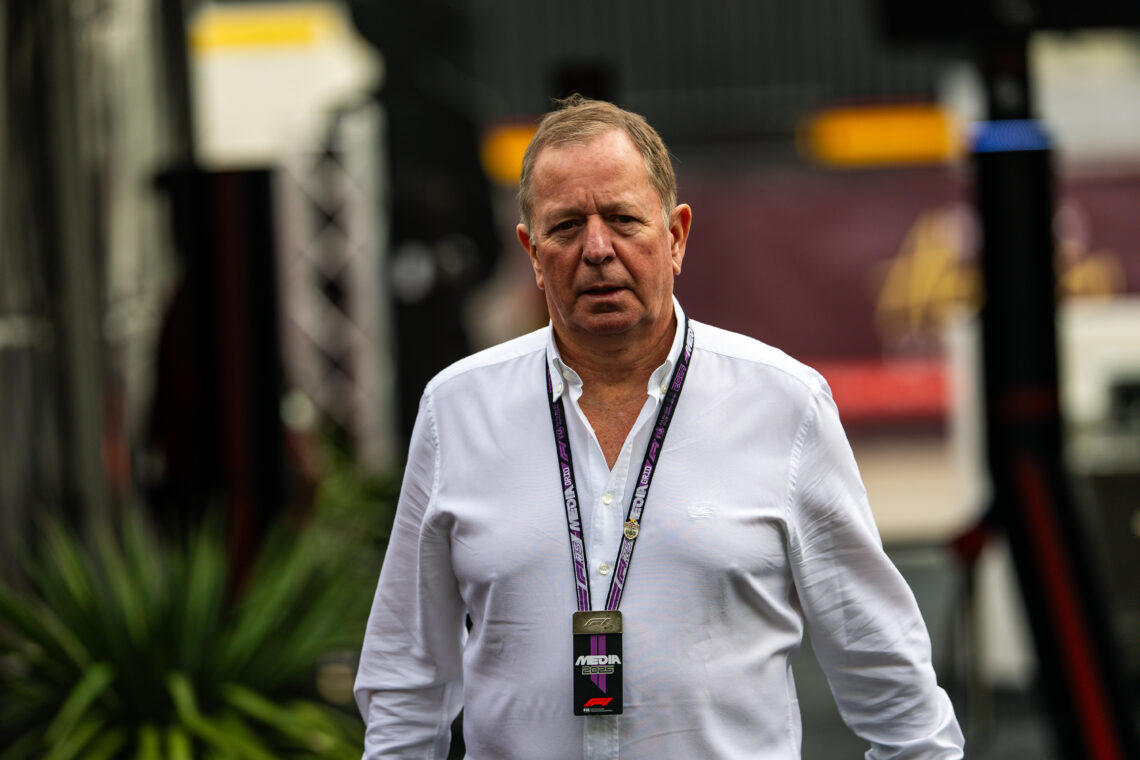

Martin Brundle has concerns about the safety of the drivers as well as the spectacle after the first of Formula 1’s new era. Brundle has been one of the biggest defenders of the controversial regulations up to this point.
The Australian Grand Prix was an entertaining race, particularly in the opening stages when Charles Leclerc battled eventual winner George Russell for the lead. Many F1 fans were unhappy after qualifying, where ‘superclipping’ impacted the traditionally flat-out session.
The weekend also featured a number of unusual crashes, including Max Verstappen’s qualifying accident and Oscar Piastri’s pre-race shunt. At the start of the race, Franco Colapinto nearly crashed into Liam Lawson as the new procedure created chaos.
Martin Brundle admits 2026 F1 cars are ‘dangerous’ in their current form
Writing on X after practice at Albert Park, Brundle said he was ‘totally relaxed’ about the new rules ‘despite all the doubts and high-level criticism’. But his tone shifted after the race weekend concluded.
Verstappen said he was no longer ‘enjoying’ F1 after qualifying, while reigning champion Lando Norris declared that the sport had swapped its ‘best’ generation of cars for the ‘worst’.
Writing in a column for Sky Sports, Brundle acknowledged that the cars are too ‘unpredictable’ in their current form. He knew the regulations were ‘flawed’ at the outset, but still found it ‘crazy’ to see drivers slowing down on straights.
“I grimace at the thought of controlling these cars on a wet day at – say – Monaco, or a Safety Car restart on a damp cold track on slicks,” Brundle wrote. “The power delivery is clearly too unsophisticated and unpredictable right now, but it will improve quickly with some proactive mindsets.
Who is going to win the 2026 F1 Chinese Grand Prix?
Let us know why in the comments!
“Many of us knew these regulations were partially flawed some years ago when announced. To triple the output of the kinetic electrical motor (MGU-K) and yet remove the very efficient generator from the turbocharger (MGU-H) was always going to make it difficult to harvest enough battery juice, especially on high speed and minimal braking circuits like Melbourne.
“But what we’ve ended up with is a car which can largely deplete all of its battery capacity in one decent straight. And a nasty knock-on effect of losing that turbo MGU-H is that standing starts have become extremely difficult to consistently deliver, and some cars are not getting off the line at all well, which is dangerous.
“I know there are several suggestions from teams, some along the lines of reducing the kinetic motor output, meaning you can deploy less battery power but for longer, and not having the crazy situation where cars are slowing down towards the end of straights with drivers actually downshifting while still flat out.”
F1 teams will need wind on their side at the Chinese Grand Prix
Looking ahead to the second leg of the back-to-back in China this weekend, the 1.2-km back straight is a cause for concern. It will be the longest full-throttle stretch the new cars have encountered.
Teams will be scrambling for a way to conserve enough energy for that full-throttle blast. Brundle quipped that they may need ‘a stiff tail wind’ to help them out.
He wrote: “Given all we have learned in Oz I would expect the cars to function a step better in a few days time in China, but that massively long back straight is going to cause some energy problems and complaints. Let’s hope there’s a stiff tail wind.”
As Brundle says, the learning curve for teams and drivers is extremely steep at the moment, so the product should look more refined in a few races’ time. There is a willingness to tweak the rules early in the season in order to preserve the driving and viewing experience.
Receive exclusive F1 news and updates twice a week to your mailbox


