Lando Norris
 McLaren
 Mercedes
 Red Bull
 Ferrari
 Williams
 Racing Bulls
 Aston Martin
 Haas
Haas Alpine


Since George Russell was disqualified from the Belgian Grand Prix for his car being underweight, there have been a lot of theories as to why it happened.
Russell converted to an unusual one-stop strategy midway through the race after discussing with the team whether it was viable over the radio.
His lap times appeared to hold up as his second stint on the hard tyre went on, while feedback from Mercedes teammate Lewis Hamilton also helped the team decide to go with the strategy.
After the regular post-race checks took place by the FIA, Russell’s car was found to be 1.5kg under the 178kg minimum. As this was a breach of the F1 technical regulations, Russell was disqualified and victory was inherited by Hamilton with Charles Leclerc promoted to third.
There have been some question marks over whether Russell would have had a performance advantage from his underweight car, which enabled him to pull off the unlikely strategy. Former F1 driver Karun Chandhok has shared what he was told by the team that debunks this theory when speaking on X (formerly Twitter).
Karun Chandhok shares what Mercedes told him about George Russell’s car
In the immediate aftermath of the disqualification, Mercedes team principal Toto Wolff issued a statement saying they “clearly made a mistake” with their pre-race calculations.
The win did kick off several conspiracy theories that his performance could only be tied to the fact that he was running with an underweight car.
Chandhok was told by Mercedes engineers an important factor that debunks the theory that Russell was running with a weight advantage throughout the race.
“Merc told me yesterday that the issue seems to be from wear & tear from extending the 2nd stint. Cars were identical at the start. Even if you say .03 x 16 laps extra GR did = less than half a second so no real performance advantage because LH caught him anyway but couldn’t pass,” wrote Chandhok.
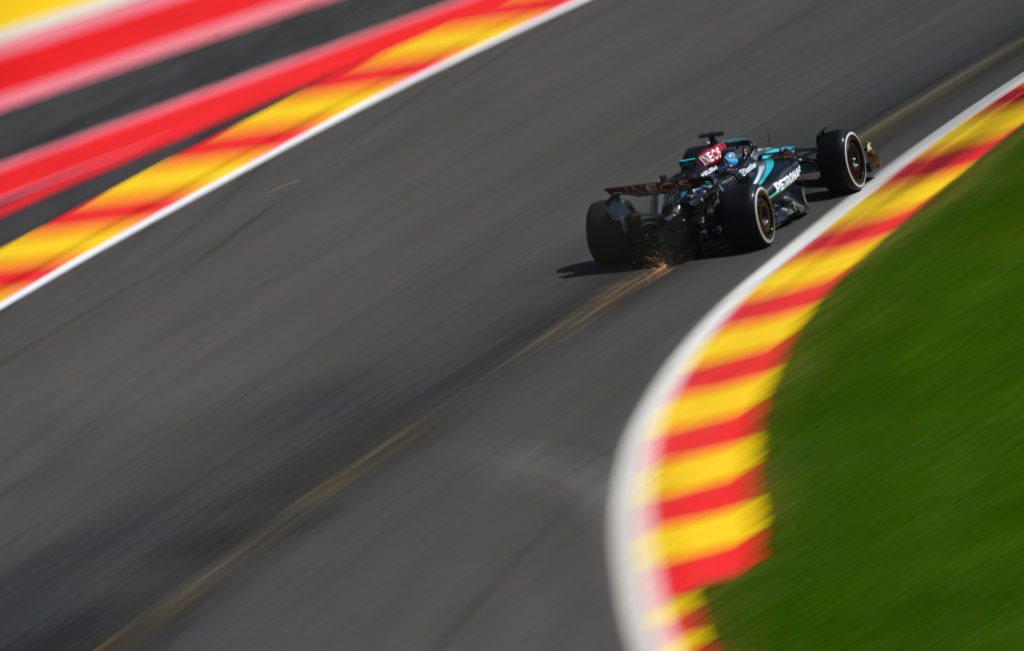
Several theories on why George Russell’s Mercedes was underweight
There have been several theories as to why Russell’s Mercedes was 1.5kg under the weight limit after the race, but it is accepted that the tyre strategy played a critical role.
Trackside engineering director Andrew Shovlin said Mercedes will investigate what happened but initially believed the “loss of rubber from the one-stop” caused the problem.
Pirelli’s director of motorsport, Mario Isola, also offered three factors on why Russell might have been under the weight limit due to the unique conditions at Spa Francorchamps.
READ MORE: Mercedes driver George Russell’s life outside F1 from net worth to height
Due to the long lap at Spa, drivers are told to U-turn into the pit lane straight after the race instead of completing a cool-down lap. This prevents them from having an opportunity to pick up tyre ‘marbles’ at the end of the race to add extra weight to the car.
Mercedes also made a key specification change to their car’s floor between Friday and Saturday. With the lack of dry running before the cars were put into Parc Ferme, it was likely a multifaceted issue that led to the miscalculation of the car’s overall weight for the race.
Receive exclusive F1 news and updates twice a week to your mailbox