McLaren
 Mercedes
 Red Bull
 Ferrari
 Williams
 Racing Bulls
 Aston Martin
 Haas
Haas Alpine


Ferrari made some revolutionary changes to their car ahead of the 2025 Formula 1 season and the arrival of Lewis Hamilton from Mercedes.
Team principal Fred Vasseur admitted before the season started that Ferrari were only going to retain 1% of their previous car, which came within 14 points of winning the constructors’ championship.
It’s safe to say that with the summer break close to coming to an end, this season hasn’t gone to plan for the Scuderia.
McLaren are on the verge of winning another championship, and while Ferrari are still second in the standings, they’re not going to close a nearly 300-point gap in the next 10 race weekends.
Ferrari hope suspension changes made this season will benefit them in 2026, but that means the rest of this season could still be painful.
| RANK | DRIVER | WINS |
| 1 | Michael Schumacher | 72 |
| 2 | Niki Lauda | 15 |
| 3 | Sebastian Vettel | 14 |
| 4 | Alberto Ascari | 13 |
| =5 | Felipe Massa | 11 |
| =5 | Fernando Alonso | 11 |
| 7 | Kimi Raikkonen | 10 |
| 8 | Rubens Barrichello | 9 |
| 9 | Charles Leclerc | 8 |
| =10 | Jacky Ickx | 6 |
| =10 | Gilles Villeneuve | 6 |
Lewis Hamilton is still searching for his first Ferrari podium finish, while Charles Leclerc will wonder how he didn’t win the Hungarian Grand Prix after somehow finishing P4.
F1’s regulations change in 2026, but that didn’t stop the FIA from making rule changes heading into this season.
F1 technical expert Matthew Somerfield believes that one directive in particular harmed Ferrari far more than ‘most people’ realise.
READ MORE: All you need to know about Scuderia Ferrari from team principal to factory
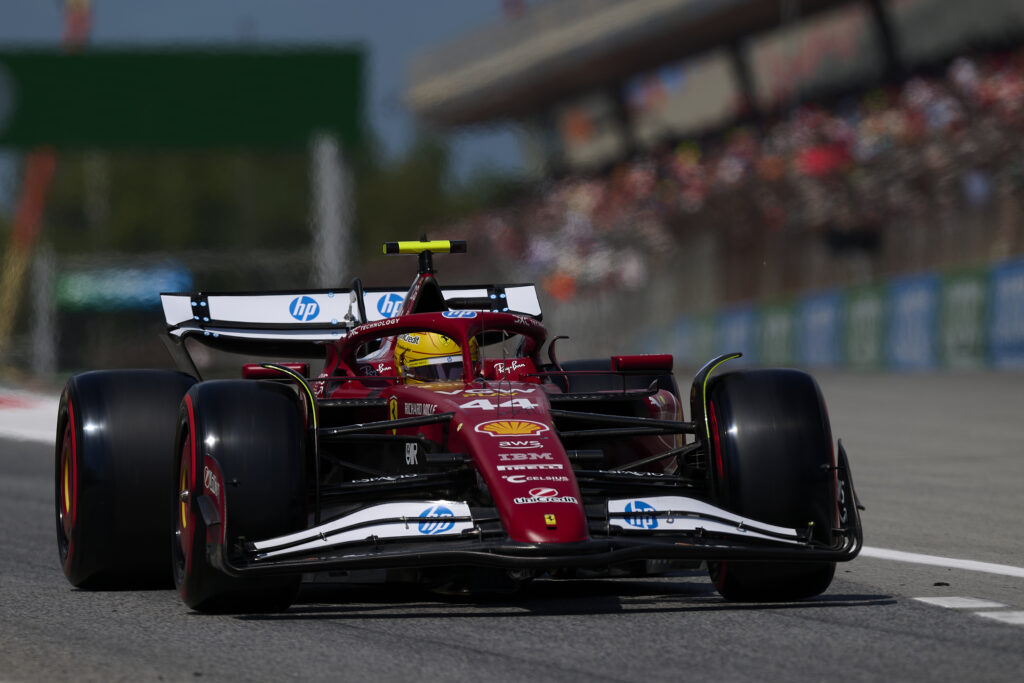
Ferrari hurt by Spanish Grand Prix front wing directive more than ‘most people’ believed
Somerfield was speaking about Ferrari’s struggles on the Missed Apex Podcast and said: “If we look at Ferrari’s development this season, they bought a big package in Bahrain, so ahead of the already talked about Spanish Grand Prix situation.
“And unfortunately, that floor didn’t really provide the results that they were looking for, but they persevered with it because they believed it had more performance in hand than the old design.
“They’ve also been pretty proactive when it comes to rear wing design choices and bringing new rear wings to circuits to have more options at their disposal.
“So, different downforce levels, etc. But I do really think that they were perhaps more than most people have appreciated by the Spanish Grand Prix change to the front wing deflection tests.
| Position | Constructors' Standings | Points |
| 1 | McLaren Racing | 559 |
| 2 | Scuderia Ferrari | 260 |
| 3 | Mercedes-AMG Petronas | 236 |
| 4 | Red Bull Racing | 194 |
| 5 | Williams F1 Team | 70 |
| 6 | Aston Martin F1 Team | 52 |
| 7 | Stake F1 Team Kick Sauber | 51 |
| 8 | Racing Bulls | 45 |
| 9 | Haas F1 Team | 35 |
| 10 | Alpine F1 Team | 20 |
“They certainly made a big choice in terms of the design side of things when they made that change. They moved over to the more outwashed design front wing. So that also meant that, well, we’ve got to make some other changes.
“And then that led them into more changes later down the line, i.e. the rear suspension, which has been much talked about, but hasn’t probably given them the results that they were ideally looking for because of the situation we’ve already talked about with feel with McLaren and Mercedes and even Red Bull have had that problem as well.
“And they had another entire new floor, the front structure, the underfloor and the diffuser at the Austrian Grand Prix. So all that development they did earlier in the season was sort of washed away by the front wing deflection test coming in.
“They needed a new floor to counteract that; they had the new rear suspension. It’s sort of like a cyclic situation with Ferrari. They’ve not really moved anywhere in the pack in terms of their performance.
“But I think it’s because they lost some and they’ve had to re-recover that through other outside situations occurring, i.e. the front wing deflection test situation and their lack of correlation with the first floor update.”
READ MORE: Who is Ferrari team principal Fred Vasseur? Everything you need to know
Ferrari struggles at the Spanish Grand Prix make sense after front wing directive
Before the season started, many people were questioning why the FIA weren’t introducing their tougher front wing flexing tests for the opening race in Australia.
Stricter rules on the flexibility of the rear wing were introduced as quickly as the Chinese Grand Prix, with Alpine particularly impacted.
The Spanish Grand Prix saw Hamilton qualify ahead of Leclerc, with the Monegasque driver focusing on Sunday’s performance rather than one-lap speed.
| RANK | DRIVER | TEAM | POINTS |
| 1 | Oscar Piastri | McLaren | 25 |
| 2 | Lando Norris | McLaren | 18 |
| 3 | Charles Leclerc | Ferrari | 15 |
| 4 | George Russell | Mercedes | 12 |
| 5 | Nico Hulkenberg | Sauber | 10 |
| 6 | Lewis Hamilton | Ferrari | 8 |
| 7 | Isack Hadjar | Racing Bulls | 6 |
| 8 | Pierre Gasly | Alpine | 4 |
| 9 | Fernando Alonso | Aston Martin | 2 |
| 10 | Max Verstappen | Red Bull | 1 |
It worked for Leclerc, as he finished on the podium, while Hamilton was overtaken by Nico Hulkenberg and had to settle for sixth.
Hamilton was heard complaining on the team radio, which wasn’t unique to the Circuit de Catalunya, but highlighted that the car was becoming more difficult to drive.
A new rear suspension has been introduced in recent races that Ferrari hope will help them close the gap to McLaren, but they were far more penalised by front wing changes earlier in the year that might have made that gap unassailable.
Receive exclusive F1 news and updates twice a week to your mailbox