Lando Norris
 McLaren
 Mercedes
 Red Bull
 Ferrari
 Williams
 Racing Bulls
 Aston Martin
 Haas
Haas Alpine


Ferrari driver Charles Leclerc helped Pirelli to conclude its latest test of F1’s 2026 tyre range at the Hungaroring on Wednesday in a mule version of the Scuderia’s 2025 car.
Pirelli hired the home of the Hungarian Grand Prix out for two days of testing following last Sunday’s race, as the Italian manufacturer tried to simulate the stresses that F1’s regulation changes will yield next term. Further tests are also due at Monza, Mugello and Mexico City.
The 2026 engine and aerodynamic regulations will be the biggest overhaul of F1’s rulebook so far. They will also see Pirelli bring 18-inch tyres that are 25mm narrower at the front and 30mm narrower at the rear. Pirelli plans to homologate its 2026 tyre range by December 15.
Wednesday’s test was interrupted as Alpine’s Franco Colapinto crashed at the Hungaroring’s Turn 11 during Pirelli’s 2026 tyre test. The Argentine and Pierre Gasly were due to share the Alpine A525, but Colapinto’s crash meant the Enstone outfit had to withdraw from running.
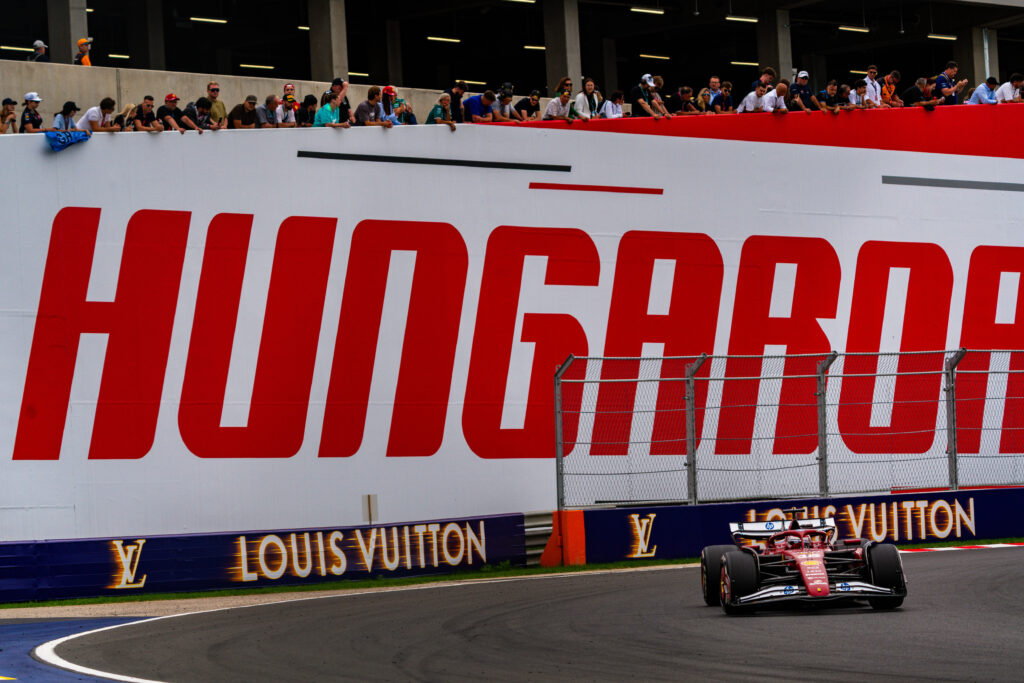
Charles Leclerc set the pace as Franco Colapinto crashed in Pirelli’s 2026 F1 tyre test in Hungary
Colapinto’s crash left Leclerc with the Hungaroring to himself in the afternoon session, with Ferrari running a modified version of their car for the 2025 F1 season to help Pirelli prepare for F1’s 2026 regulation changes. Yet both drivers completed qualifying runs in the morning.
READ MORE: Everything you need to know about F1’s 2026 engine and chassis regulations
| TEAM | ENGINE |
| Red Bull | Red Bull Powertrains (in partnership with Ford) |
| Ferrari | Ferrari |
| McLaren | Mercedes |
| Mercedes | Mercedes |
| Aston Martin | Honda |
| Racing Bulls | Red Bull Powertrains (in partnership with Ford) |
| Haas | Ferrari |
| Williams | Mercedes |
| Alpine | Mercedes |
| Audi | Audi |
| Cadillac | Ferrari |
Pirelli produced a mixed run plan with Leclerc and Colapinto pushing its 2026 C3, C4 and C5 tyres to assess their performance. While the engine modes Ferrari and Alpine used for their simulations are unspecified, Leclerc and Colapinto’s fastest laps were 1:19.407 and 1:20.270.
Colapinto only completed a total of 25 laps before his crash, while Leclerc recorded 144 laps after also completing race simulations in the afternoon. Conditions, which ranged from 21°C to 29°C, were comparable with Tuesday’s test for Lando Norris, Liam Lawson and Paul Aron.
The McLaren and Racing Bulls drivers plus Alpine reserve driver also completed a similar run plan to what Pirelli planned for Leclerc on Wednesday. Norris, Lawson and Aron also tested Pirelli’s 2026 C3, C4 and C5 tyres with various runs in conditions ranging from 21°C to 31°C.
Alpine reserve driver Paul Aron set the fastest lap across Pirelli’s 2026 F1 tyre test in Hungary
Norris and Aron respectively used modified mule versions of McLaren and Alpine’s 2023 F1 cars during Pirelli’s tyre test at the Hungaroring on Tuesday. Lawson drove a modified mule version of Racing Bulls’ car used during the 2024 F1 season to help simulate the 2026 rules.
While engine modes are again unconfirmed, McLaren ace Norris’ fastest lap in Pirelli’s 2026 tyre test was 2.578 seconds slower than his 2023 Hungarian GP qualifying lap which put the Briton P3 on the grid. It was even 3.859s slower than his time in Q3 for P3 at the 2025 race.
Norris’ fastest lap on Tuesday of a 1:19.272 along with Lawson’s 1:19.510, and Leclerc’s best lap on Wednesday of a 1:19.407, were even slower than Alpine reserve driver Aron’s fastest effort with a 1:18.789. The 21-year-old Estonian would be the only driver to lap in the 1:18s.
Pirelli will now review the data it collected at the Hungaroring to further refine the tyres the Italian manufacturer will then look to test at Monza, Mugello and Mexico City later this year. F1 will continue to use six different tyre compounds ranging from C1 to C6 in the 2026 term.
Receive exclusive F1 news and updates twice a week to your mailbox