Lando Norris
 McLaren
 Mercedes
 Red Bull
 Ferrari
 Williams
 Racing Bulls
 Aston Martin
 Haas
Haas Alpine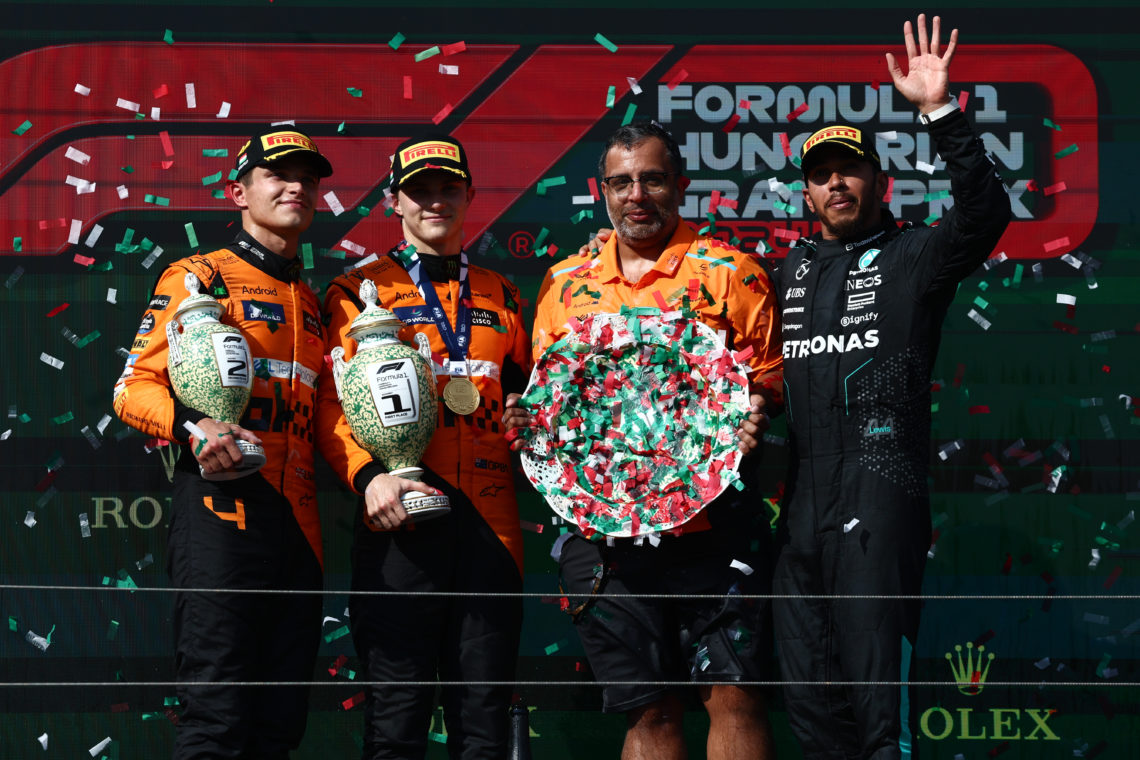

Team orders have existed in Formula 1 since the start of the championship in 1950, and they have proven controversial when they have decided the outcome of a race.
When F1 started, team orders were often a case of drivers swapping their car for their teammate’s because of a mechanical problem and enabling them to win a race.
Ferrari once told Luigi Musso to hand his car over to Juan Manuel Fangio at the 1956 Italian Grand Prix. Musso refused and, instead, Peter Collins had to hand his car to Fangio, which enabled the Argentine to secure the 1956 F1 drivers’ championship.
Nowadays, F1 teams use orders to instruct their drivers not to race each other, either in a bid to secure a guaranteed race win or to influence the outcome of a championship.
At the 2024 Hungarian Grand Prix, McLaren made a strategic error by pitting second-placed Lando Norris before leader Oscar Piastri during the final pit stops.
This enabled Norris to undercut his teammate and take the lead but, after some pleading from the team, the Briton agreed to give the lead back to Piastri for the Australian to take his first Grand Prix victory.
With that in mind, here are six other notable examples of when team orders have been used to determine the outcome of an F1 race.
1979 German Grand Prix – Clay Regazzoni told to hold station over Alan Jones
During the 1979 German Grand Prix, Clay Regazzoni was instructed by the Williams pit crew not to attack his teammate Alan Jones for the lead despite being ahead in the championship.
Jones went on to win the race by 2.9 seconds from Regazzoni, yet it would be Jody Scheckter who would win the title at the end of the season with 51 points compared to Jones’ 40 points.
1998 Belgian Grand Prix – Damon Hill makes a proposition to Jordan
The 1998 Belgian Grand Prix was eventful, not least because of the massive pileup that occurred within the first few meters that almost wiped out the entire field in the very wet conditions.
Both Jordans driven by Damon Hill and Ralf Schumacher emerged unscathed, and later found themselves leading the race following an infamous collision between Michael Schumacher and David Coulthard.
While leading, Hill came over the team’s radio to make a proposition to Jordan, who stood a chance of securing their first race win as a team.
Hill said: “I’m going to put something to you here, and I think you’d better listen to this. If we race, if we two race, we could end up with nothing. So, it’s up to Eddie [Jordan]. If we don’t race each other, we’ve got an opportunity to get a first and second. It’s your choice.”
Jordan subsequently ordered Ralf Schumacher not to pass Hill to ensure the 1-2 finish. After the race, Michael Schumacher bought out his brother’s contract for £2 million and told team owner Eddie Jordan that he would never race for the team again.
1999 German Grand Prix – Mika Salo denied first F1 win
Mika Salo was given a call-up midway through the 1999 F1 season after Michael Schumacher broke his leg in a crash at Silverstone racing for Ferrari.
During the 1999 German Grand Prix, Salo was leading the race when Ferrari instructed him to move aside for teammate Eddie Irvine to help his chances in the drivers’ championship battle with Mika Hakkinen.
Salo obliged and gave up what would have been his only F1 victory in 109 races, while Irvine failed to win the championship that year.
2002 Austrian Grand Prix – Ferrari orchestrate an F1 farce
Perhaps the most controversial team orders decision of all came during the 2002 Austrian Grand Prix.
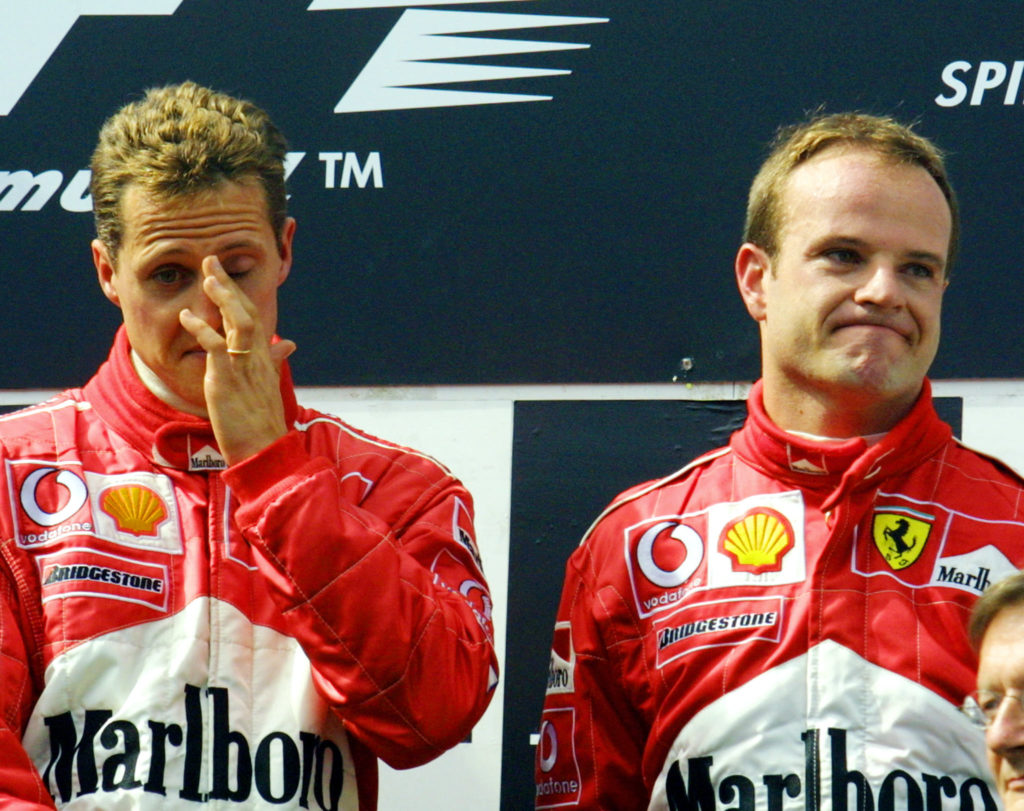
Rubens Barrichello had qualified on pole and was leading for most of the race. But on the 63rd lap, Ferrari team principal Jean Todt ordered Barrichello to move aside for Michael Schumacher to improve the German’s position in that year’s drivers’ championship.
Despite initially saying he would not relinquish the place, Barrichello let Schumacher pass around 90 meters before the chequered flag. The Brazilian’s late move conjured an image whereby both Ferraris effectively passed the finish line in unison, with Schumacher taking the win.
It left a sour taste among F1 fans, with the majority booing and jeering the Ferrari team. An embarrassed Schumacher let Barrichello onto the top step of the podium and handed him the winner’s trophy, leading to a £800,000 fine by the FIA for each and the team.
Team orders that interfere with a race result were then subsequently banned by the governing body, although they were later permitted once again.
2010 German Grand Prix – Felipe Massa is told, ‘Fernando is faster than you’
The next time team orders would come into the spotlight was during the 2010 German Grand Prix, when Felipe Massa was leading a race for the first time since his comeback from a freak accident in 2009.
The Ferrari driver was leading the race when Ferrari instructed him to pick up the pace over teammate Fernando Alonso.
After failing to improve his lap times, Massa’s engineer, Rob Smedley, came over the radio and delivered the infamous line: “Fernando is faster than you. Can you confirm you understand that message?”
It was effectively telling Massa to move over for Alonso and, moments later, the Brazilian eased back and allowed the Spaniard past to go on and win the race.
Although team orders were banned at the time, Ferrari argued that it did not issue an overt ‘directive’ to Massa and merely pointed out that his teammate was quicker.
The episode led to the team orders rule being lifted by the FIA for the following season after they admitted they were not working under their current form. Former Ferrari team principal Todt was the President of the FIA at the time.
2025 Italian Grand Prix – McLaren order Oscar Piastri to give Lando Norris P2
McLaren also created further team order drama with Piastri and Norris at the 2025 Italian Grand Prix, which ultimately secured the latter three extra points that saw him win that year’s drivers’ title.
With Ferrari rival Charles Leclerc gaining from behind, McLaren asked Norris to let Piastri pit first on the provision that the Australian would not undercut the Briton for P2. But while Norris obliged, he emerged behind Piastri after having a slower pit stop.
So, McLaren told Piastri to give P2 in the Italian GP back to Norris, which the Australian eventually agreed to after initially questioning the order as he felt pit stops would not necessitate team orders. Piastri struggled to get over the team order, as well, as his title bid fell apart thereafter.
Piastri started the race at Monza boasting his biggest lead atop the drivers’ standings all year at 34 points over Norris and 104 over Red Bull rival Max Verstappen. Yet Norris went on to win the 2025 title by just two points over Verstappen and 13 over Piastri.
Receive exclusive F1 news and updates twice a week to your mailbox