Lando Norris
 McLaren
 Mercedes
 Red Bull
 Ferrari
 Williams
 Racing Bulls
 Aston Martin
 Haas
Haas Alpine


Damon Hill had a fairly unusual career for a Formula 1 world champion, getting his first chance in the sport as a 32-year-old in 1993 with Williams.
The Brit joined the legendary F1 team after fellow compatriot Nigel Mansell had a dispute with Williams over the signing of Alain Prost. Not wanting to work with the Frenchman, the 1992 champion left the team, opening the door for Hill.
Prost would win his fourth and final title in 1993, while his rookie teammate collected three wins and finished third. The following year, he would challenge for the title, but controversially missed out to Michael Schumacher.
| Grand Prix | 115 |
| Wins | 22 |
| Podiums | 42 |
| Pole Positions | 20 |
| Fastest Laps | 19 |
| Points | 360 |
| Championships | 1 (1996) |
The German deliberately crashed into Hill at the final race in Adelaide, taking both cars out of the race and confirming Schumacher as the champion. Williams did not challenge the result, leaving Hill to settle for second.
He would finish runner-up to Schumacher again in 1995, before he got the better of the German the following year to clinch his first and only world championship. 1996 would be the final year that he would drive competitive machinery, as Hill bizarrely ended up at the back of the grid for the next season.
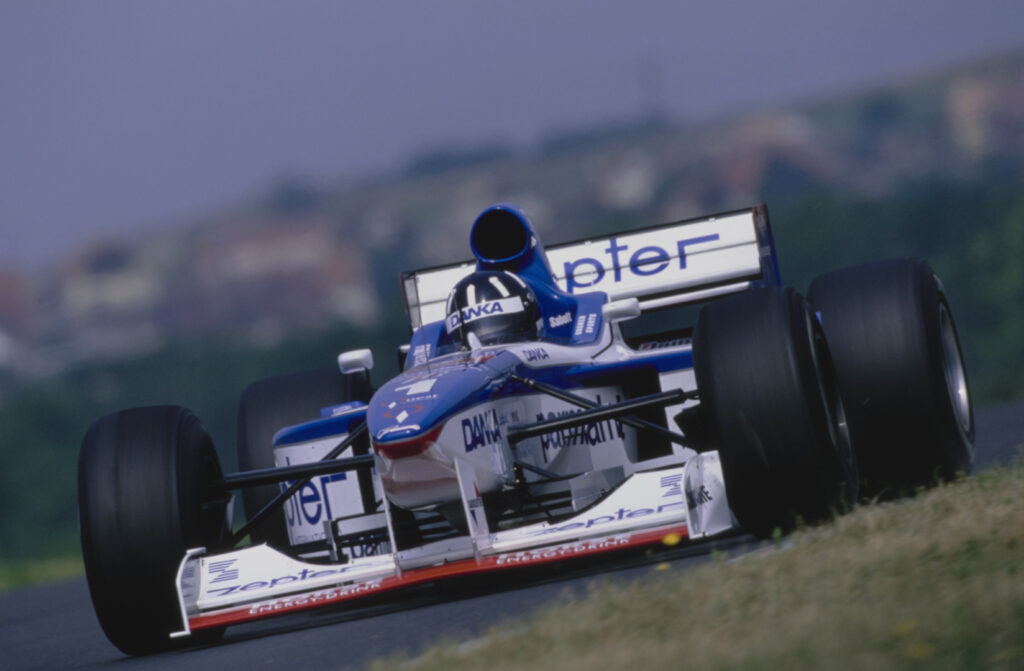
Damon Hill could only laugh as a hydraulics issue cost him a historic win at the 1997 Hungarian GP with Arrows
Despite being the defending world champion, Hill left Williams in 1997 and joined backmarkers Arrows. Previously known as Footwork, the Leafield-based team spent the majority of their history at the back, with a best finish of fifth in the standings in 1988 with 23 points; a feat they would never beat.
The minnows grabbed one pole position and nine podiums in their history, but never reached the top step of the podium. Hill would come tantalisingly close at the 1997 Hungarian Grand Prix.
Qualifying a hugely impressive third, Hill passed Jacques Villeneuve and Schumacher in the early stages and looked set to pull off one of the greatest upsets in F1 history. However, with a handful of laps to go, Hill’s hydraulics failed and left him coasting in his A18.
Villeneuve passed Hill for the win on the final lap, but the Brit miraculously kept the car going to finish second. The Brit could only laugh after the race as he heartbreakingly missed out on an incredible result.
“The hydraulics went and I couldn’t change gear,” he explained to Motor Sport Magazine. Then the throttle wouldn’t work either, because that was operated by the hydraulics. I was just stuck in fifth gear.
“There was no way I could make it go any faster. I couldn’t rev the engine, I couldn’t change gear, I just had to tug along. I didn’t think I was going to make it to the finish.”
“I remember thinking, ‘B——-!’ But then you think, ‘Second ain’t bad, I suppose.’ I don’t think anyone felt that we’d been cheated. You had to laugh really, because we shouldn’t have been there in the first place. The person who was more gutted than anyone was poor old Jackie Oliver.
“It was a race to remember, and a lot of people still talk to me about it. At that time I was in negotiation with McLaren for 1998, so the next thing to do was phone up Ron Dennis and say, ‘There you go!’ But that didn’t really work out.”

Damon Hill enjoyed his time at Arrows despite dropping from the front of the grid to the back
Hill would not score points for Arrows again after the Hungarian GP before leaving for Jordan the following season. Despite being a huge downgrade on Williams, he embraced the opportunity at Leafield as he did not want to take a year out of racing.
“I regarded Arrows as a one-year holding opportunity,” he said. “Tom [Walkinshaw] offered me the best deal. I didn’t want to take a year out, so I thought I’d give Arrows a go: if it comes off, great, I’ve got a good team; if it doesn’t, I’ve got to jump.
“I knew I was with a team that had little hope of doing anything, but you don’t say so at the time. You just think, ‘Well, it’s the best option I have at the moment, let’s make the most of it.’ Really, the Yamaha project was always going to be difficult.
“But the basis of the A18 wasn’t bad: it was an old Benetton design that Frank Dernie kind of took with him. The fundamental balance was quite good, and the Yamaha engine was very light. And with the Bridgestones there was always going to be a chance they’d get it right”
“For a team that was hanging on by its fingernails, it was a real lifeline. The car was very easy to drive, and you could take a lot of liberties with it.
It just lacked horsepower and downforce. But John Barnard introduced some changes which beefed it up in a few places, and we just approached the racing as an opportunity to take some chances and have some fun.”
Receive exclusive F1 news and updates twice a week to your mailbox