Lando Norris
 McLaren
 Mercedes
 Red Bull
 Ferrari
 Williams
 Racing Bulls
 Aston Martin
 Haas
Haas Alpine


| First held: | 1959 |
| Times held: | 46 |
| Circuit: | Circuit of the Americas (COTA) |
| Circuit length: | 5.5km (3.4m) |
| Laps: | 56 |
| Most wins: | 6x Lewis Hamilton (2007, 2012, 2014, 2015, 2016, 2017) |
The United States Grand Prix has discontinuously appeared on the Formula 1 calendar since 1959. The Circuit of the Americas in Austin has also hosted the round since the 2012 season.
F1 returned to America in 2012 after a four-year hiatus with the series’ sixth different circuit since 1959. Sebring International Raceway in Florida held the inaugural United States GP but lost the race to Riverside International Raceway in California as Formula 1 returned in 1960.
Yet F1 did not settle at Riverside and moved the race to Watkins Glen in 1961. It would settle at the New York track until 1980, as well. But the United States lost its round of the calendar until Phoenix hosted a street race from 1989 to 1991. F1 also moved to Indianapolis in 2000.

History of the F1 United States GP
Formula 1 was not the first motorsport series to contest the United States Grand Prix as the race’s name dates back to 1908. The US GP was also not the first American round to feature on a Formula 1 calendar. But the 1959 US GP was the first US GP to be part of an F1 season.
America actually held the third-ever race as part of a Formula 1 world championship in 1950 when the Indy 500 counted towards the championship. The Indy 500 also continued to be a part of Formula 1 until 1960. Yet not every driver who competed in the Indy 500 entered F1.
The United States GP has since had a stable spot on the Formula 1 calendar since it became the series’ flagship American race. Several F1 races held in the USA have also embraced the names of the cities hosting the round like the Miami GP and the Las Vegas GP most recently.
F1 also awarded the United States GP the final race of the 1959 season when Jack Brabham, Stirling Moss and Tony Brooks could all still claim the title. A fourth-place finish would prove to be enough for Brabham to clinch the title as Bruce McLaren won his first Grand Prix in F1.
McLaren also became the youngest F1 Grand Prix winner at 22 years, three months and 12 days old. It was a record the Kiwi held until Fernando Alonso won the 2003 Hungarian GP at 22 years and 26 days. But the promoter for the 1959 United States GP did not share his joy.
What is the Circuit of the Americas like?
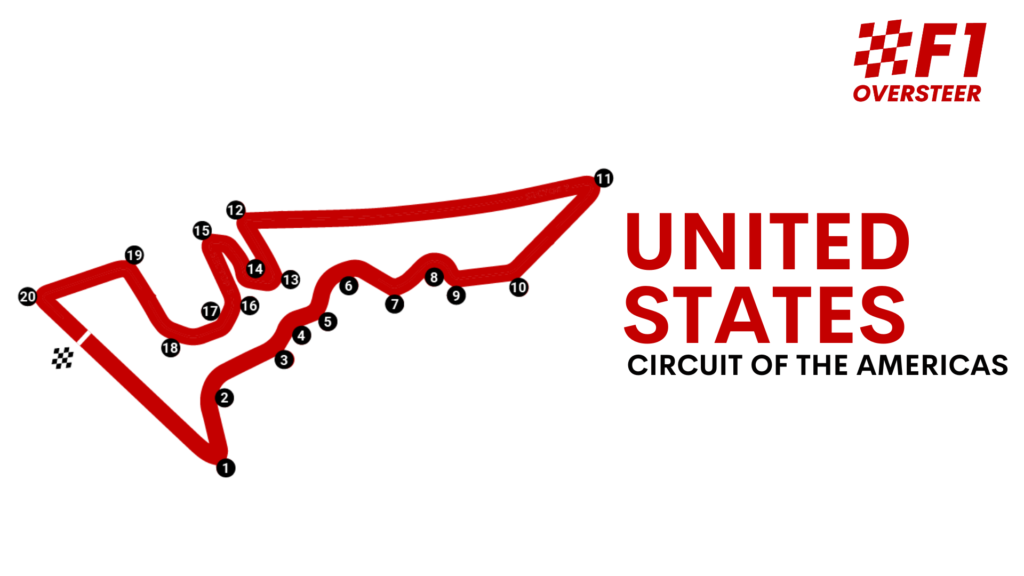
The Circuit of the Americas is one of the most complete tracks in Formula 1 and the perfect home for the United States Grand Prix. It delivers F1 everything that the series needs for exciting races and a venue for supporters to visit in one of the most reputedly cool cities in America.
A lap of COTA starts with a 133-foot climb from the start line to the 90-degree hairpin left Turn 1. A quick burst back down the hill then flows into the section of the track inspired by Silverstone and Suzuka. The fast-flowing corners gradually tighten to slow the F1 cars down.
The 1.2km (0.7mi) long back straight of COTA then awaits and provides the best overtaking spot into Turn 12. COTA took further inspiration from Hockenheim’s stadium sequence for Turns 12 to T15. While Istanbul Park’s Turn 8 inspired the multi-apex T16-17-18 at COTA.
Last 10 winners of the F1 United States Grand Prix
| 2015 United States GP: | Lewis Hamilton (Mercedes) |
| 2016 United States GP: | Lewis Hamilton (Mercedes) |
| 2017 United States GP: | Lewis Hamilton (Mercedes) |
| 2018 United States GP: | Kimi Raikkonen (Ferrari) |
| 2019 United States GP: | Valtteri Bottas (Mercedes) |
| 2021 United States GP: | Max Verstappen (Red Bull) |
| 2022 United States GP: | Max Verstappen (Red Bull) |
| 2023 United States GP: | Max Verstappen (Red Bull) |
| 2024 United States GP: | Charles Leclerc (Ferrari) |
| 2025 United States GP: | Max Verstappen (Red Bull) |
Sebring and Riverside failed to help F1 capture the United States
Sebring, which stages the prestigious 12 Hours of Sebring endurance race, did not seize the hearts of the American public. Neither did F1’s only visit to Riverside in 1960. But Formula 1 found its first real home in the States at Watkins Glen, which also embraced regular tweaks.
The New York circuit stayed on the Formula 1 calendar until 1980, when Alan Jones rounded out Williams’ inaugural title-winning season with the win. The Australian had already sealed the drivers’ title but shone at Watkins Glen to recover from the rear of the field after Lap 1.
Watkins Glen firmly helped Formula 1 to establish its presence in the United States and pave a route for localised races in Long Beach, California and the Caesars Palace GP in Las Vegas. But Formula 1 would only hold three actual United States Grand Prix between 1981 and 1999.
The United States GP even returned to F1 for the first time since 1991 in 2000 with a return to Indianapolis. But rather than re-embracing the Indy 500 for the schedule, Formula 1 took to the famous Speedway’s Grand Prix Road Course that splits off from the rectangular oval.
Tyregate at the 2005 United States GP ruined F1’s reputation in America
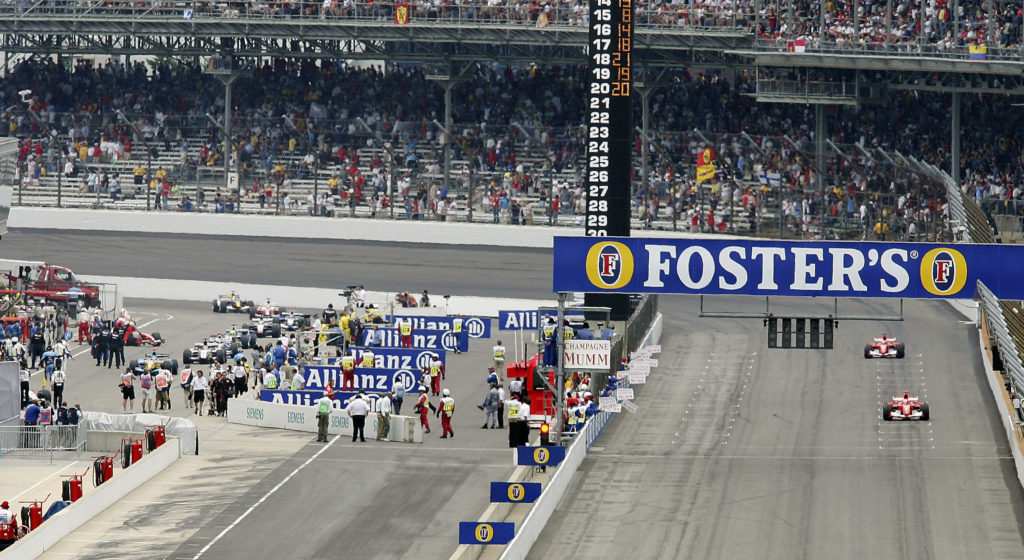
Yet Indianapolis would later host one of Formula 1’s most controversial races in 2005. It was later dubbed Tyregate after all of the Michelin runners retired after the formation lap. Only the six Bridgestone-shod drivers started the 71-lap event from a field of 20 Formula 1 cars.
F1 continued to visit Indianapolis for two more years but the fallout of Tyregate had ruined the series’ reputation in America. The Circuit of the Americas in Austin, Texas would help F1 restore its image, though, when it became the latest home of the United States GP in 2012.
A record 250,000 Formula 1 fans packed into Indianapolis across the 2005 United States GP weekend as Michael Schumacher and Ferrari fought with Alonso and Renault for that year’s championship. But the events of Sunday, June 19 ruined all of Formula 1’s USA momentum.
Resurfacing works at the banked Turn 13, which forms Turn 1 of the Indy 500 oval, created a more abrasive surface. But Ralf Schumacher suffered a huge crash through the corner as his Toyota’s left-rear Michelin tyre failed. His replacement, Ricardo Zonta, also suffered a failure.
Michelin did not understand why its tyres were failing through Turn 13, so flew out a second specification of tyre. But the new rubber still suffered the same problems, so Michelin asked the FIA to introduce actions to slow the field through Turn 13. Yet the plea was unsuccessful.
Without a compromise, the 14 drivers using Michelin tyres peeled into the pit lane after the formation lap. The full grandstands also erupted in boos as the six Bridgestone drivers took the start. Only Ferrari pair Schumacher and Rubens Barrichello also finished on the lead lap.
The Circuit of the Americas put Formula 1 back on the American map
Formula 1 was desperate to rebuild the audience it had started to grow in the United States after the fallout of Tyregate. But its efforts to have a race in New Jersey with the Manhattan skyline in the background never got off the ground. Yet Austin would get F1 back to the USA.
The purpose-built Circuit of the Americas gave Formula 1 its new home for the United States GP in 2012. It also proved an instant hit with fans and drivers after taking inspiration from an array of iconic tracks, like Silverstone’s Maggots-Becketts sequence and Suzuka’s Esses.
COTA now provides around $1m (£800k) to the local economy in Texas thanks largely to the success Formula 1 has had. Performances by Taylor Swift, Justin Timberlake, Bruno Mars and Britney Spears have also helped the United States GP to grow F1’s American audience.
The circuit has also become one of many where Lewis Hamilton has dominated and it even yielded his final win for McLaren. The Formula 1 legend won the 2012 United States GP in a great battle with Sebastian Vettel, going past the German by just millimetres on the straight.
Receive exclusive F1 news and updates twice a week to your mailbox