Lando Norris
 McLaren
 Mercedes
 Red Bull
 Ferrari
 Williams
 Racing Bulls
 Aston Martin
 Haas
Haas Alpine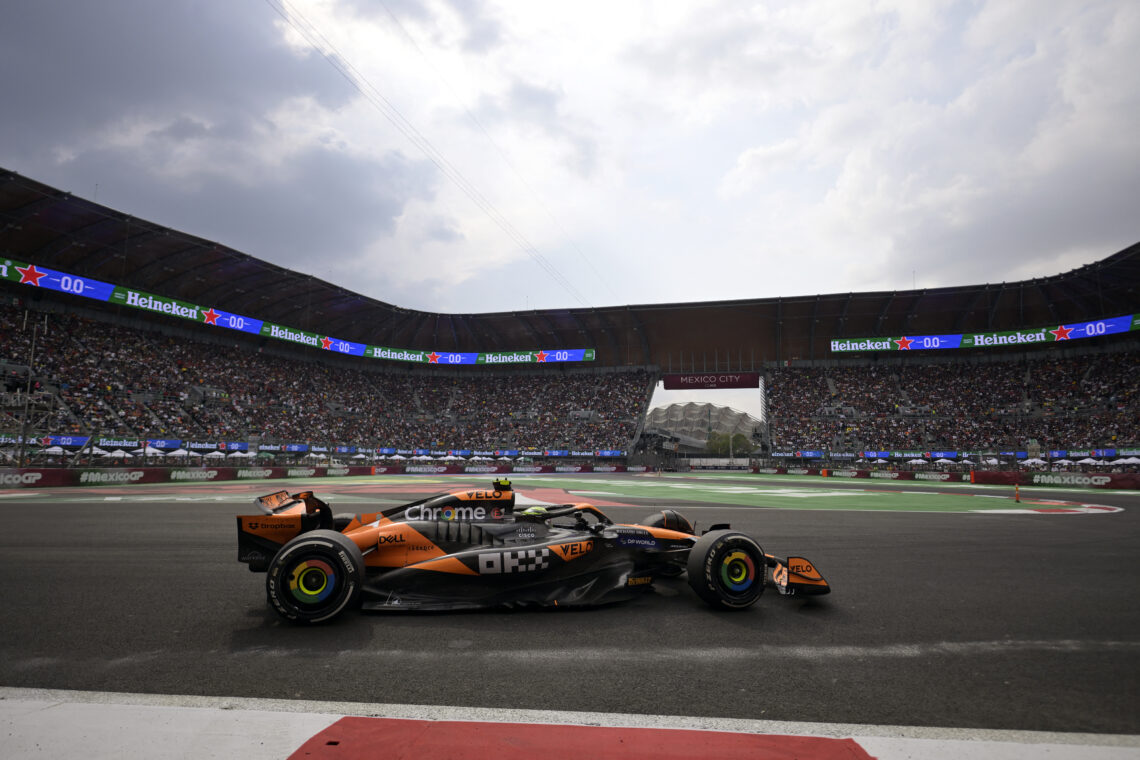


| First held: | 1963 |
| Times held: | 25 |
| Circuit: | Autodromo Hermanos Rodriguez |
| Circuit length: | 4.3km (2.6m) |
| Laps: | 71 |
| Most wins: | 5x Max Verstappen (2017, 2018, 2021, 2022, 2023) |
The Mexico City Grand Prix is a race that has been held discontinuously on the F1 calendar since 1963. The race also changed its name from the Mexican Grand Prix in 2021 to reflect the increased local financial support involved in staging the event.
Formula 1 has always raced at one circuit whenever the series has visited Mexico, however, with the Autodromo Hermanos Rodriguez. The track has also embraced many versions since F1’s inaugural visit after removing its infamous Peraltada final corner for F1’s return in 2015.
The Autodromo Hermanos Rodriguez even welcomed F1 to Mexico for the first time in 1962 for a non-championship round. It had only opened in the Magdalena Mixhuca public park in 1959, too. The track later changed its name to honour two of Mexico’s most revered drivers.

History of the F1 Mexico City Grand Prix
Formula 1 drivers and teams faced a unique challenge at the inaugural Mexican GP whilst it was a non-championship race in 1962. The Autodromo Hermanos Rodriguez offered a fresh challenge with the circuit 7,340ft above sea level and having a rapid 180-degree final corner.
The track being in a public park also presented a problem as the shifting soil made for a very bumpy surface. But Formula 1 returned to the track in 1963 for its first championship race in Mexico. The Mexican GP in 1964 would also decide that year’s drivers’ championship battle.
Jim Clark knew what it took to master the Autodromo Hermanos Rodriguez after winning in 1962 and 1963. But John Surtees beat Clark and Graham Hill to the championship by just a point when Ferrari ordered Lorenzo Bandini to let his teammate through to finish in second.
Surtees and Bandini making the podium also secured Ferrari the constructors’ championship as Dan Gurney claimed one of the American’s four Grand Prix wins. American Richie Ginther also won the Mexican Grand Prix in 1965 for Honda’s first victory after leading for every lap.
What is the Autodromo Hermanos Rodriguez like?

Former President of Mexico, Adolfo Lopez Mateos, ordered the Magdalena Mixhuca track to rename the circuit as the Autodromo Hermanos Rodriguez in appreciation of brothers Pedro and Ricardo Rodriguez. Pedro Rodriguez also won the first race ever the circuit held in 1959.
Changes over the years have moved the circuit away from the internal road network of the public park into the racing circuit it is now. But it has retained most of its original identity as a Grand Prix track, over 2km (1.2m) above sea level in the capital and largest city of Mexico.
A lap of the circuit begins with a 1.2km (0.7m) pit straight, before the heavy braking zone of the Turn 1-2-3 chicane. The path into Turn 1 is also the main overtaking point from the start of the race to the chequered flag thanks to the vast slipstream effect and lower air pressure.
Overtakes are also possible into the T4-5 chicane. But the Autodromo Hermanos Rodriguez tightens up into an almost single-file sequence from the exit of Turn 5 through to the exit of Turn 11. The Turn 7 to 11 Esses sequence also often restricts the chances of an exciting race.
The removal of the famous Peraltada for Formula 1’s return to Mexico in 2015 in place of a stadium sequence also restricts the chances of an exciting Grand Prix. F1 drivers must slow to nearly a crawl through the tight corners that pass through the Foro Sol baseball stadium.
The previous 10 winners of the F1 Mexico City GP
| YEAR | WINNER |
| 2015 Mexican GP: | Nico Rosberg (Mercedes) |
| 2016 Mexican GP: | Lewis Hamilton (Mercedes) |
| 2017 Mexican GP: | Max Verstappen (Red Bull) |
| 2018 Mexican GP: | Max Verstappen (Red Bull) |
| 2019 Mexican GP: | Lewis Hamilton (Mercedes) |
| 2021 Mexico City GP: | Max Verstappen (Red Bull) |
| 2022 Mexico City GP: | Max Verstappen (Red Bull) |
| 2023 Mexico City GP: | Max Verstappen (Red Bull) |
| 2024 Mexico City GP: | Carlos Sainz (Ferrari) |
| 2025 Mexico City GP: | Lando Norris (McLaren) |
Fan trouble blighted the 1970 Mexican Grand Prix
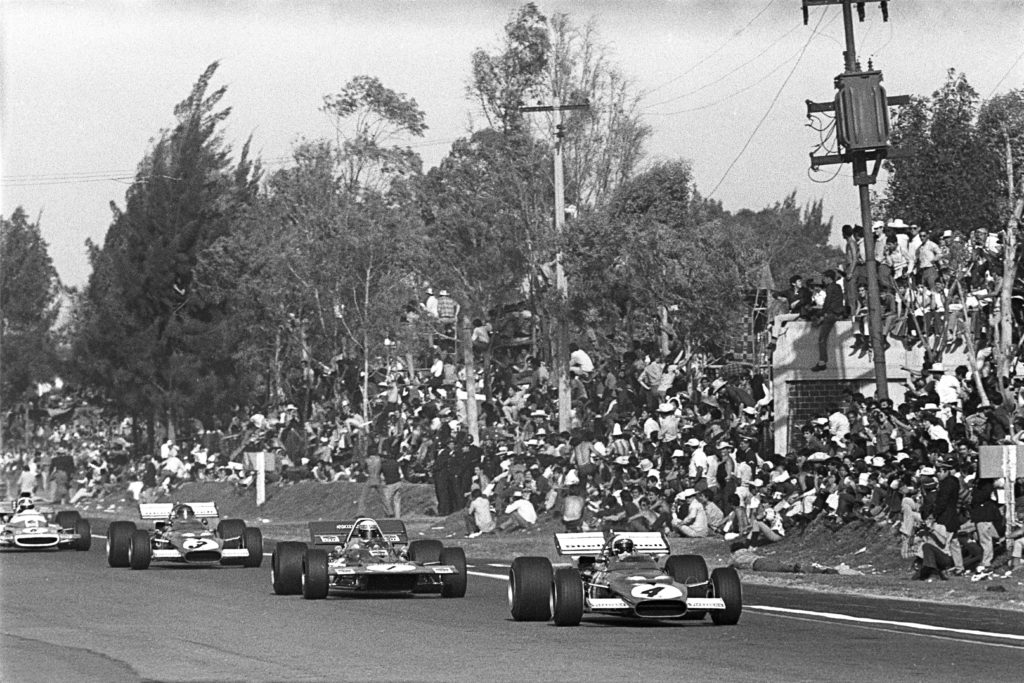
Unsavoury scenes blighted the 1970 Mexican Grand Prix, however, and preceded Formula 1 abandoning the race until 1986. Mexico was desperate to see a home win after losing in the quarter-finals of that year’s FIFA World Cup on home soil and Pedro Rodriguez was in form.
Rodriguez was only the third Mexican Formula 1 driver after following his younger brother Ricardo, who raced for Ferrari in 1961 and 1962. Ricardo also died at the non-championship 1962 Mexican GP after entering in a privately run Lotus with Ferrari opting against entering.
Around 200,000 fans flooded into the Autodromo Hermanos Rodriguez to see Pedro battle for home glory. But issues quickly arose as some fans destroyed the trackside fencing to get closer to the track. Some spectators even threw glass bottles onto the track, forcing a delay.
It took 75 minutes from when the 1970 Mexican Grand Prix was scheduled to start to clear the debris. Yet the problems persisted and Jackie Stewart unavoidably hit a dog at 257km/h (160mph). It, ultimately, proved to be the last Mexican GP until the 1986 Formula 1 season.
Nigel Mansell produced one of F1’s ‘most daring overtakes’ in 1990
Organisers of the Mexican GP attempted to revive the race numerous times before Formula 1 returned to the Autodromo Hermanos Rodriguez in 1986. The circuit resurfacing most of the track would help to facilitate its return. Yet it would still remain a very bumpy track in most.
But its return would lead to an instant classic Grand Prix in 1990 as Nigel Mansell and Ferrari teammate Alain Prost fought for glory. Ayrton Senna had led much of the race but McLaren retired his car on Lap 63 after suffering a puncture which left the Scuderia duo to fight it out.
Prost had only managed to qualify in P13 after adapting his race set-up to Mansell in P4 and Senna in P3. But the set-up worked the trick as the Frenchman charged his way through the field. He would ultimately win the 1990 Mexican GP by 25 seconds over Mansell in second.
Mansell had to fight McLaren’s other driver, Gerhard Berger, to finish in second, as well. But the Briton pulled off a wonderful move around the outside at the fearsome Peraltada. It was no longer a high-speed, banked, 180-degree right-hander but still had next-to-no run-off.
The Peraltada was always compromised as the corner backs onto the streets of Mexico City. It was also through the original layout of the Peraltada that Ricardo Rodriguez lost his life in 1962. Yet Mansell kept his foot planted on his Ferrari’s floor and overtook Berger on Lap 67.
Mansell also described his overtake as ‘one of the most daring overtaking manoeuvres in F1 history’. In contrast, Senna rolled his McLaren through the Peraltada during practice for the 1991 Mexican GP after striking one of its infamous bumps and losing control of the MP4/6.
Formula 1 bid goodbye to the Peraltada after the 1992 Mexican GP
Formula 1 would ultimately leave the Autodromo Hermanos Rodriguez again after the 1992 Mexican GP. But while it returned to Mexico in 2015, the Peraltada corner was consigned to the pages of F1 history. A baseball stadium replaced the corner during an extensive rebuild.
The stadium was the first in-field complex in Formula 1 history and can host 40,000 fans. F1 also holds the podium ceremonies inside the stadium arena filled with passionate fans. But the corners which took the Peraltada’s place also removed the chance for knife-edge racing.
Receive exclusive F1 news and updates twice a week to your mailbox