Lando Norris
 McLaren
 Mercedes
 Red Bull
 Ferrari
 Williams
 Racing Bulls
 Aston Martin
 Haas
Haas Alpine


| First held: | 2008 |
| Times held: | 16 |
| Circuit: | Marina Bay Street Circuit |
| Circuit length: | 4.9km (3m) |
| Laps: | 62 |
| Most wins: | 5x Sebastian Vettel (2011, 2012, 2013, 2015, 2019) |
The Singapore Grand Prix is the original Formula 1 night race and it debuted on the calendar during the 2008 season. It was also F1’s first street race in Asia and the circuit for Crashgate.
Formula 1 got off to an explosive start in Singapore when the series first raced at Marina Bay in 2008. Renault told Nelson Piquet Jr to crash on Lap 14 after Fernando Alonso made his pit stop. The crash forced a safety car and gave Alonso the lead before going on to win the race.
F1 has since witnessed many chaotic Singapore Grand Prix throughout its visits to the island country in maritime Southeast Asia. At least one safety car period is almost guaranteed and the race often hits the two-hour limit. It is one of the longest and most challenging F1 races.
What is the Marina Bay Street Circuit like?

Formula 1 has visited the Marina Bay Street Circuit for every edition of the Singapore Grand Prix to date. The track has also rarely changed since F1’s inaugural visit in 2008. But it had a new layout for the 2023 race owing to the construction of an entertainment and stage area.
The Singapore GP organisers first changed the Marina Bay Street Circuit layout ahead of the 2013 race as they removed the Singapore Sling. The chicane was notorious for its high kerbs that punished any mistakes and flicked Kamui Kobayashi airborne before he crashed in 2011.
Further changes followed in 2015 with the reprofiling of Turns 11-13 and again in 2019 with Turns 16-17. But the biggest changes were for the 2023 Singapore GP when the Marina Bay Street Circuit removed the section which passed by the waterfront and under a grandstand.
It was one of the more iconic segments of the circuit as it cut underneath the grandstand at Turn 18. It was also a hot spot for crashes as drivers regularly refused to use the run-off area and dug into the Tecpro barrier. But the chicanes also restricted the chances for an overtake.
There are several potential overtaking points around the Marina Bay Street Circuit but most rely on DRS zones. The stop-start nature of the third sector often negates the effect of DRS into Turn 1. But most passes are made with the help of DRS during the long run into Turn 7.
Moves are also possible into Turn 10 but require the overtaking car to be close through the exit of T9. The slow hairpin out of the Anderson Bridge can also restrict the impact DRS has into T14. But a daring driver can make a lunge at T13 with a good run on the narrow bridge.
History of the F1 Singapore GP
The history of the Singapore Grand Prix pre-dates Formula 1’s debut visit in 2008 as Formula Libre held eight races with the name during the 1960s and 70s. But F1 resurrected the name in 2008 as it visited Singapore for the first time and for the first Formula 1 race held at night.
Formula 1 agreed to arrange the Singapore GP as a night race as driving under the scorching hot daytime conditions would be an unnecessary risk for the competitors. The temperatures drop drastically in the night and make the Grand Prix achievable for the drivers and the cars.
Ambient temperatures in Singapore during September, when F1 traditionally holds the race, average around 29°C. But another main factor is the humidity, which averages around 81% but can hit around 94%. Formula 1 also did not have a wet Singapore GP until the 2017 race.
The temperatures, humidity, high-speed and bumpy street track and regular two-hour races combine to make the Singapore GP one of Formula 1’s most challenging events. The drivers can lose up to 3kg of weight in the races and base their training schedules on the conditions.
Last 10 winners of the F1 Singapore GP
| 2014 Singapore GP: | Lewis Hamilton (Mercedes) |
| 2015 Singapore GP: | Sebastian Vettel (Ferrari) |
| 2016 Singapore GP: | Nico Rosberg (Mercedes) |
| 2017 Singapore GP: | Lewis Hamilton (Mercedes) |
| 2018 Singapore GP: | Lewis Hamilton (Mercedes) |
| 2019 Singapore GP: | Sebastian Vettel (Ferrari) |
| 2022 Singapore GP: | Sergio Perez (Red Bull) |
| 2023 Singapore GP: | Carlos Sainz (Ferrari) |
| 2024 Singapore GP: | Lando Norris (McLaren) |
| 2025 Singapore GP: | George Russell (Mercedes) |
Renault sparked controversy at the 2008 Singapore GP with Crashgate

Formula 1 was supposed to see title rivals Felipe Massa in a Ferrari and Lewis Hamilton in a McLaren fight for the first Singapore Grand Prix in 2008. The Brazilian had beaten the Briton to take the maiden pole position. But Crashgate would see Renault and Alonso steal the win.
Crashgate refers to the sporting scandal Piquet Jr revealed one year after the race when the Brazilian admitted Renault told him to crash in order to bring out a safety car to help Alonso. The Spaniard had pitted one lap before Piquet Jr crashed and moved to the front of the grid.
Piquet Jr only made his revelation after Renault dropped the son of three-time F1 champion Nelson Piquet. But his promise to tell the FIA’s investigation the truth secured him immunity from any punishment. Renault axed Piquet midway through his second season in Formula 1.
The FIA slapped Renault with a two-year suspended ban from Formula 1 for the team’s part in Crashgate. It deemed the team’s former boss Flavio Briatore with engineering director Pat Symonds and Piquet Jr conspired alone to cause the crash by spinning into the Turn 17 wall.
Alonso had only qualified in P15 for the 2008 Singapore GP but he moved to the front of the pack after other drivers pitted under the safety car to recover Piquet Jr’s Renault. Massa was among the drivers to stop but left Ferrari’s box prematurely with the fuel hose still attached.
The first wet Singapore GP brought chaos to the Formula 1 grid in 2017
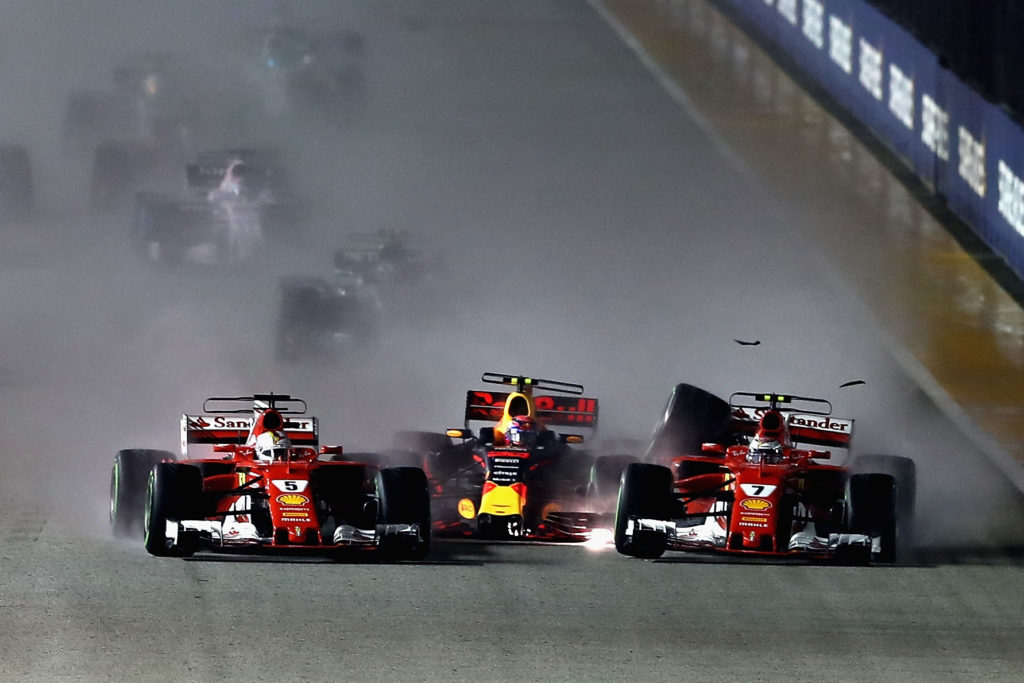
The first F1 Singapore GP held in wet conditions also brought chaos to the grid in 2017. Rain fell around the Marina Bay Street Circuit near the start of the race to force the teams to run the intermediate tyres. It also made the event the first F1 night race held in wet conditions.
Yet despite the conditions, Kimi Raikkonen got a superb launch from P4 on the grid. The Finn would find himself quickly pulling alongside Max Verstappen but Sebastian Vettel would not spot his Ferrari teammate. Instead, they sandwiched Verstappen’s Red Bull in a pincer move.
Vettel’s desperate move to drift across the circuit from pole position to cover Verstappen left no room for Raikkonen’s car. Verstappen then trying to avoid Vettel pitched Raikkonen into a spin as his rear-right tyre flung loose. The Finn even touched Vettel to damage both Ferraris.
It was not the end of the incident, either, as Raikkonen’s stricken car drifted onwards into T1 to collect Verstappen. Their crash also collected Alonso and span the McLaren driver, who had made a great start around the outside. Vettel would also retire due to his car’s damage.
Ferrari flatly tweeted, ‘Verstappen took Kimi out and then went into Sebastian’, to describe the first-corner crash at the 2017 Singapore GP. The Scuderia then followed it with a second tweet: ‘What we tweeted was a factual description of events. No need to speculate on this.’
Other notable moments from past Singapore Grand Prix include Hamilton’s sensational pole position lap in 2018. The Briton described a 1:36.015 lap around Marina Bay as ‘magic’ after snatching P1 with a time 1.329 seconds faster than he went in Q2 and after being P14 in Q1.
Receive exclusive F1 news and updates twice a week to your mailbox