Lando Norris
 McLaren
 Mercedes
 Red Bull
 Ferrari
 Williams
 Racing Bulls
 Aston Martin
 Haas
Haas Alpine


Oliver Bearman believes Haas are still learning how to “utilise” Ferrari’s new engine, but GPS data from the 2026 F1 Australian Grand Prix showed them what is possible.
Bearman emerged as the best of the rest at Albert Park last Sunday, as the Haas driver came home in seventh place. The Briton improved from P12 on the grid in Melbourne, to start his season with six points. It took Bearman four rounds to secure six points for Haas last season.
Ferrari secured 27 points in the Australian GP, as Charles Leclerc reached the rostrum in P3 with a 0.625s margin over teammate Lewis Hamilton in P4. Leclerc even fought for the lead at Albert Park until Ferrari decided not to pit under the early VSC, which Mercedes utilised.
Bearman was Jenson Button’s Driver of the Day in Australia given his rise through the order, while Haas teammate Esteban Ocon started his campaign with a P11 finish from P13 on the grid. Bearman thinks the 2026 Australian GP was also a good opportunity for Haas to learn.
Who is going to win the 2026 F1 Chinese Grand Prix?
Let us know why in the comments!
Ferrari’s ‘flat out’ GPS data in Australia showed Oliver Bearman that Haas are still learning their engine
Havering, London-born Bearman notes that Haas were not able to take Albert Park’s Turn 5 flat out until the end of FP2, crossing into FP3. Yet Bearman noted from the GPS traces that Ferrari’s Leclerc and Hamilton were able to take the fast T5 right-hander flat straight away.
READ MORE: How to watch the 2026 Chinese GP, with F1 Sprint and Grand Prix start times
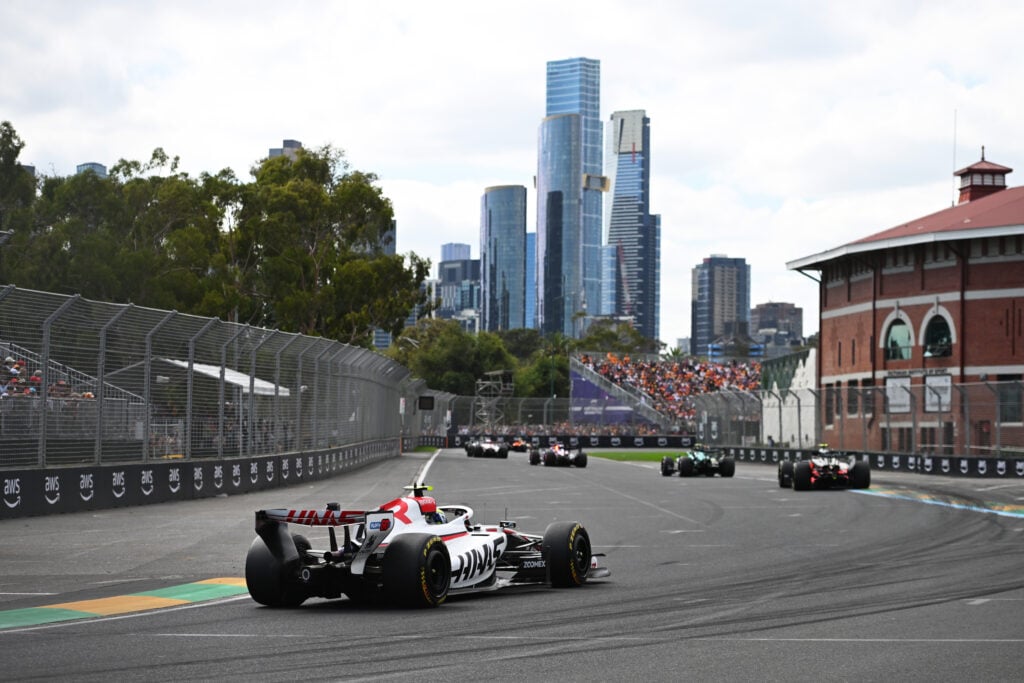
Bearman believes Ferrari’s pace through Albert Park’s Turn 5 from the off showed Haas still have things to learn about the Scuderia’s new power unit. Now, Haas can use what the team learnt in Melbourne going forward, starting with this week’s Chinese Grand Prix in Shanghai.
“We arrived in Australia and gradually learnt it as we went along,” Bearman said, via quotes by Motorsport.com. “Now, after that weekend, we have two or three benchmarks. We expect to be slower in certain corners, maybe with shorter gears in others.
“Also, when you’re slower at the apex, you obviously also need to use more power output. It is all a big knock-on effect. It’s helpful to know this, and have this information to carry forward for future races.
“We think we know the gap between us and Ferrari in terms of power unit utilisation. We’ve already gathered information in Australia.
“Turn 5 was an example, Ferrari were flat out right from the start, just by looking at their GPS speed. For us, however, it wasn’t flat out until the end of FP2, or even FP3.”
Ferrari’s cornering speed in Australia was their biggest positive, as the SF-26 was one of the fastest cars through, in particular, the low-speed corners. Hamilton and Leclerc’s pace in the medium-speed turns was also on par with what Mercedes could achieve around Albert Park.
Bearman and Haas will hope they can now use what they learnt about Ferrari’s 2026 engine in Australia to improve the VF-26’s cornering speed at the Chinese GP this weekend. Leclerc and Hamilton will likewise hope Ferrari can use a full weekend’s worth of data to improve.
Receive exclusive F1 news and updates twice a week to your mailbox