Lando Norris
 McLaren
 Mercedes
 Red Bull
 Ferrari
 Williams
 Racing Bulls
 Aston Martin
 Haas
Haas Alpine


Day one of F1’s Bahrain test is now in the books, and access to the team’s telemetry data has shown a stark difference between the power units of each engine manufacturer.
Following the inaugural shakedown of the 2026 F1 cars taking place behind closed doors in Barcelona, the more traditional week of testing that the grid is currently in the midst of allows for a finer analysis of the new challengers.
Lando Norris is looking to defend his title this year, and while Max Verstappen will be hoping to kick Red Bull’s new collaboration with Ford off with a bang after missing out on the championship by just two points in the last term.
The biggest change with the regulatory overhaul that has taken place ahead of the upcoming campaign is the new engine formula, which is seemingly changing the way that the grid is driving.
Fernando Alonso has shared his ‘annoying’ verdict on the new ruleset, and his qualms are evident in the telemetry comparison between Norris and Verstappen’s benchmarks.
- READ MORE: Max Verstappen’s rivals should be worried after what Red Bull insiders have said at Bahrain testing
Day 1 in Bahrain and it’s Lando Norris on top! ⏱️
Whose lap time caught your eye the most? 👀
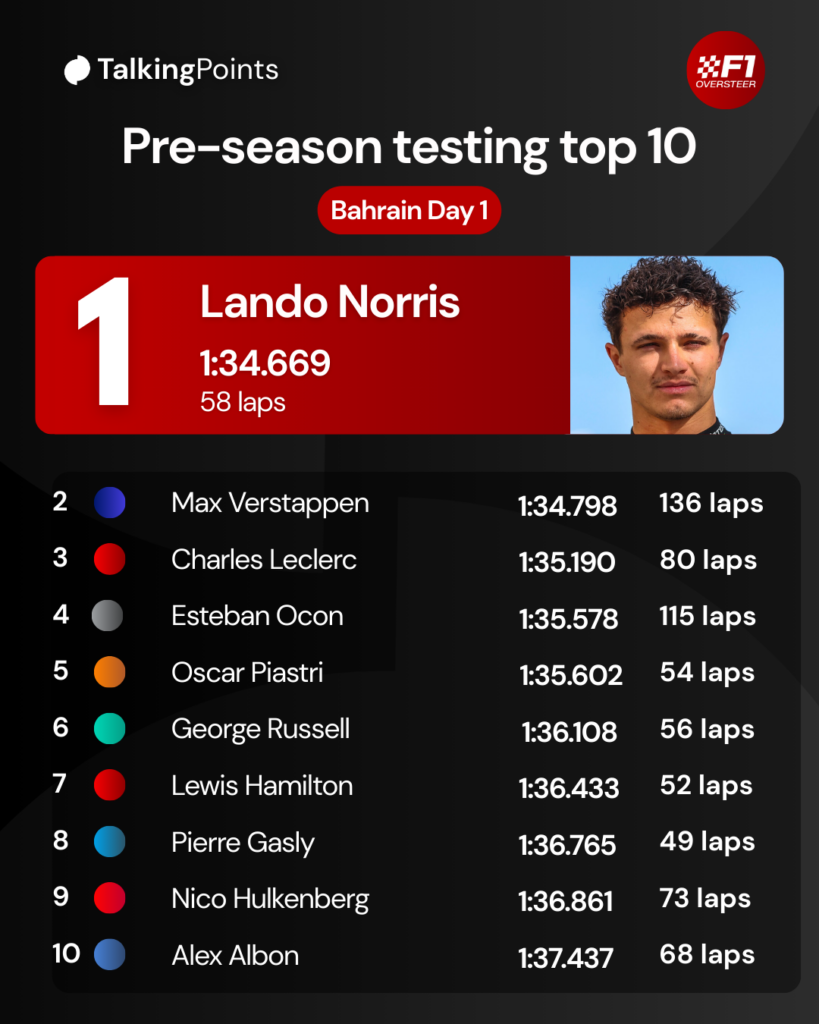
Lando Norris decelerated a lot more than Max Verstappen during their fastest laps at F1’s Bahrain test
According to a report by Autosprint, a comparison between the fastest laps of Verstappen and Norris on day one of F1’s Bahrain test reveals ‘notable differences’ in the utilisation of electrical power in the 2026 power units.
The McLaren star ended the day with the benchmark of 1:34.669, with his title rival during last year’s campaign finishing day one with a time of 1:34.798.
The difference between the two cars was most evident on the start/finish straight. Norris’ MCL40 seemed to hit a ceiling at 327kph and actually began to lose speed before he even touched the brakes.
Norris’ speed regressed down to around 320kph before entering the braking zone, which is a much bigger gap between top speed and entry speed to his rival at Red Bull.
Verstappen peaked at 338kph on the same section of the circuit, and only lost 3kph before the Dutchman slammed on the brakes into turn one, which indicates that the Austrian constructor’s new power unit has a lot more electrical efficiency during the latter stages of the straight.
Damon Hill has shared his worries over F1 cars slowing down on the main straights due to energy management strategies.
The 1996 world champion raised the question of whether a sudden reduction in top speed for cars that are being trailed in the slipstream will cause accidents in the future.
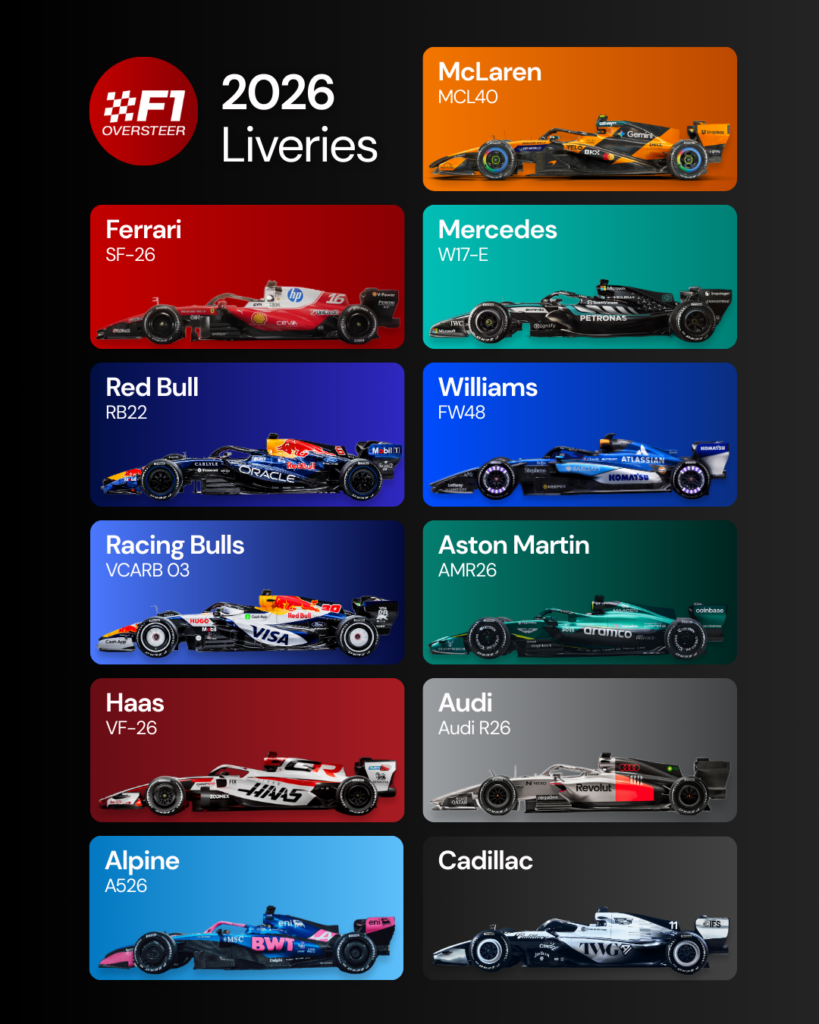
The 2026 F1 liveries are all locked in 🔥
Which team nailed it and which team REALLY missed? 👇
The Red Bull-Ford engine showcased some vulnerabilities at Racing Bulls
Despite the new Red Bull-Ford engine appearing to be relatively strong at the works outfit, Racing Bulls ran into some issues during the first day of testing in Bahrain.
Rookie Arvid Lindblad’s day was cut short after an impressive amount of data gathering in the morning. The Young Brit clocked in the second-highest number of laps, behind Carlos Sainz, in the opening session, with 75.
However, engineers identified an issue with the DM01 over the lunch break, and spent the rest of the day trying to fix the issue.
It meant that Lindblad was unable to get some valuable laps in ahead of his maiden campaign, in which he will be going head-to-head with teammate Liam Lawson.
The Kiwi is in the VCARB03 today, and Jenson Button has told Lindblad to keep an eye on Lawson’s data in order to maximise his learning before the meaningful sessions begin in Australia.
Receive exclusive F1 news and updates twice a week to your mailbox