Lando Norris
 McLaren
 Mercedes
 Red Bull
 Ferrari
 Williams
 Racing Bulls
 Aston Martin
 Haas
Haas Alpine


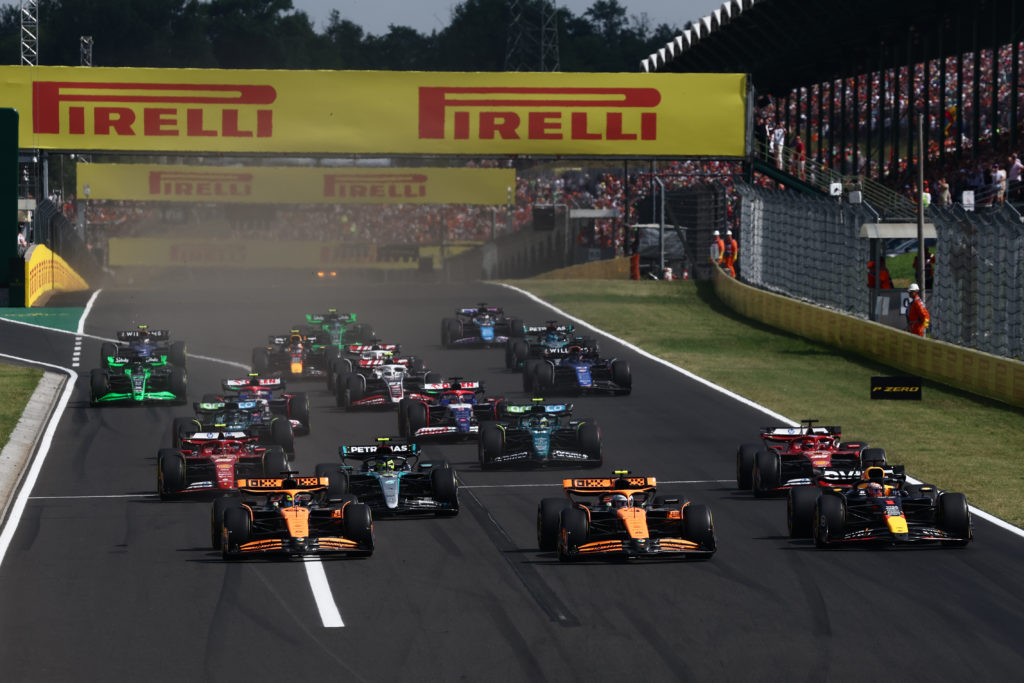
Formula 1 is enduring a thrilling mid-season after Oscar Piastri became the seventh different driver to win a race in Hungary.
It is a stark contrast compared to last year when Max Verstappen was on his run of victories which did not stop until the Singapore Grand Prix in October.
The competitiveness on the grid is largely in part due to field converging, having either taken ‘inspiration’ from Red Bull or achieved an aerodynamic platform that gives them stability as well as performance.
McLaren was the first team to achieve this earlier in the year when it could comfortably finish on the podium in China, then recent upgrades for Mercedes have now put them back in the hunt.
Red Bull appears to have made a step backwards along with Ferrari after their early success, but the challenge is on to add more performance in the final 10 races after the summer break.
Discussing the competitiveness of the season so far, Karun Chandhok believes there is one rule change that F1 should adopt to make it easier for a close field in the future when speaking on the Sky Sports F1 podcast.
Karun Chandhok’s F1 rule change that could improve competition
The last time F1 had seven different winners in a season was 2012, which remarkably happened consecutively.
The unpredictability eventually phased out as the season went on, largely due to the lack of cost cap and aerodynamic testing restrictions (ATR). This meant teams with bigger budgets could outspend each other, with Red Bull and Ferrari eventually going on to have a title showdown at the final race in Brazil.
Chandhok explains the change he would make to ensure a more competitive field in the future.
“I’ve been banging on about this for six months. I’ve written columns, I’ve said it on our broadcasts, all sorts. The rule cycle needs to be six years,” said Chandhok.
“Three years to allow people to catch up, three years of great competition, then you can change the rules. So, yeah, I think we’ve got a brilliant next 18 months coming up. Let’s enjoy it.”
F1’s budget cap and ATR rules to thank for competitiveness
The current budget cap of £106 million per team plus the ATR sliding scale based on the championship order, is partially why the field is much closer compared to previous years.
The cost restrictions coupled with the restrictions on the amount of time teams at the top can spend on aerodynamic testing and wind tunnel usage have led to a massive swing in performance between the top teams, as they have all tried to maximise their performance gains.
READ MORE: Everything we know about F1’s 2026 regulation changes so far from engines to tyres
As has been evidenced in the qualifying sessions, the difference between dropping out early and progressing can often be a couple of tenths.
Red Bull is facing its first proper test of competition since the 2021 season, having aced the major rule changes with the dominant RB18 and RB19 in the last two years.
Much of this is set to change for the 2026 season, as F1 is set to adopt a new regulation set that includes active aerodynamics and updated power unit specifications.
Receive exclusive F1 news and updates twice a week to your mailbox