Lando Norris
 McLaren
 Mercedes
 Red Bull
 Ferrari
 Williams
 Racing Bulls
 Aston Martin
 Haas
Haas Alpine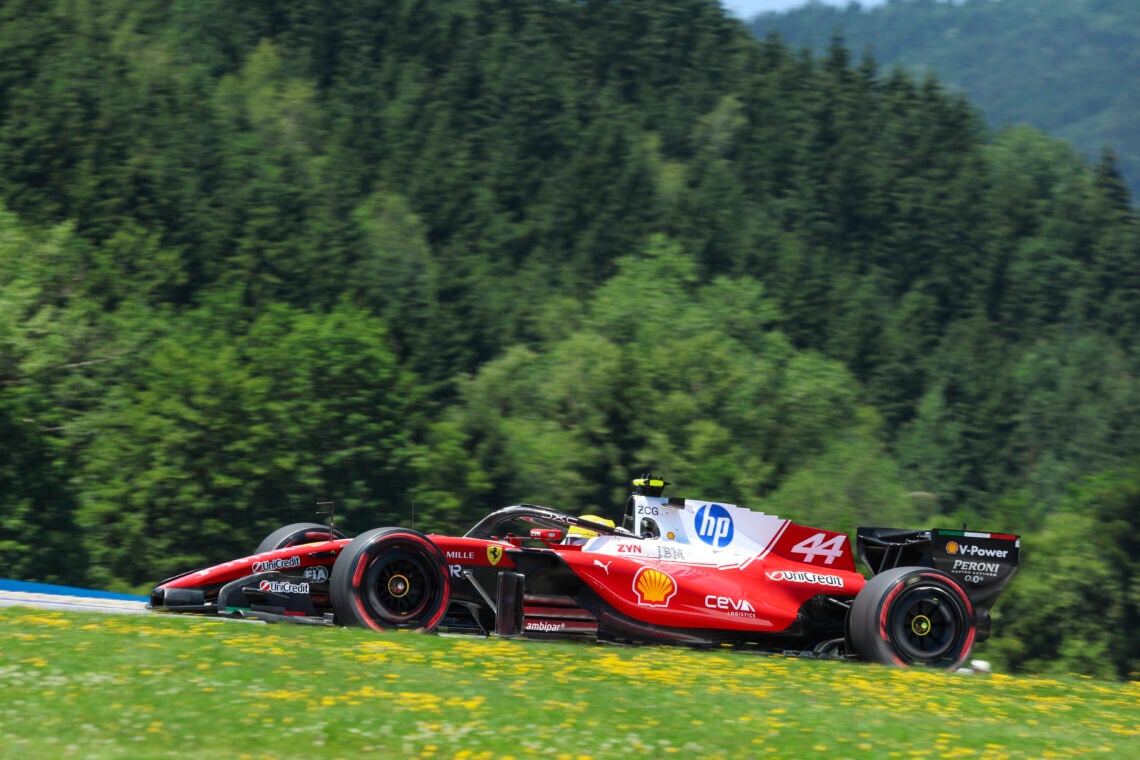


Jenson Button loved watching Lewis Hamilton on track at the 2026 F1 Austrian Grand Prix last week, as he could clearly see why the Ferrari racer is “so competitive” again.
Hamilton endured a self-proclaimed “nightmare” first season as a Ferrari driver in 2025. The array of challenges that Hamilton faced after joining the first non-English team of his career, along with his endless issues during the ground-effect era, made 2025 a complete disaster.
This season has seen a reset, however, with the seven-time champion scoring his first Grand Prix win in red and potentially even returning to contending for the title. Hamilton will go to this week’s British Grand Prix sitting third in the standings and is only 46 points adrift of first.
What is the weirdest thing on your 2026 British Grand Prix bingo card?
Daniel Ricciardo hilariously hit Lando Norris with a space hopper in 2022
Jenson Button loved watching Lewis Hamilton ‘sideways’ in his Ferrari in Austria
Hamilton scored his first Grand Prix win for Ferrari in Barcelona during round seven, with his three-stop strategy and the Scuderia’s updates giving the 41-year-old the edge over George Russell of Mercedes. But the altitude and boiling conditions in Austria prevented any repeat.
READ MORE: How to watch the British GP and Silverstone Sprint, and the weather forecast
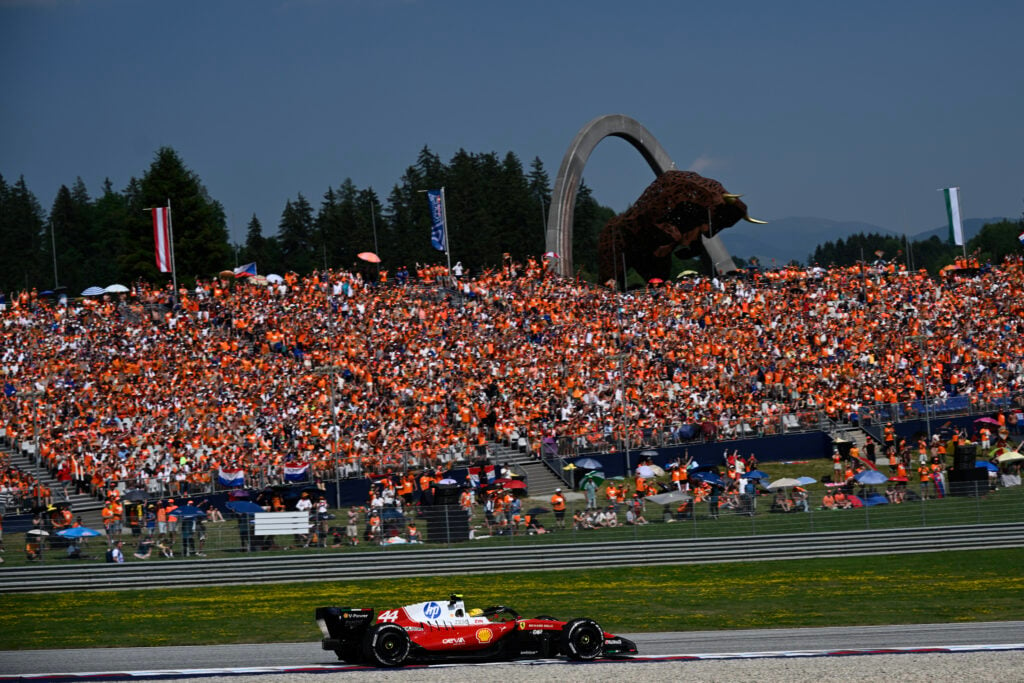
Yet while Hamilton had to settle for P5 in the Austrian GP, as well as finishing 26.393s behind the lead as Russell won, Button loved how his former McLaren teammate would push his car through the final turns. He feels it was a clear sign of how F1’s 2026 regulations are allowing Hamilton to utilise his “aggressive” driving style that the ground-effect regulations annulled.
Button told select media, including F1 Oversteer, during an event hosted by Viagogo ahead of the 2026 British GP: “The cars, themselves, I think are more fun to watch.
“Watching Lewis come out of the last corner, or the second-to-last corner, in Austria sideways almost every lap, it’s really cool. It’s great that they can push these cars as hard as they can.
“Whereas last year’s cars, if you had a bit of oversteer, you were off in the wall. It was a very twitchy car – lots of ground-effect, but as soon as you put that car at yaw, the ground-effect stopped working, so you lost all the rear downforce.
“This year, it’s a lot more natural for the drivers to push, and I think that’s why we’re seeing, for example, Lewis being so competitive, because he is able to be aggressive with the car, which we know is his style of driving.
“So, yes, I would like to drive them, and they’re so fast in a straight line. It’s phenomenal the acceleration these cars have.”
Jenson Button has changed his mind on the 2026 regulations after F1’s rule tweaks in Miami
Name an F1 circuit better than Silverstone, we’ll wait…
The 2026 regulations marked the biggest regulatory overhaul in the championship’s history, as F1 introduced new power units with changes to the aerodynamic, chassis and tyre rules. F1 cars are now shorter, slimmer and lighter than the monsters from the ground-effect era.
But while Button believes F1’s latest chassis and aero regulations are getting the best out of Hamilton with Ferrari now, the new engine formula did not sit as well with the 2009 drivers’ champion initially. F1 overhauled the power unit in 2026 by increasing the electrical output.
F1 moved from the previous 20/80 power share in favour of the internal combustion engine (ICE) to almost a 50/50 split with the battery in 2026. Many drivers soon criticised the latest regulations, and even Button found it “quite difficult” to stay on top of the power situation.
After a lot of discussions, F1 agreed to make changes from the Miami Grand Prix in May that saw the harvesting limit reduced from eight to seven megajoules for qualifying. The FIA also increased the levels of engine super clipping allowed for harvesting to the full 350 kilowatts.
Now, while there were still examples of the so-called yo-yo racing in Austria, Button believes F1 has a product that is far more palatable for drivers and fans. It is also not the first time in recent history that drivers have had to perfect when to use their tools to make an overtake.
Button added: “I think the first couple of races of the year were quite difficult for us all to understand what was going on, even for me!
“The drivers driving up to the start of their qualifying laps slowly, it confused me. But they have to have all the deployment around the lap. So, it’s obviously been confusing for us as fans of the sport. I think since Miami, we’ve seen a big shift in the races, and being a bit more traditional in terms of overtaking.
“Obviously, in Austria, if you used your boost from Turn 1 to Turn 2, you could get passed from Turn 2 to Turn 3 by the other car, which had more boost. But then we had DRS before, we’ve had KERS before, so this sort of thing isn’t unusual, and I think it makes for some good overtaking moves.”
Receive exclusive F1 news and updates twice a week to your mailbox