

 Lando Norris
 McLaren
 Mercedes
 Red Bull
 Ferrari
 Williams
 Racing Bulls
 Aston Martin
 Haas
Haas Alpine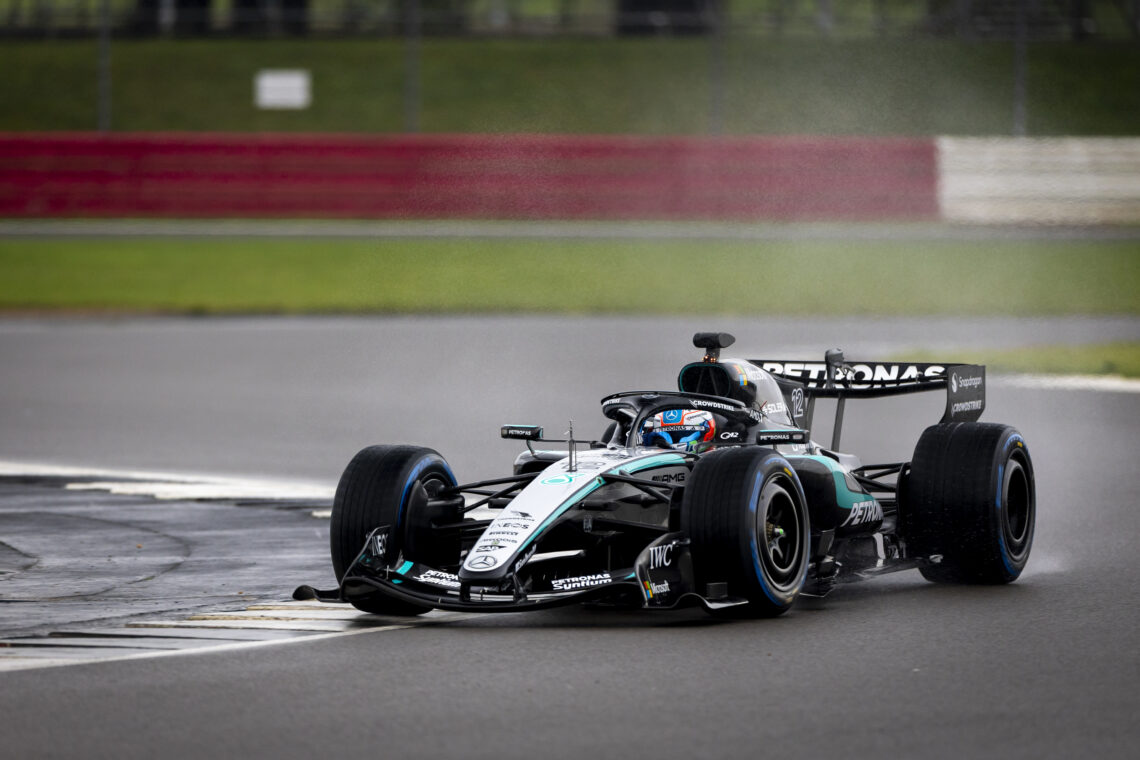


The first images of the Mercedes W17 show an interesting slot near the rear tyres, which could prove to be a stroke of ingenuity from the designers at the Silver Arrows’ Brackley base.
Much of the discussion regarding F1’s new era of regulations this season has been about the engine formula.
However, an overhaul to the aerodynamic package is also a huge change, and Mercedes may have figured out a ‘groundbreaking’ workaround for the redundancy of F1’s ground effect regulations from last year.
During an appearance on Peter Windsor’s YouTube channel, F1 tech expert Craig Scarborough revealed a key element of the Mercedes W17 that caught his eye from the initial images.
Should F1 give designers more freedom now that there’s a cost cap?

Craig Scarborough spots ‘groundbreaking’ detail on Mercedes W17 during first laps on track
After talking through the design philosophy that Mercedes engineers are understood to have taken during development of the front and side of the W17, Scarborough detailed a ‘big surprise’ that he found at the rear of it.
He said, “I only just picked up these images before we came on for this chat and found out something quite important on the Mercedes. Almost groundbreaking, I guess you could call it.
When you think of a diffuser, you think of a closed ramp section in order to keep the air at low pressure inside the diffuser, but then we think of some other alternatives.
“Things like a double diffuser or Red Bull’s first blown diffuser, which had an opening in it, and Mercedes have done something similar.
“What I would call a slotted diffuser, rather than a double diffuser, which is quite different.”

Now, a normal diffuser is a sealed ramp at the back of a car’s floor, and its job is to expand the air coming from under the car, which creates a low-pressure vacuum that sucks the car down onto the track.
However, the air, as Scarborough puts it, is ‘lazy’. By the time it reaches the very back of the car, it starts to slow down, causing the vacuum to alleviate, which is known as flow separation.
Mercedes’ solution to this is cutting a slot (visible in front of the rear wheel in the image above) into the diffuser in order to inject fast-flowing air from the sidepods into it to drastically improve their aerodynamic performance.
This also means that the W17 is relying more on receiving grip from the floor elements rather than the wings, which, in turn, creates less drag and further increases performance on the straights.
Describe Mercedes’ 2026 F1 livery in one word

Craig Scarborough also answered the question of ‘How is this legal?’
Of course, the main question regarding the breakthrough from Mercedes regards its legitimacy in the rulebook.
Scarborough gave his thoughts on it, explaining, “I’m sure a lot of people will be looking at this and scratching their heads, thinking, ‘How is this legal?’
“I believe this is not so much to do with the diffuser regulations and the floor wall as the regulations call it, but actually how they integrate with the brake duct or the brake deflector regulations.
I imagine everyone is going to go back to the rule book and look at some of their previous aero work to see if it’s something that they can adopt again with any developments we see on a test car.
“You have to have that caveat of, ‘Is this real? Or is this just something that they’re winding everyone up about?’ I doubt that very much. But again, we will just have to see how this shakes out through testing.
“And more importantly, when we get to Melbourne, which is the first time that cars are scrutineered and other teams could potentially protest or indeed copy it by then as well.”
Mercedes are already expecting a protest at the first round of the 2026 season following the FIA’s refusal to take action against their engine compression ratio exploit that has emerged in recent weeks.
Receive exclusive F1 news and updates twice a week to your mailbox


