Lando Norris
 McLaren
 Mercedes
 Red Bull
 Ferrari
 Williams
 Racing Bulls
 Aston Martin
 Haas
Haas Alpine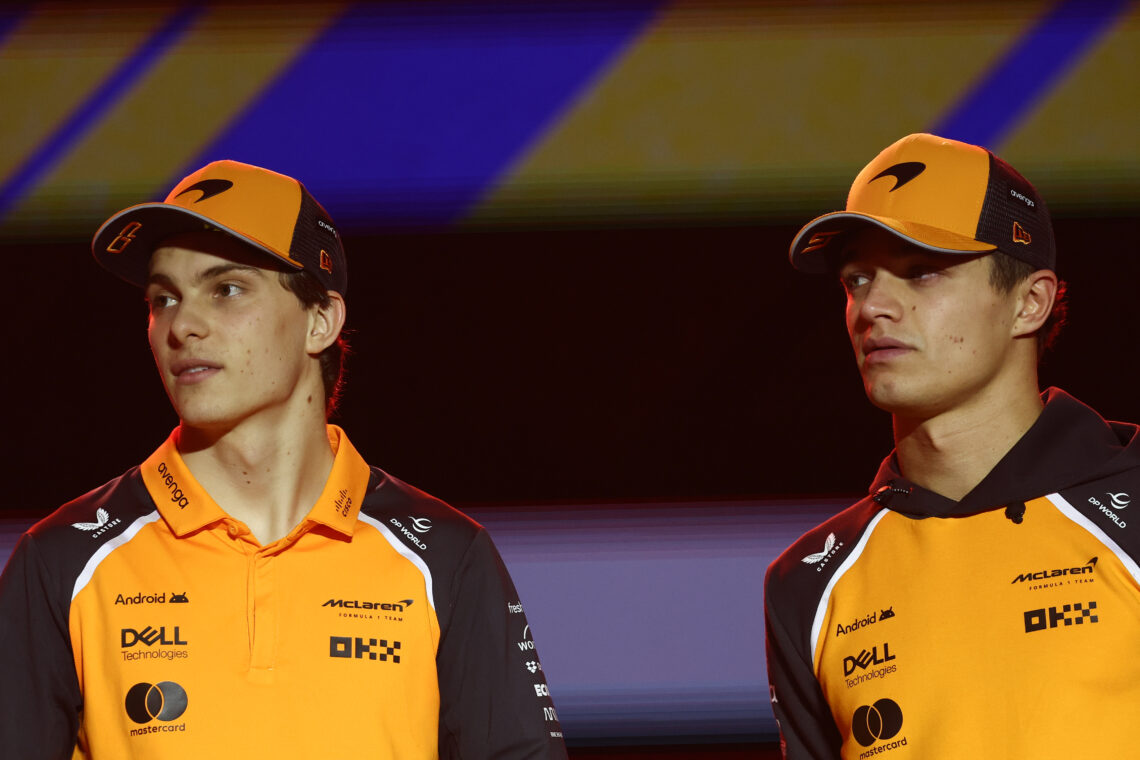


McLaren joined the party at the Barcelona shakedown test later than most, as Lando Norris posted his first laps on Wednesday before Oscar Piastri took over on Thursday.
The Woking squad decided to sit out the first day of pre-season testing in Spain on Monday, and they also skipped day two due to the wet conditions. Teams are only able to run on any three out of the five days that F1 has hired the Circuit de Barcelona-Catalunya for this week.
McLaren finally hit the track with new F1 champion Norris on Wednesday, with the 26-year-old also sporting the #1 on his car for the first time. The Briton enjoyed a strong maiden run in the MCL40, after McLaren elected against holding a private shakedown ahead of the test.
Piastri took over from Norris on Thursday, and the 24-year-old also quickly set about racking up the miles once McLaren ventured onto the track. McLaren are running in a black livery at the Barcelona shakedown, as the papaya team will not reveal the real livery until February 9.
Lando Norris drives the MCL40 with the No.1 for the first time 🏆
Does it bring extra motivation or extra pressure for our new world champion?
Gary Anderson suspects the FIA will want a closer look at McLaren’s bargeboards
McLaren’s stealthy test livery has hidden some of the details on the car that Norris will hope he can retain the F1 drivers’ championship in. Yet the design of McLaren’s bargeboards have caught the attention of Gary Anderson, who suspects the FIA will also be interested in them.
READ MORE: Everything you need to know about F1’s 2026 engine and aero regulations
Former Jordan technical director Anderson is “keen” to see whether the FIA accepts the way that McLaren and a number of teams have designed their bargeboards that create outwash. The FIA hoped that F1’s 2026 regulations would have the opposite effect and create inwash.
Anderson told The Race: “We can see that the bargeboards are now more elaborate than on the render version shown on Monday. These horizontal vanes will help extract airflow from the bargeboard footplate.
“The original style of bargeboard that the FIA believed it was proposing was to instigate inwash. However, from what I have seen so far, most teams have found a way past that and are now creating outwash.
“Quite a few of the teams have a similar appendage on the endplates and similar treatment to the bargeboard area. So, I’m keen to see where the FIA stands as far as these concepts are concerned. They clearly have an influence on outwash.”
McLaren’s bargeboard design is far from as complex as a pre-ground-effect era F1 car
What changes would you make to Ayao Komatsu’s ultimate F1 driver?

Norris’ maiden run in McLaren’s new car built for the 2026 F1 regulations revealed the team have designed their bargeboards with horizontal slats along the lower section. The design is considerably more complex than the renders that the team released to show off their livery.
McLaren’s renders did not show any vanes along the lower section of their bargeboard. But the actual bargeboard that they hit the circuit with this Wednesday remains some way away from the extravagant designs that teams developed until the ground-effect from 2022-2025.
The purpose of an F1 bargeboard is to control the airflow behind the front tyres and in front of the sidepods, especially at lower speeds. But complex bargeboard designs also create outwash and thus create turbulence for the following car, which F1 tried to remove in 2022.
Receive exclusive F1 news and updates twice a week to your mailbox