Lando Norris
 McLaren
 Mercedes
 Red Bull
 Ferrari
 Williams
 Racing Bulls
 Aston Martin
 Haas
Haas Alpine


F1 teams are now facing a ‘severe test’ of their new F1 power unit at the Australian Grand Prix due to the difference in the amount of time drivers will spend at full throttle compared to the Bahrain circuit.
The F1 regulations for the 2026 season received a baptism of fire during pre-season, with the six-day-long test in Bahrain exposing a multitude of issues with the new engine formula.
The 50/50 split between electrical and thermal energy is the main talking point, with several drivers voicing their frustrations over the change due to the increased demand for energy management.
Max Verstappen issued the most damning verdict on the new engines, likening them to ‘Formula E on steroids’. The comment landed the Dutchman in hot water with FOM, but he has never been one to mince his words.
Despite the electrical output of the new power units nearly tripling, drivers have complained about having to lift and coast far more often than usual, in order to harvest as much energy as they possibly can and optimise their lap.
Fernando Alonso is among the opposing drivers, labelling the greater demand for energy management as ‘annoying’ after his first laps in Aston Martin’s AMR26.
- READ MORE: McLaren add unique real-time display to help Lando Norris and Oscar Piastri track 2026 energy levels
Should F1 bosses have been ‘tougher’ on Max Verstappen after he criticised the 2026 rules?

F1 teams facing ‘severe test’ at Australian Grand Prix after energy management issues in Bahrain
According to a report by Autosprint, the frustrations that were voiced by drivers in Bahrain are expected to intensify at the season-opening Australian Grand Prix.
Data from Mercedes has suggested that their drivers were at full throttle for an average of 61% during each of their flying laps. The output of the electrical components inside the power unit is at its height when they have their feet to the floor.
Now, the reason for the ‘severe test’ comes from the fact that drivers often spend around 71% of a lap around the Albert Park Circuit at full throttle, meaning that even more electrical energy will be utilised.
Given the need to keep one eye on battery levels, the report suggests that flat-out laps at the Australian Grand Prix will, unfortunately, be a ‘thing of the past’.
Except for turn six, the entirety of the middle sector of the circuit is completely flat in an F1 car, and it remains to be seen how teams and drivers will cope with the added teaspoon of uncertainty.
The fifth round of the season, the Saudi Arabian Grand Prix, is also expected to throw some spanners in the works.
It’s understood that the Jeddah Corniche Circuit demands drivers to race at full throttle for nearly 80% of the lap, and with a lot of long corners and little hard braking zones, gaining a sufficient amount of energy back will prove to be a difficult task.
- READ MORE: Ferrari’s ‘objective’ with Lewis Hamilton’s rear wing flipping at F1 testing is not speed but energy
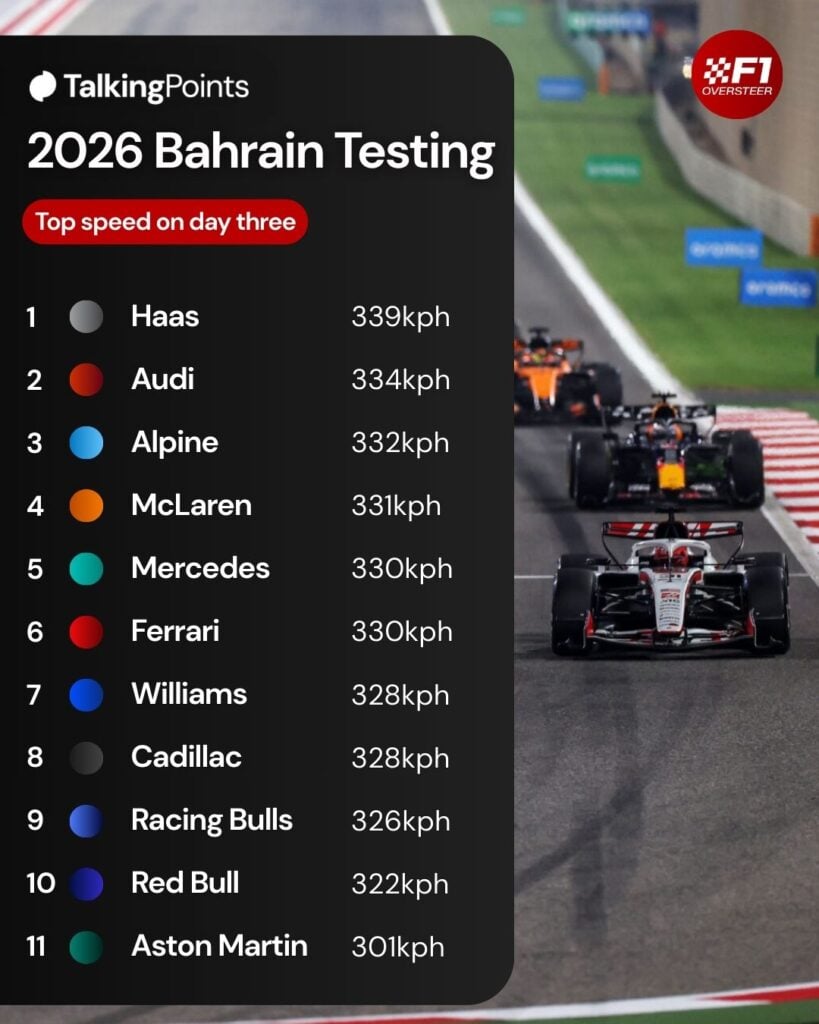
Aston Martin are currently facing a 38kph deficit to Ferrari’s engine! Do you think they’ll even QUALIFY for the Australian Grand Prix?!
Let us know in the comments below!
Aston Martin will especially struggle with racing flat-out at the Australian Grand Prix
One team that may feel the brunt of the new energy split more than the others is Aston Martin. The Silverstone-based team is understood to have the most inferior power unit on the grid, and their electrical components are the main cause of it.
Anthony Davidson spotted Alonso suffering ‘harvesting’ issues during his turn at the wheel of the AMR26 in Bahrain, which doesn’t bode well for their chances of securing any sort of good result in Melbourne whatsoever.
Honda have vowed to right their wrongs in the 2026 engine, but the earliest that they are expected to bring an upgrade is at the Chinese Grand Prix, which takes place one week after the season-opener.
What’s more, Aston Martin’s engine issues are looking so desperate that it isn’t even a guarantee that they will qualify for the Australian Grand Prix.
The regulations stipulate that a car must set a lap time within 107% of the fastest lap in order to book a place on the grid.
With Aston Martin currently suffering a deficit of around 38kph to their rivals, it could be a wasted trip down under for the British constructor.
Receive exclusive F1 news and updates twice a week to your mailbox