Lando Norris
 McLaren
 Mercedes
 Red Bull
 Ferrari
 Williams
 Racing Bulls
 Aston Martin
 Haas
Haas Alpine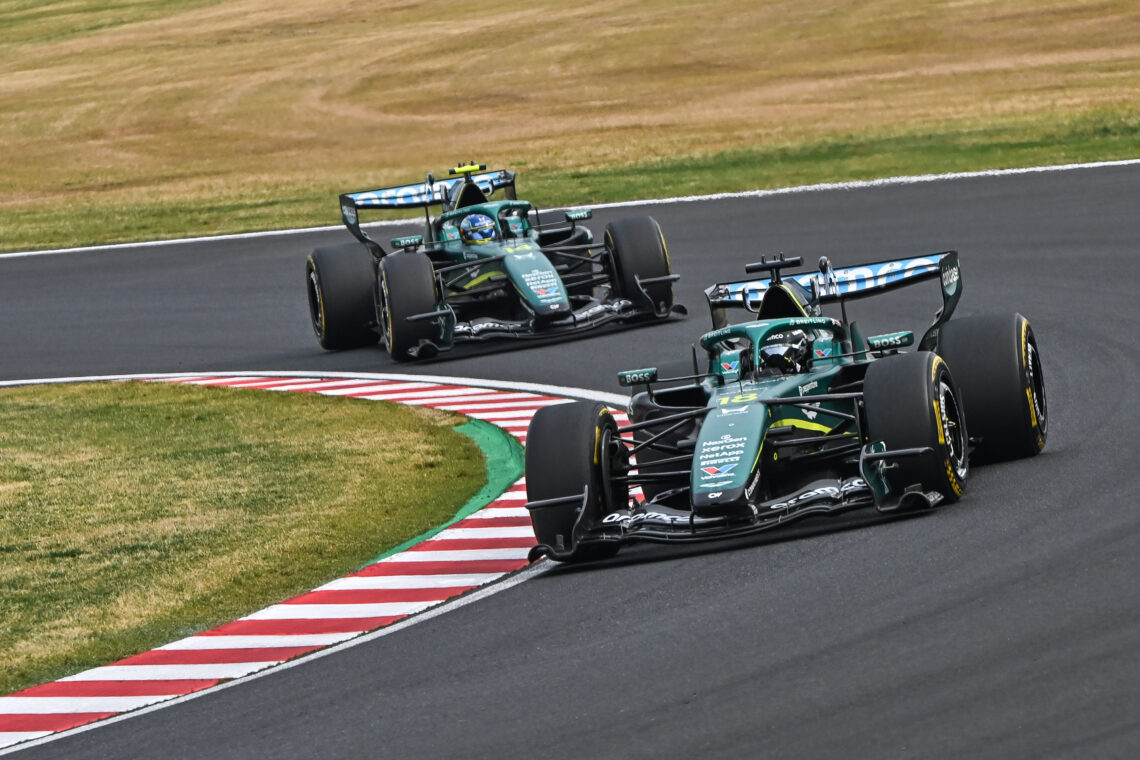


Aston Martin are well down on their Formula 1 rivals through the corners, which proves that they can’t blame Honda for their 2026 problems.
Speaking before the season opener in Australia, Newey said Aston Martin have a top-five chassis. With a competitive engine, that would mean they were competing for Q3 appearances and points.
Given that Aston Martin are still over 1.5 seconds away from escaping Q1, based on their Japanese GP performance, the suggestion is that Honda’s underpowered, malfunctioning engine is spoiling the team’s season.
Did Aston Martin make a mistake dropping Mercedes as engine partners for Honda?

Aston Martin data shows they are ’20kph’ down in the corners despite blaming Honda
The narrative put forward by Newey and other members of the team is starting to unravel. In Japan, Mike Krack acknowledged Aston Martin were struggling in high-speed corners.
And data shared by The Race shows that Aston Martin’s minimum speed is as much as 20kph (12mph) slower than their rivals. Logically, their relatively weak straight-line performance should allow them to attack the corners more aggressively, but they are losing even more time.
This demonstrates that the AMR26 is ‘chronically troubled’. Whether it’s corner entry, through-corner speed or corner exits, they are failing across the board.
Aston Martin’s car is believed to be overweight, which is naturally a contributing factor. The team have several fundamental problems to solve, while many competitors are simply refining a competitive package.
Aston Martin’s F1 car might be even worse than its engine
As pointed out by The Race, for Newey’s claim about the chassis to be correct, Honda’s engine would need to be 2.5 seconds off the pace per lap, and ‘nobody seems to believe this is the case’.
In fact, there are some experts who suspect that the car is an even bigger problem than the power unit.
Who was the greater driver, Niki Lauda or Michael Schumacher?
Two icons! Two eras! Only one can take the crown…

One report claims Aston Martin are developing a ‘toxic blame culture’, and there is growing evidence that Honda have become a scapegoat.
Outwardly, the relationship between the team and their engine supplier still seems to be functioning, and there’s currently no prospect of an early split. The length of their deal has not been disclosed, but logic dictates that it would cover the current rules cycle, which lasts until the end of 2030.
Receive exclusive F1 news and updates twice a week to your mailbox