Lando Norris
 McLaren
 Mercedes
 Red Bull
 Ferrari
 Williams
 Racing Bulls
 Aston Martin
 Haas
Haas Alpine


The Japanese Grand Prix joined the Formula 1 calendar in 1976 and has been one of the mainstays ever since, so F1 Oversteer delves into which drivers have been the most successful at the race.
F1 has held the Japanese GP at two different tracks, with Suzuka hosting the bulk of the races while the Fuji International Speedway held the first race in 1976. After two years at Fuji in 2007 and 2008, the race returned to Suzuka in 2009, where it has been held ever since.
Suzuka is a highly technical circuit and has been a regular title-deciding venue, as the race was historically scheduled later in the season, with Ayrton Senna, Michael Schumacher and Mika Hakkinen all sealing F1 drivers’ championship titles in Japan during their careers.
The race was not held due to the Covid-19 pandemic in 2020 and 2021. It returned in 2022 and marked the scene where Max Verstappen clinched his second F1 world title while using a Honda engine in the back of his Red Bull.
Verstappen is not the most successful driver in the history of the Japanese GP, though, with fellow F1 champions Schumacher and Lewis Hamilton scoring more Japanese Grand Prix wins to date.
Michael Schumacher is the most successful driver at the Japanese Grand Prix
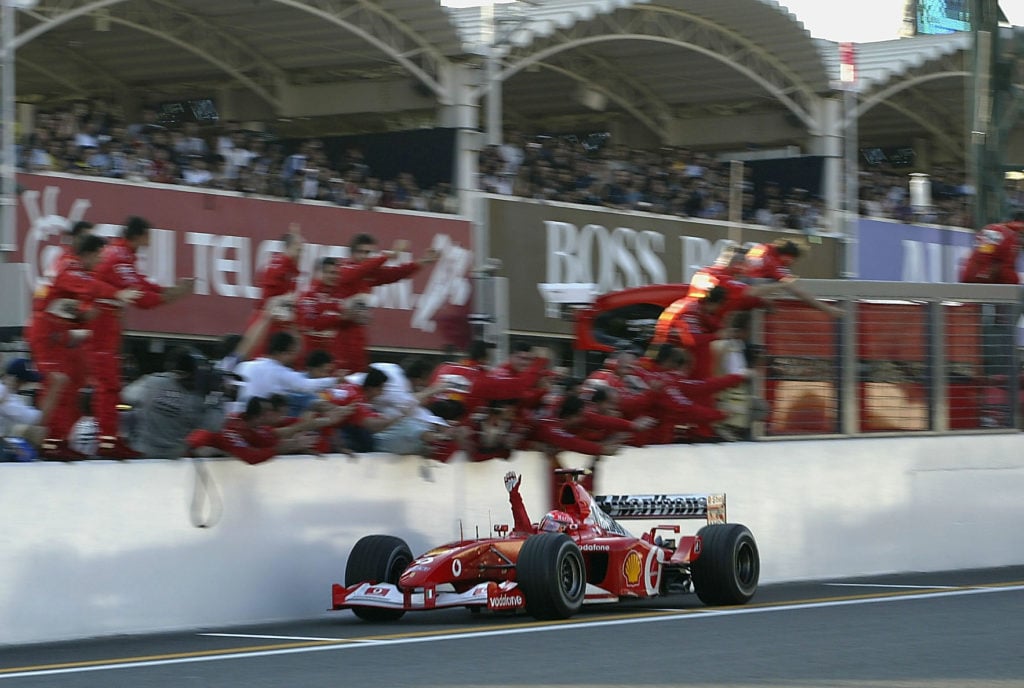
Schumacher remains the most successful driver in the history of the Japanese Grand Prix, having taken six victories at Suzuka. He first won in the Land of the Rising Sun at the 1995 race on the way to lifting his second world championship title for Benetton.
In 1997, Schumacher won the race for Ferrari and took the championship lead heading into the final round after a controversial decision from the FIA stewards to disqualify title rival Jacques Villeneuve for ignoring yellow flags in a practice session.
Villeneuve was already on a suspended race ban for a similar offence from the race earlier in the season at Monza, and following an appeal, he was disqualified after the chequered flag. Villeneuve would go on to win the title at Jerez after Schumacher was disqualified from the 1997 F1 season for deliberately crashing into the Williams driver.
Schumacher’s next wins in Japan came in 2000, 2001, 2002 and 2004 with Ferrari during his period of dominance with the team.
His run of victories would end in 2005 when Kimi Raikkonen took a stunning win from 17th on the grid, the same race in which Fernando Alonso also pulled off a memorable overtaking move on Schumacher around the fast left-hander of 130R.
The Japanese Grand Prix has seen nine repeat winners
Throughout its period on the calendar, there have been nine repeat winners of the Japanese GP to date. Gerhard Berger was F1’s first repeat winner in Japan, with victories in 1987 and 1991.
Hamilton and Alonso, meanwhile, are the only two drivers to win the Japanese GP at two different tracks, having both won editions staged at Suzuka and Fuji.
Hakkinen, Damon Hill, Senna, Verstappen and Schumacher have all won races at Suzuka and subsequently went on to clinch the drivers’ championship.
Verstappen famously won the title in 2022 amid confusion over the points awarded for that year’s Japanese GP, following confusion surrounding the rules around a shortened race distance due to a red flag.
| WINS | DRIVER | YEARS |
| 6 | Michael Schumacher | 1995, 1997, 2000, 2001, 2002, 2004 |
| 5 | Lewis Hamilton | 2007, 2014, 2015, 2017, 2018 |
| 4 | Sebastian Vettel | 2009, 2010, 2012, 2013 |
| 4 | Max Verstappen | 2022, 2023, 2024, 2025 |
| 2 | Gerhard Berger | 1987, 1991 |
| 2 | Ayrton Senna | 1988, 1993 |
| 2 | Damon Hill | 1994, 1996 |
| 2 | Mika Hakkinen | 1998, 1999 |
| 2 | Fernando Alonso | 2006, 2008 |
Receive exclusive F1 news and updates twice a week to your mailbox