

 Lando Norris
 McLaren
 Mercedes
 Red Bull
 Ferrari
 Williams
 Racing Bulls
 Aston Martin
 Haas
Haas Alpine


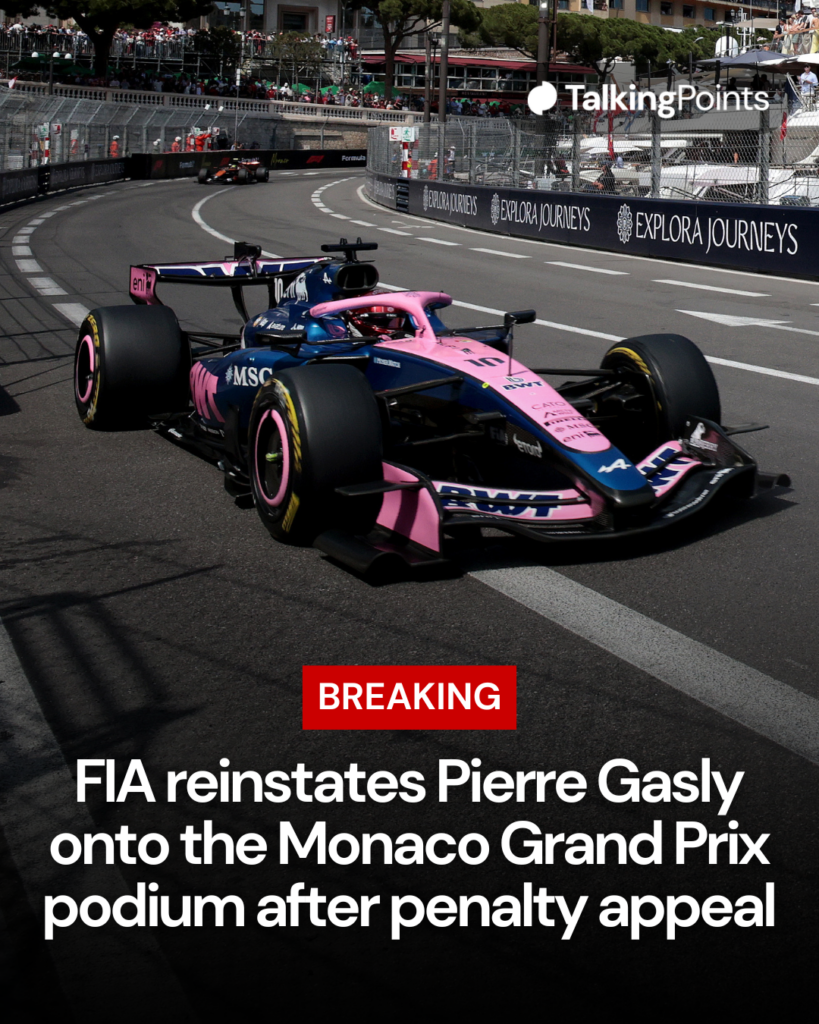
After the 2026 Monaco Grand Prix, Alpine protested a penalty they received from the FIA that had revoked their podium finish with driver Pierre Gasly. But how did that happen?
FIA rulebooks allow Formula 1 teams to protest the results of any penalty or stewarding decision made during a weekend thanks to something called the right of review process. Through this process, a team can request an opportunity to present information that could cause the FIA to change their mind and reverse the previous decision they had made.
But how does the right to review work? What do teams need to provide to the FIA, and what is expected of the FIA during the review process? We’ll break it down.
What is the FIA right of review process?
Formula 1 is one of the most highly monitored sports in the world. With rulebooks spanning hundreds of pages and thousands of sensors tracking each car’s performance, there’s no shortage of information pouring in throughout a Grand Prix
Yet only three or four stewards are assigned to monitor all of that data during the course of a Grand Prix. Errors can happen; stewards often aim to come to quick conclusions during investigations based on the data and video footage they have on hand, but they do not always have access to team-specific onboards or data sensors.
That’s why it’s critical for the FIA, which creates and enforces the rules that dictate Formula 1, to have a process by which race teams can formally protest a ruling made by the stewards. That process is called the ‘right of review.’
To get even more specific, the FIA Right of Review is a judicial mechanism outlined in Article 14 of the FIA International Sporting Code that allows any competitor to request that the FIA re-examine any penalties, so long as the competitors are able to provide new, significant, and relevant evidence that was unavailable to the stewards at the time of the original ruling.
Competitors must submit a formal, completed application to the FIA in order to request a right of review. An incomplete or inaccurate application can result in the request being discarded.
Further, any competitor submitting a right of review application must also make a deposit of €20,000, which can be returned if the application is deemed relevant. This deposit is used as a deterrent designed to prevent teams from submitting applications that they do not believe they can win.
Finally, right to review applications must be submitted within 96 hours of the end of the race.
The FIA rescinds Pierre Gasly’s penalties and he gets P3 in the Monaco Grand Prix – Is this the right outcome?
How does a right of review application result in an overturned penalty?
When competitors submit a completed right of review application to the FIA, that is only the first step in the right of review process. Next, the FIA will schedule a hearing with the competitor in question.
In this hearing, the competitor who submitted the right of review will present any relevant evidence to the FIA in order to support their claims. This evidence must be new to the FIA, which means that it will be evidence that the FIA did not have access to while issuing the penalty. The evidence must be relevant to the overturning of the penalty in question. The evidence must have been unavailable to the stewards at the time of the ruling. And the evidence must be significant, in that it must be able to change a steward’s perspective.
What constitutes ‘new’ information? While F1 and the FIA keep track of thousands of data points over the course of a Grand Prix weekend, those two entities do not have immediate access to every data point being tracked.
Each team will have access to onboard camera footage and team-specific data points that can offer additional context to what transpired during a Grand Prix. The footage and data points will provide the data required by the review process.
During the first hearing, the FIA will evaluate whether or not that evidence satisfies the criteria set out by the sporting regulations, namely, that the evidence is new, significant, and relevant. This is called an “admissibility hearing,” and it will determine whether or not the right of review proceeds.
If the FIA decides that the evidence provided by the competitor satisfies those criteria, then the FIA will schedule a second hearing; in that hearing, the FIA will determine whether or not the evidence justifies the overturning of the penalty. If the FIA decides the evidence from the first hearing is not sufficient, then the second hearing will not go forward.
The second hearing is considered the “merit hearing,” where the FIA will determine whether or not the penalty in question should be overturned based on the information the team has provided.
It is possible that a competitor could provide new and relevant information that does not result in an overturning of a penalty. The FIA could deem the information provided by the competitor to be new and relevant, but during the merit hearing, the FIA could nevertheless choose to stand by its original ruling.
Any decisions made by the FIA during the merit hearing are also subject to appeal. In the case of the 2026 Monaco Grand Prix, the FIA overturned the penalties applied to Pierre Gasly for speeding in the pit lane based on evidence provided by Alpine. However, McLaren and Red Bull both appealed the FIA’s decision. They are required to submit new and relevant evidence of their own in order for that appeal to proceed.
The FIA right of review process, at a glance
To sum up, the FIA right of review is initiated when a competitor submits an application to the FIA that disputes a penalty. To do so, the competitor must pay a fee.
The FIA will then schedule an admissibility hearing in which the competitor presents evidence to dispute the penalty. This evidence must be new (i.e., stewards have not yet seen this information), it must have been unavailable (i.e. stewards and teams could not access this information during the race), it must be significant (i.e. it must make a strong case in favor of overturning the penalty), and it must be relevant (i.e. it directly addresses the infringement that was penalized).
If the FIA determines that the evidence does not satisfy those requirements, the right of review request will be denied.
However, if the FIA determines that the evidence does satisfy its criteria, it will schedule a merit hearing in which the team will present the evidence again, this time with an eye to changing the stewards’ minds. Based on the evidence, stewards can either deny the right of review, in which case the penalty will still stand, or they can approve the right of review, which will overturn the penalty in question.
If the FIA decides that the petitioning competitor was correct and the penalty deserves to be overturned, other teams or competitors can file their own right of review submission in an effort to present additional evidence with an eye to convincing the FIA to reinstate the penalty.
Receive exclusive F1 news and updates twice a week to your mailbox


