Lando Norris
 McLaren
 Mercedes
 Red Bull
 Ferrari
 Williams
 Racing Bulls
 Aston Martin
 Haas
Haas Alpine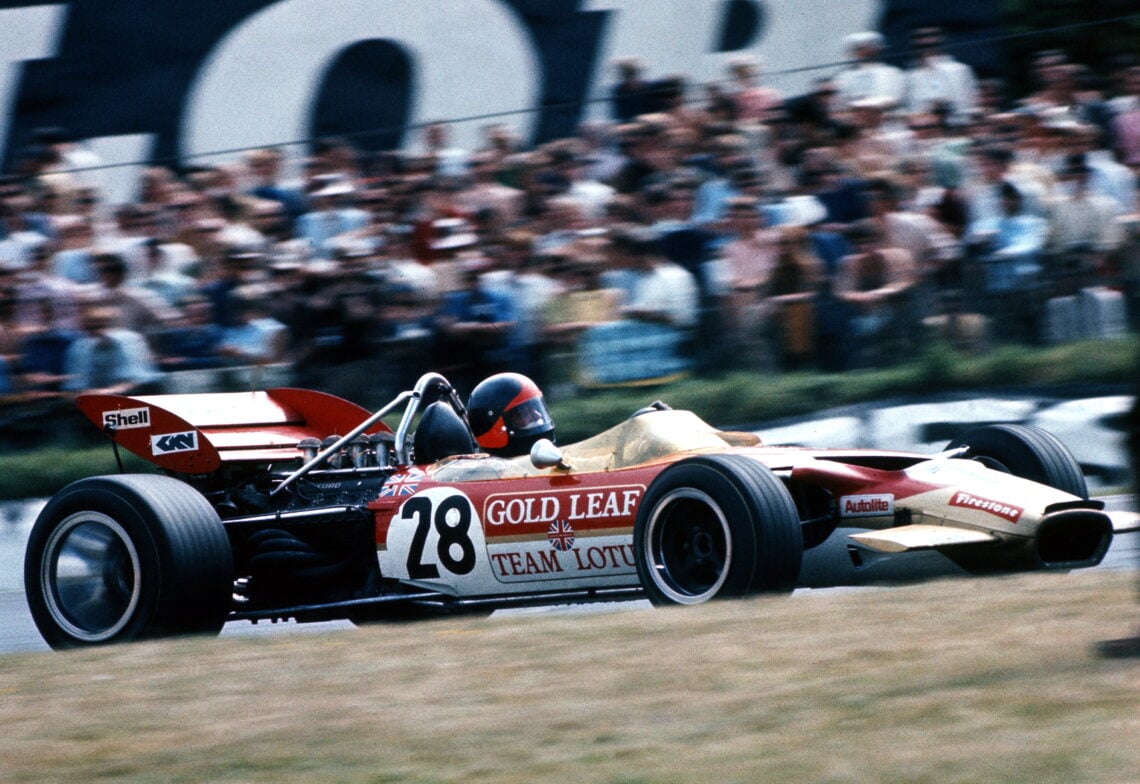


Despite the fact that Grand Prix racing was invented in continental Europe, Formula 1 has transformed into a decidedly British affair. In 2026, there are more British drivers on the grid than there are drivers from any other country, and almost every single team is based in the United Kingdom.
But the reason for the UK’s overwhelming success in Formula 1 can be traced back through its lineage of exceptional racing teams, which have been transforming open-wheel racing since the invention of the world championship.
Today, in honour of the British Grand Prix, we’re ranking some of the most influential teams in F1 history.
8. Hesketh Racing
- Years active: 1974-1978
- Race wins: 1
- Championships: 0
- Notable drivers: James Hunt, Alan Jones
- Contribution: Introducing glamour, party, and celebrity
Those of you familiar with Formula 1 history likely know the team founded by Lord Alexander Hesketh as the “party team,” which has often been enough to cast it aside as an unserious operation. Yet that fun-loving attitude is exactly what made this team so transformative in F1.
Attend a Grand Prix today, and everywhere you look, you’ll find glamour. From the never-ending flow of champagne and endless lobster tails to celebrity appearances and drivers arriving in high-performance sports cars, there’s no shortage of good times to be had. For many, attending F1 is simply a chance to have a few drinks and schmooze in the presence of fast cars.
And back in the early 1970s, that’s exactly what Hesketh Racing was doing.
Was it the most responsible use of money at the time? Perhaps not; Hesketh found Formula 1 a very efficient way to drain the Lord’s family coffers. But was it transformative? Absolutely.
F1 was, at the time, a fairly down-home sport. Paddocks were located in dirt parking lots, teams traveled as cheaply as possible, and the folks who turned up were often dedicated gearheads. Hesketh Racing’s eternal party helped transform F1 into a destination, and by the end of the 1970s, more and more teams were learning from Hesketh’s example.
7. Toleman Motorsport
- Years active: 1981-1085
- Race wins: 0
- Championships: 0
- Notable drivers: Ayrton Senna
- Contribution: Ayrton Senna
Toleman Motorsport could trace its origins back to the Toleman family of Ford deliverers turned gentleman drivers who, with guidance from a man named Alex Hawkridge, transformed their transportation empire into a racing team.
Unlike many of the other teams on this list, Toleman was not a successful car constructor, nor did it transform the commercial side of the sport. Of the 70 races it entered, it only qualified for 57 of them, and it can boast just three podiums to its name.
But it’s the driver who secured those podiums that earns Toleman a spot on this list, because it was Toleman who first signed Ayrton Senna.
Senna had moved to England in 1981 to pursue a professional open-wheel racing career, hopping between teams in the lower categories before being courted by multiple Formula 1 teams. Deals with Lotus, McLaren, and Brabham had all fallen apart for contractual, commercial, or personal discrepancies. Toleman, then, was the only team willing to both offer Senna a deal and work with him to ensure it was a good one. He joined as a test driver in 1983 and made his debut with Toleman in 1984, where he gave the team its best-ever season.
Though Senna would leave Toleman at the conclusion of the year, and though Toleman would fold soon after, the team has nevertheless gone down in history as one of the most pivotal British teams in motorsport history thanks to their signing of one rookie from Brazil.
6. British Racing Motors (BRM)
- Years active: 1951-1977
- Race wins: 17
- Championships: 1 (1962)
- Notable drivers: Jackie Stewart, John Surtees, Graham Hill, Niki Lauda
- Contribution: F1’s first major effort at a British team
While British teams like Cooper did technically enter Formula 1 before the likes of British Racing Motors, BRM is notable for its insistence upon producing a British car.
The team was founded by driver and entrepreneur Raymond Mays after World War II. Mays had been building and racing cars before the war, in an era where success in motorsport was almost directly tied to national pride. Those final years of racing leading up to the war had been dominated by German machines, and Mays wanted England to boast a similar success and pride.
It was not an easy road. BRM was originally funded by an unstable trust that featured financial backing from the British automotive industry which could be pulled at any time. When Alfred Owen bought the team, it was allowed to truly flourish, during which time it secured 17 race wins and a championship for Graham Hill.
On the technical level, BRM also made a point of developing its own unique engines, like the V16 and H16 that occasioned varying levels of success. But BRM’s biggest contribution to Formula 1 was its deeply ingrained sense of British pride, which has become a standard of F1 today.
5. March Engineering
- Years active: 1970-1992
- Race wins: 2
- Championships: 0
- Notable drivers: Niki Lauda, Ronnie Peterson, Chris Amon
- Contribution: Refined the customer team approach to Formula 1
A ‘customer team’ is any race team that fields cars it purchases from a different manufacturer and that it does not build itself. Customer teams have existed since the very first day of Formula 1, but the customer approach would not be refined until the introduction of March Engineering.
The major accomplishment for March was its ability to democratise the grid. It built a variety of race cars for European open-wheel disciplines as well as for North American series like Can-Am, and it priced those cars fairly enough that they became the go-to for new teams like Tyrrell, Williams, Hesketh, Penske, and RAM.
What made this such a big deal? Well, open-wheel cars are expensive to design and manufacture; for many years, teams like Alfa Romeo or Ferrari could produce superior race machines thanks to their robust road car development facilities. British teams were generally smaller and not affiliated directly with an automaker, which meant it was far easier to purchase various components and assemble them in order to go racing than it was to build everything in-house.
While March did race in F1 itself (and by doing so introduced drivers like Ronnie Peterson and Niki Lauda to the grid), its biggest contribution to the sport was its sale of chassis to smaller teams.
4. Motor Racing Developments (Brabham)
- Years active: 1962-1992
- Race wins: 35
- Championships: 2 (1966, 1967)
- Notable drivers: Jack Brabham, Jochen Rindt, Graham Hill, Niki Lauda, Nelson Piquet, Damon Hill, Martin Brundle
- Contribution: First F1 use of a wind tunnel, engineering excellence, Bernie Ecclestone’s F1 transformation
While Jack Brabham was Australian by birth, the Formula 1 team he founded in 1962, Motor Racing Developments, was licensed in the United Kingdom and became a British institution par excellence. And in its day, MRD (better known simply as Brabham) was transformative.
Jack Brabham, for example, is the only F1 driver to win a drivers’ championship in a team bearing his own name. The team boasted the first use of a wind tunnel to design Formula 1 cars in order to perfect aerodynamics, which is integral to motorsport today. By 1970, the team had become one of the world’s largest manufacturers of open-wheel racing cars, which it sold to a variety of customer teams. Then, when their customer era ended, they became legends of innovation with carbon brakes, hydropneumatic suspension, and its “fan” car.
Yet Brabham made another major contribution to Formula 1 in the form of Bernie Ecclestone.
Ecclestone was a former racer turned driver manager when he took over Brabham in the early 1970s, and he quickly became a vocal member of the Formula One Constructors’ Association (FOCA). At that point in time, FOCA was a loose coalition of British teams that worked together to secure better pay and more favorable travel costs when compared to continental European teams like Ferrari. But when Ecclestone joined, he quickly transformed FOCA into a force for change; he actively battled FISA, which was the name of the FIA at the time, and also began to negotiate some of F1’s earliest commercial television deals.
The battle between FISA vs. FOCA came to an end with the signing of the first Concorde Agreement in 1981, which definitively handed commercial rights to an Ecclestone-led FOCA. From there, he established the Formula One Promotions and Administration, which would become the Formula One Group. That group is now owned by Liberty Media.
We have Ecclestone to thank for the explosion of popularity in F1 through the 1970s through the 2010s, and it all stemmed from his role as Brabham team principal.
3. McLaren Racing
- Years active: 1966-present
- Race wins: 203
- Championships: 10 (1974, 1984, 1985, 1988, 1989, 1990, 1991, 1998, 2024, 2025)
- Notable drivers: Bruce McLaren, James Hunt, Alain Prost, Niki Lauda, Ayrton Senna, Keke Rosberg, Mika Hakkinen, David Coulthard, Kimi Raikkonen, Lewis Hamilton
- Contribution: One of the most successful F1 teams in history
Much like Brabham, McLaren Racing featured a founder of Antipodean origin who came to England to go racing and who thereby transformed the scope of Formula 1 history.
New Zealand’s Bruce McLaren founded the team back in 1963, and it would make its F1 debut three years later, in 1966. Since that time, McLaren has become the most storied British outfit in all of F1 history; it is, after all, the only team on this list that is still operational.
And the team has transformed F1 time and again over the years. From their introduction of the bright papaya shade (in order to help their cars stand out on television) to becoming the first F1 team to utilise carbon fibre in 1981, McLaren has been on the cutting edge for decades.
The team’s success is perhaps all the more impressive, too, when you consider the fact that their founder was killed just four years into its existence. The loss of Bruce McLaren could have devastated the young operation, but those who had worked with the Kiwi understood that the best way to honour his legacy would be to continue racing. Now, McLaren is the most successful British F1 team, and the second-most successful of all time, after Ferrari.
2. Cooper Car Company
- Years active: 1950-1969
- Race wins: 16
- Championships: 2 (1959, 1960)
- Notable drivers: Stirling Moss, Jack Brabham, Bruce McLaren, John Surtees, Jochen Rindt
- Contribution: Introduced and normalised mid-engined cars
The Cooper Car Company was one of the first British constructors to compete in Formula 1, and their major contribution to the sport came when they moved the engine from the front of the car to the middle, behind the driver.
While there had been ample experimentation with engine layouts throughout automotive history, many folks adopted the belief held by Enzo Ferrari that “the horses pull the carriage, not push it”, or, that engines should be placed in the front of the car in order to “pull” it rather than at the rear.
Yet Cooper found there were distinct advantages to a rear-engined machine. Those cars were more balanced and less prone to spins thanks to their lower centre of gravity and their more even power distribution. It was a lesson that German team Auto Union had learned in the pre-war era, but it wasn’t one that had made its way to Formula 1 until Cooper introduced the mid-engined T43 in 1957.
The success of the T43 forced everyone in F1 to take notice, and by 1961, the entire F1 field would feature engines mounted behind the driver.
1. Team Lotus
- Years active: 1958-1994
- Race wins: 74
- Championships: 7 (1963, 1965, 1968, 1970, 1972, 1973, 1976)
- Notable drivers: Jim Clark, Graham Hill, Jochen Rindt, Emerson Fittipaldi, Mario Andretti, Nigel Mansell, Ayrton Senna, Nelson Piquet
- Contribution: Engineering innovation and sponsorship
There is simply no team in British Formula 1 history, let alone in F1 history overall, that had more of an impact than Team Lotus.
Originally founded by driver turned engineer Colin Chapman in 1952, Lotus entered the F1 world championship in 1958 and became an instant success in 1960 with the introduction of its mid-engined Lotus 18.
From that point on, Lotus proceeded to introduce to F1 so many of the technical innovations we simply take for granted today. The Lotus 25 introduced the first stressed monocoque chassis in F1, which created a lighter and stiffer race car. The Lotus 49 bolted the engine directly to the monocoque, thereby saving weight because of the way it carried suspension and aerodynamic loads. The Lotus 49B introduced the first aerofoils, or wings, to F1, thereby cementing the critical importance of aerodynamics from that point forward. The Lotus 78 introduced ground effect to F1 by using sliding skirts to create a pressure vacuum under the car. The Lotus 88 featured two different chassis in order to circumvent bans on ground effect.
Though the team continued racing after Chapman’s death in 1982, the bulk of its on-track success can be traced to its founder’s bold ideas.
Yet Chapman may very well have introduced an even more important concept to F1: sponsors.
Back in the sport’s earliest days, teams were expected to compete in their home country’s “national colours,” and branding those cars with company logos was considered uncouth. Concessions had to be made early on for companies that supplied things like oil or tyres directly to the team, but when Chapman arrived at the 1968 Spanish Grand Prix with a red, white, and gold livery inspired by its new sponsor, Gold Leaf Tobacco, Chapman opened the floodgates to the commercialisation of the sport.
While modern fans may cringe under the sheer number of logos that don modern F1 cars, Chapman’s decision to accept funding from and promote a non-motorsport company kicked off an era of rapid financial growth, which in turn allowed for the rapid evolution of technology that characterised F1’s golden era. We likely would not have had the likes of the Lotus 78 or 88 without it, and we certainly wouldn’t have the multi-million dollar operations we have today.
Receive exclusive F1 news and updates twice a week to your mailbox