Lando Norris
 McLaren
 Mercedes
 Red Bull
 Ferrari
 Williams
 Racing Bulls
 Aston Martin
 Haas
Haas Alpine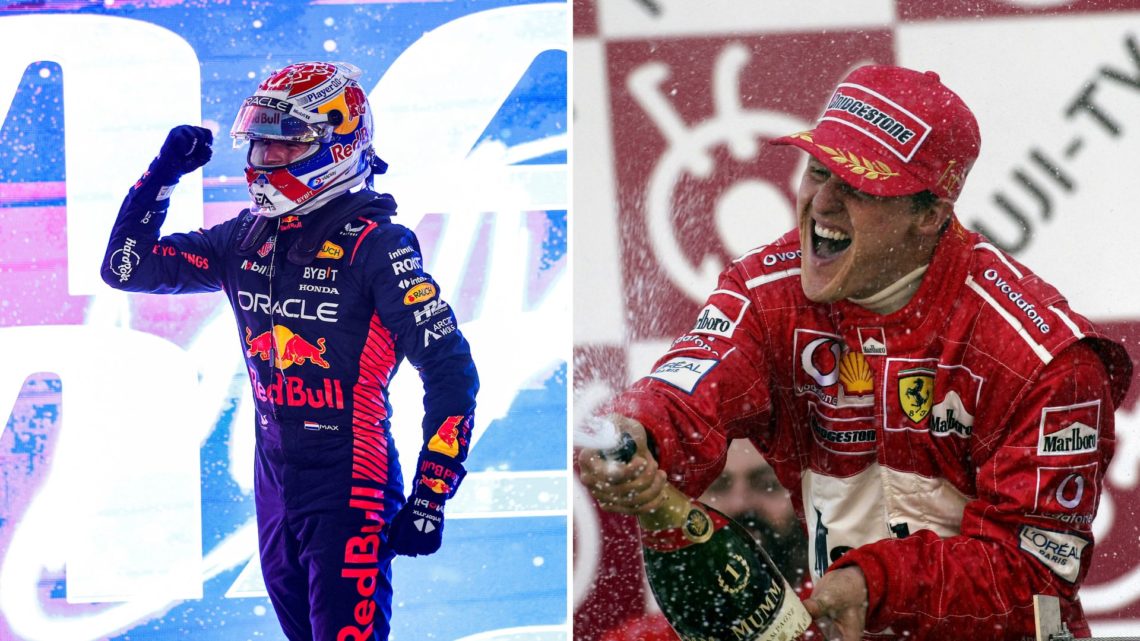


Max Verstappen and Michael Schumacher are responsible for two of the best seasons in Formula 1 history.
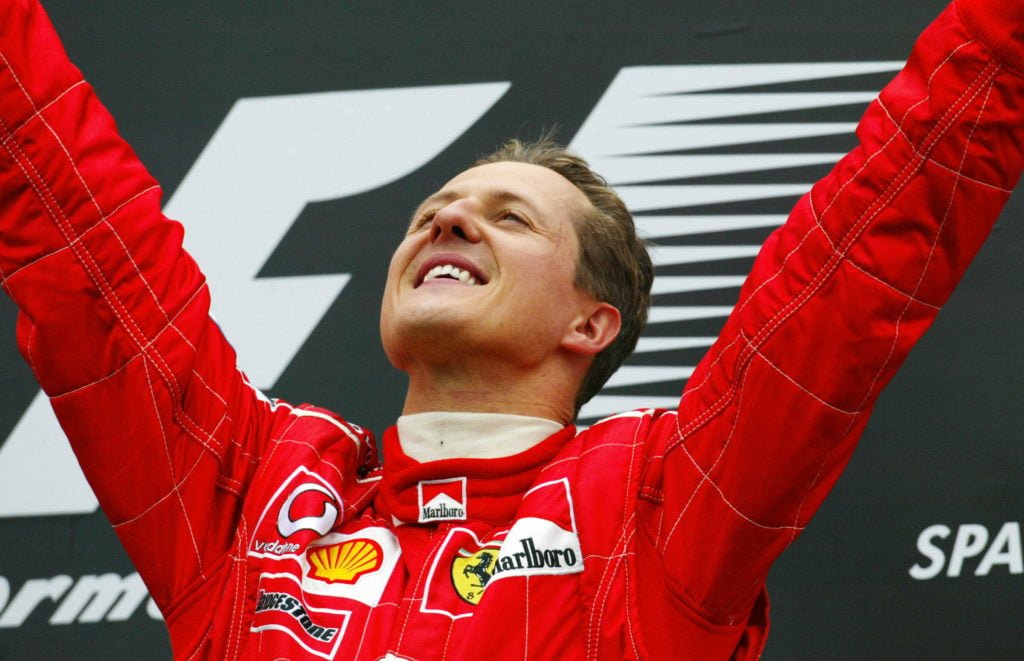
Between 2000 and 2004, Michael Schumacher and Ferrari were unstoppable.
After winning two championships with Benetton, Schumacher decided to switch to race for the Scuderia and after several years of improvement, the German finally earned his third title at the turn of the century.
Alongside Rubens Barrichello, Schumacher saw off the threat of Mika Hakkinen, David Coulthard, his brother Ralf Schumacher and Juan Pablo Montoya to win five titles on the bounce.
Max Verstappen has the opportunity to match Schumacher’s incredible achievement in 2025 with Red Bull.
He pipped Lewis Hamilton to the 2021 title during the most dramatic final lap in Formula 1 history and has been unstoppable ever since.
Charles Leclerc and Lando Norris have put up spirited campaigns to try and get close to the Dutchman but never come as close as Hamilton did when he won his first championship.
Verstappen’s 2023 campaign was unbelievable as he won 19 races on his way to his third title.
But how does it compare to Schumacher’s 2002 season when he ran away with the championship?
Schumacher’s 2002 car was worth a fortune, but was it as dominant as the RB19?
How do Michael Schumacher and Max Verstappen’s best Formula 1 campaigns compare?
Schumacher in 2002 and Verstappen in 2023 produced the two best seasons in F1 based on average points per race.
However, it’s unfair to compare both drivers based purely on how many points they scored.
Schumacher only had 17 Grand Prix to compete in that season, with each win only worth 10 points compared to the 25 Verstappen could earn during his 22 races.
Discounting Sprint Races – of which Verstappen won four out of six and finished on the podium for the other two – Verstappen finished first in 19 out of 22 races.
The Dutchman finished second to Sergio Perez in Saudi Arabia and Azerbaijan and only missed out on the podium once when he came home in P5 at the Singapore Grand Prix.
| Wins | 19 |
| Podiums | 21 |
| Non-podium finishes | 1 |
| Pole positions | 12 |
| Fastest laps | 9 |
| Points | 575 |
Red Bull made changes to Verstappen’s car in Singapore in 2024 that helped him return to the podium at the Marina Bay street circuit, but last year’s car was nowhere near as dominant across the rest of the campaign.
In 2002, Schumacher finished on the podium in all 17 Grand Prix, securing seven pole positions and seven fastest laps.
However, he finished second on five occasions and third at the Malaysian Grand Prix.
| Wins | 11 |
| Podiums | 17 |
| Non-podium finishes | 0 |
| Pole positions | 7 |
| Fastest laps | 7 |
| Points | 144 |
It means based on the 2025 points system – where fastest laps are no longer worth one point – Schumacher scored 22.35 points on average in 2002.
In contrast, Verstappen’s points tally without fastest laps and Sprint Race results divided by his 22 Grand Prix comes out at 23.68 points, meaning he was technically more dominant than the German legend.
Max Verstappen already compared to Michael Schumacher during his F1 career
Verstappen and Schumacher’s careers have been widely compared given their periods of dominance and driving style.
Schumacher helped Verstappen learn to go-kart as a child which might be why he’s so aggressive in attack and defence.
Although Verstappen has yet to drive any of his rivals off the road during a title-deciding race – something that saw Schumacher disqualified from the 1997 championship – it wouldn’t be a surprise to see him pushing the limits of the rules once again in 2025.
READ MORE: Red Bull driver Max Verstappen’s life outside F1 from net worth to girlfriend
If Verstappen can match Schumacher’s five titles on the bounce record, then it will confirm his place in the pantheon of Formula 1’s greatest drivers.
However, the Dutchman may forever hold the record for the most successful season in F1’s history.
Receive exclusive F1 news and updates twice a week to your mailbox