Lando Norris
 McLaren
 Mercedes
 Red Bull
 Ferrari
 Williams
 Racing Bulls
 Aston Martin
 Haas
Haas Alpine


Ayrton Senna and Alain Prost were involved in arguably the most iconic rivalry in Formula 1 history. They became teammates at a dominant McLaren team in 1988.
McLaren’s MP4/4 was one of the greatest cars ever built, winning 15 out of 16 Grands Prix. Senna prevailed in the title race, outscoring Prost 90-87 while no other driver got more than 41.
Le Professeur gained revenge the following year after a bitterly controversial clash at the Japanese Grand Prix, the penultimate round of the season. Senna needed to win the last two races to have any chance of taking the title.
| CATEGORY | SENNA | PROST |
| Titles | 1 | 1 |
| Points | 150 | 163 |
| Wins | 14 | 11 |
| Poles | 26 | 4 |
| Podiums | 18 | 25 |
With seven laps remaining, he was chasing down race leader Prost and attempted a move into the final chicane. The two cars locked wheels and slid into the runoff, with the Frenchman retiring.
Senna rejoined the race, with assistance from the marshals, and crossed the line first. However, he was later disqualified for missing the chicane, thus confirming Prost as the champion.
Ayrton Senna regretted taking out Alain Prost at the 1990 Japanese Grand Prix
Japan occupied the same spot on the calendar in 1990, and though Prost was now racing for Ferrari, the two drivers were once again in competition for the title.
Prost initially edged past championship leader Senna from second on the grid, but the pair sustained terminal damage in a high-speed turn one collision. The Brazilian was the beneficiary this time as he secured the title.
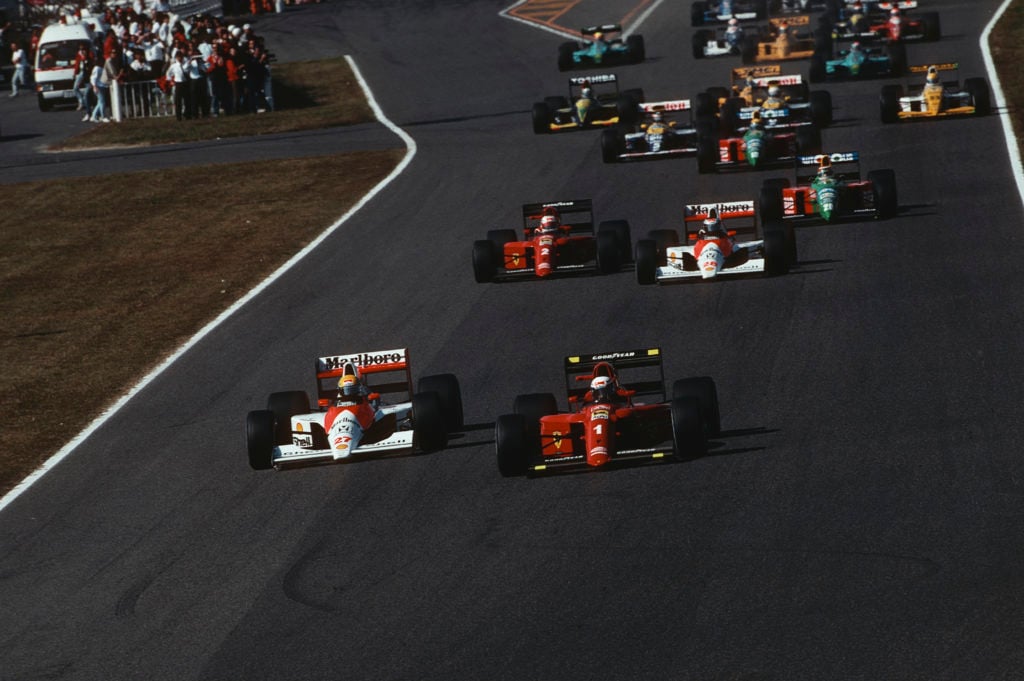
Prost was understandably furious, but Senna didn’t receive a penalty. He may have seen it as justice being served at the time, but according to Motorsport.com, he came to accept that his conduct wasn’t ‘acceptable’.
While he never said it publicly, he knew he’d ‘crossed the boundaries’, according to ‘those close to him’. Senna had cynically initiated the contact, knowing he stood to gain from a double DNF.
Karun Chandhok says Max Verstappen reminded him of Ayrton Senna in Saudi Arabia
Later in the 1990s, Michael Schumacher clashed with both Damon Hill and Jacques Villeneuve in title-deciding races. The collision with Hill in Adelaide in ’94 settled the championship in his favour, but he was thrown out in ’97.
The FIA decided that Schumacher had deliberately hit Villeneuve, who survived the incident while the Ferrari had to retire. Perhaps Prost will feel that Senna deserved the same penalty.
The modern-day equivalent of Senna and Schumacher is surely Max Verstappen. The Dutchman has established himself as an all-time great, but he’s done so in a controversial manner.
Indeed, Karun Chandhok says Verstappen has developed a ‘party trick’ that infuriates his rivals. Where Schumacher ‘swerved across the straight’ and Senna turned in aggressively during wheel-to-wheel battles, the Red Bull driver releases the brakes to make sure he gets to the apex first, even if it means leaving the track.
There’s a direct link between the trio. Schumacher idolised Senna, calling him the fastest driver ever, and then gave karting lessons to a young Verstappen at the request of his father Jos.
Receive exclusive F1 news and updates twice a week to your mailbox